Summary – Explore The Art of Noticing: how reclaiming attention through everyday observations sparks creativity, mindfulness, and meaning in a distracted world.
After finishing The Art of Noticing, I (Prince Pal) felt that familiar post-book restlessness—the kind where a good idea doesn’t want to stay on the page.
I tried to understand the person behind the thinking. So naturally, I went looking for Rob Walker himself.
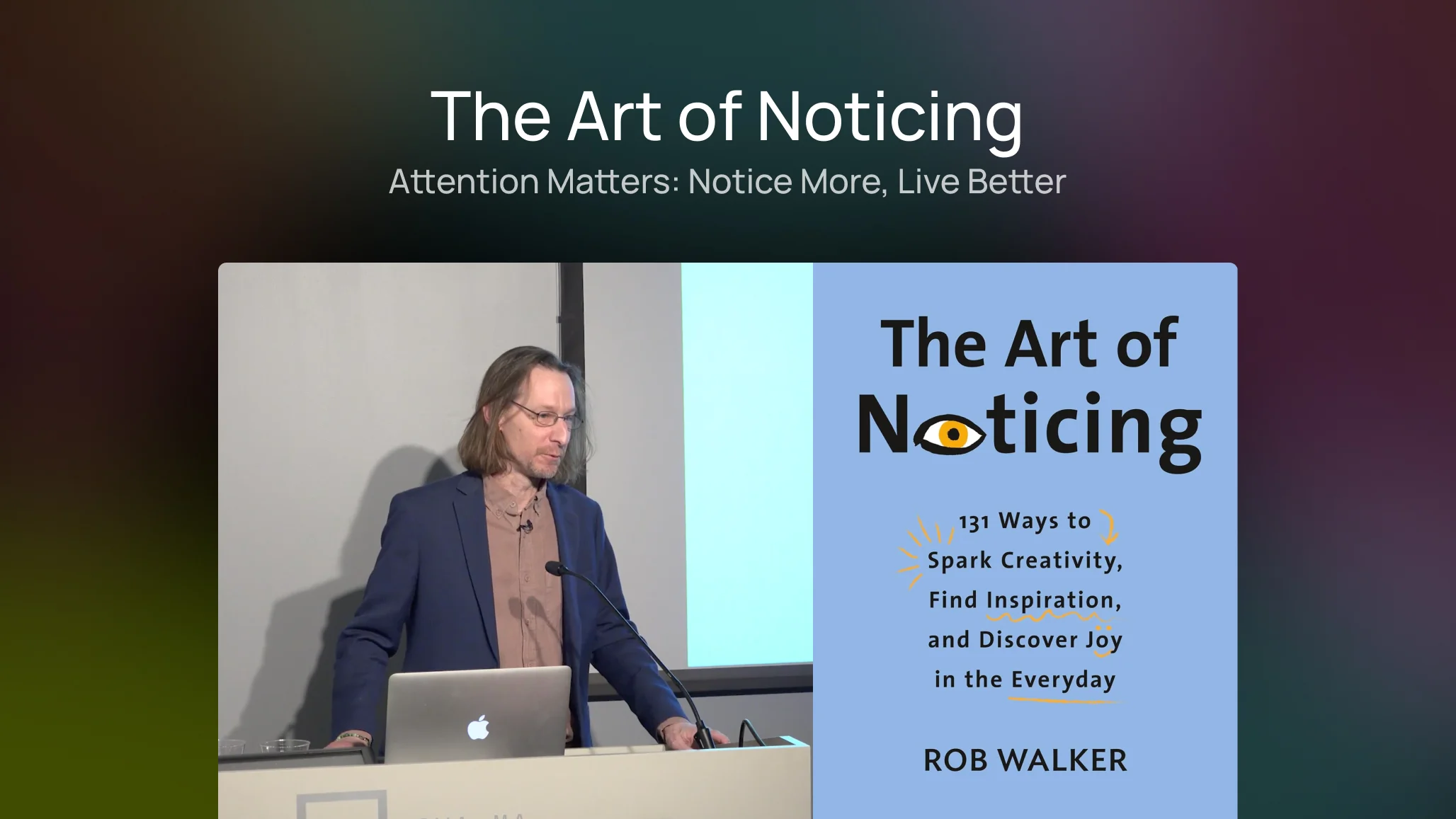
That search led me to his website and eventually to a YouTube talk. Watching him speak was like watching the book come alive.
The tone was calm, curious, and unpretentious. No grand theories. No productivity hacks. Just a steady, thoughtful invitation to slow down and actually pay attention to the world we move through every day.
That’s when something clicked for me—not just as a reader, but as an AI product designer.
Why The Art of Noticing Matters for AI SaaS Product Designers
The Art of Noticing didn’t give me a framework or a checklist. What it gave me was something far more helpful as an AI product designer: a different way of paying attention.
Discovering Rob Walker Beyond the Book
Seeing Rob Walker talk about noticing reinforced what the book gently insists on: noticing isn’t a skill reserved for artists or writers. It’s a way of engaging with reality.
Rob doesn’t position himself as someone with superior perception. Instead, he talks like someone who has practiced paying attention—and kept doing it long enough to see patterns others ignore.
That humility matters. It makes the practice feel accessible rather than intimidating.
And it made me reflect on my own work.
Let’s get started
Rob Walker has been thinking a lot lately about how we move through the world. Not in the grand, philosophical sense—though maybe that too—but in the everyday, mundane way we experience our surroundings.
Do you ever stop to wonder what phase the moon is in? I’ll be honest, he usually don’t. Most of us don’t, actually.
There was a time, not so long ago in the grand scheme of things, when every single person on this planet knew precisely where the moon was in its cycle. Now? We’re too busy checking our phones.
Rob Walker, a journalist and author who recently spoke at the Phil Patton Memorial Lecture at SVA, has made it his mission to get us to slow down and actually see things again.
His new book, “The Art of Noticing” is essentially a field guide for reclaiming your attention from the constant assault of notifications, trending topics, and the overwhelming sense that you’re always missing out on something.
The Attention Economy is Eating Our Brains (But It’s Not All Technology’s Fault)
We’ve all heard the statistics. We check our phones 150 times a day. We’re distracted. Our attention spans are shot. And sure, technology plays a role in this—it would be naive to pretend otherwise.
But Walker makes an interesting point: this fear of missing out, this desperate need to know what everyone else is paying attention to, existed long before Twitter or Instagram. It’s actually pretty human when you think about it.
The real problem, as he sees it, isn’t that we have smartphones. It’s that we have an overwhelming number of things we could pay attention to, which paradoxically means we end up paying attention to nothing in particular. Or rather, we let other people decide what deserves our attention.
When was the last time you really chose what to focus on, instead of just scrolling through whatever algorithm decided to show you that day?
Walker’s solution isn’t the usual “throw your phone in the ocean and live in a cabin” advice that’s become so popular lately. Instead, he offers something more practical: deliberate exercises to strengthen what he calls your “attention muscles.” Small, doable things that help you take control of what you notice.
Coffee Cup Lids and the Power of Overlooked Things
There’s this famous article that Phil Patton wrote, probably back in 1994 or so, about coffee cup lids. Yes, you read that right—coffee cup lids.
Not the most glamorous subject for design criticism, I’ll admit. But that’s precisely the point.
Patton looked at something everyone else overlooked—something so mundane it might as well be invisible—and found it fascinating enough to write about. And people read it. People remembered it.
Walker carries around one of these lids from Patton’s collection as a kind of talisman, a reminder that noticing what others overlook can be powerful.
It’s a theme that runs through his work and his book.
He points out that Jerry Seinfeld’s entire comedy career is built on this premise. Warren Buffett’s investment strategy? Same thing—he noticed value where others didn’t.
Rachel Carson basically invented the environmental movement by highlighting pesticides that companies were actively trying to hide.
So there’s something here beyond design appreciation or quirky observations.
The ability to notice what others miss might be one of the most valuable skills you can develop, whether you’re an artist, a scientist, an entrepreneur, or just someone trying to live a more engaged life.
Seven Ways to Start Noticing (Because 131 Would Take Too Long)
Walker’s book contains 131 different exercises or prompts for practicing attention. During his talk, he shared seven of them, and I think they’re worth exploring because they reveal something about how attention actually works.
1. Pick One Thing to Look For Everywhere
This is Walker’s gateway exercise, and it’s deceptively simple. When he was visiting San Francisco—a city he’d been to enough times that the novelty had worn off—he gave himself an assignment: pick one thing to look for everywhere he went.
Not for any particular reason, to give himself a new way of experiencing a familiar place.
The thing he chose? Security cameras. With one caveat: it had to be something no one wanted him to notice.
Once you start looking, you see them everywhere. And they have personalities, if you can believe it. Some are aggressive and obvious, practically screaming “YOU ARE BEING WATCHED.” Others are subtle, almost apologetic.
Walker photographed them obsessively for five days, much to his wife’s eventual concern when he started doing it at the airport. (She had a point—maybe don’t photograph security cameras at airports.)
But the exercise worked. He became hyper-aware of the surveillance infrastructure around us.
He started seeing patterns, noticing design choices, questioning why specific cameras looked the way they did.
The exercise transformed his experience of the city.
You can do this with anything, really. Typography is a good one—someone in the audience mentioned they collected photos of upside-down N’s, which is wonderfully specific.
Walker mentions an artist who photographed “buffs”—those patches where the city has covered up graffiti. Another artist in Australia gives out awards for the tallest urban weed growing in abandoned lots.
The key is specificity and persistence. You’re training yourself to see something that was always there but invisible to you before.
2. Cover 4’33”
This one’s about sound, which matters because we tend to be very visual creatures. We forget about our other senses.
The reference here is to John Cage’s famous composition, in which a pianist sits at a piano for four minutes and thirty-three seconds without playing. The audience was… not thrilled when it premiered.
But the piece has endured because it forces you to pay attention to the ambient sounds around you—the ones you usually tune out.
Walker actually does this exercise. He’ll spend four and a half minutes just listening to his neighborhood, his house, wherever he is. It’s sort of like meditation, except he finds it less intimidating because there’s no way to do it wrong. You’re just listening. That’s it.
I think there’s something valuable here about removing the pressure to pay attention correctly. Sometimes the best way to notice things is to permit yourself to experience them without judgment.
3. See “Is” as “Could Be.”
This is where noticing becomes the foundation for creativity and innovation. Walker points to a street artist who calls himself The Rotten Apple, who sees a bike rack and converts it into a chair.
Who looks at a fire hydrant and sees a place to set up a chessboard? Who looks at a crosswalk and sees the perfect spot for a few quick pull-ups.
It’s about conditional thinking—seeing the world not just as it is, but as it could be. This doesn’t have to be severe or profound. A lot of street artists just convert everyday objects into visual jokes.
The point is to exercise the part of your brain that can imagine possibilities, while others see fixed realities.
And honestly? This is what design is, at its core—seeing something broken and imagining how it could work better—seeing something functional and imagining how it could be beautiful.
4. Find Something to Complain About
Seth Godin, the business guru, suggested this one to Walker, and I love it because complaining gets such a bad rap. We’re told not to be negative, not to focus on problems. But Walker makes a compelling defense of complaining.
He tells this story about James Murphy from LCD Soundsystem, who spent years with his friends complaining about the music they wanted to hear but couldn’t find.
Until one day, he realized their complaint would carry a lot more weight if they actually made that music instead of just whining about its absence.
The key insight from Godin is this: if you think it’s broken, it’s broken. You get to define the problem. You’re not wrong.
Walke
r and some collaborators applied this principle in New Orleans with something called The Hypothetical Development Organization.
They found neglected buildings around the city and created fake development signs announcing ridiculous futures for them.
The Museum of the Self. The New Orleans Loitering Center (Walker has a thing about “No Loitering” signs).
They had these professionally made and installed them on the actual buildings without permission.
Were they trying to fool people? Not really. The point was to draw attention to these forgotten spaces and imagine different possibilities for them.
It was a complaint turned into a creative action. And it ended up as part of the Official United States Presentation at the Venice Architecture Biennale, which is a pretty good outcome for what started as noticing something annoying.
5. Change Your Route
This one’s simple but profound: every once in a while, take a different path. Walker frames this both literally—change your commute—and metaphorically. It’s about habit-breaking.
We optimize everything. We find the most efficient route to work and then take it every single day for years.
Which makes sense from a productivity standpoint, but as one of Walker’s friends says, “The more efficient you are, the faster time goes.” And that’s not really a worthy goal all the time.
Another friend puts it differently: the real goal should be “to have more nows.” You don’t get any “nows” when you’re on autopilot, traveling the same route for the millionth time.
Jim Coudal, a designer Walker admires, talks explicitly about how important it is to solve problems you’ve solved before, but in entirely new ways.
This requires breaking your own patterns, which is uncomfortable but necessary.
6. Ask About the Weirdest Thing in the Room
This one shifts focus to other people and their stories. When you’re at someone’s house or office, look around and ask about the strangest or most out-of-place object you see. There’s almost always a good story behind it.
Walker runs a project called Project Object with his collaborator, Josh Glenn, in which they collect stories about people’s meaningful objects.
There’s the guy who keeps his Wendy’s toy car because of a disastrous first date where he ran it through his girlfriend’s hair.
There’s the woman who holds her wisdom teeth. Another woman has her framed, microwaved underwear (long story, involves her grandmother, don’t ask).
These objects are windows into people’s lives and memories.
And asking about them is an easy icebreaker that leads to honest conversations, rather than small talk about the weather.
7. Take Ten Seconds
Walker closes with this one, which he admits he’s stealing from Mr. Rogers. At an Emmy acceptance speech, Fred Rogers asked the room full of Hollywood celebrities to take ten seconds of silence and think about the people who helped them become who they are.
The people who loved them into being, who cared about them, and wanted what was best for them.
Walker actually made the audience do this during his talk. And then he quoted Rogers: “Whomever you’ve just been thinking about, how pleased they must be to know the difference you feel they’ve made.”
This is where all the noticing leads, I think. It’s not just about seeing interesting things in your environment. It’s about recognizing what matters to you.
Choosing what to care about. Deciding where to direct your limited attention in a world that’s constantly trying to control it for you.
Why Noticing Matters (And Why It’s Hard)
There’s something almost radical about choosing to notice things that no one wants you to see.
We live in an age of trending topics, where it’s easy to feel that if everyone isn’t talking about something, it must not be important. Walker couldn’t disagree more.
The things you notice that no one else does—those are the most important. They’re what make you you.
They’re the foundation of your unique perspective, your creativity, your potential contributions to the world.
But here’s the thing: it’s genuinely challenging to trust your own attention in a culture that’s constantly telling you where to look.
Social media is designed to show you what everyone else is looking at. News algorithms prioritize what’s trending.
Even our conversations often revolve around shared cultural touchstones—did you see that tweet, did you watch that show, did you hear about that thing?
There’s nothing wrong with shared experiences, obviously. But when others direct all of your attention, you lose something essential.
You lose the ability to be surprised by your own interests. You lose the confidence that comes from trusting your own curiosity.
The Introvert’s Dilemma
Walker admits he’s an introvert. He likes to spy on people rather than talk to them. (Though he’s quick to add, “You could talk to me afterwards.”)
This is interesting because so many of his exercises involve engaging with strangers or at least being aware of other people.
His students surprised him early on by proposing exercises that involved talking to strangers and interacting directly with others.
It was eye-opening for him. He realized that other people can be sources of attention and noticing, too, not just the physical environment.
There’s something here about how noticing can push you outside your comfort zone.
If you’re naturally observant of objects and spaces, maybe the challenge is to see people.
If you’re people-focused, perhaps the challenge is to notice the built environment or natural phenomena you usually overlook.
Museums and the Problem of Information Overload
One of my favorite sections that Walker mentioned is about what to look for in a museum.
His questioner, Anne Quito (who moderated the Q&A), described her own practice of “museum diet”—looking only at three things, no matter what —as an act of what she calls “thought monogamy.”
Walker’s answer was characteristically unexpected. His leading museum practice?
Eavesdropping. He’s learned to think of other people talking—which might typically be annoying when you’re trying to have a Vermeer moment—as an opportunity rather than an annoyance.
People can be ridiculous in museums, and listening to their conversations is fascinating.
His other suggestion: declare something to be art. He and his wife were once in a museum looking at big wooden boxes, unable to tell if the art was in the boxes or if the boxes themselves were the art.
So they just decided the boxes were the art. And now they do this all the time—see something in the world and declare it art. It’s a Duchamp moment. You permit yourself to decide what’s worth noticing.
This gets at something essential about authority and attention. Who gets to decide what’s worth looking at? The museum? The art world? Or you?
The Dangers of Noticing (Or: Can You Notice Too Much?)
During the Q&A, someone asked whether noticing can be taken to an extreme. They mentioned friends who are wine connoisseurs who talk for ten minutes before taking a sip, essentially ruining the experience for everyone else.
Walker’s response was measured. Yes, theoretically, if you go overboard with esoterica, you might miss important things.
But we’re so far in the other direction right now—so obsessed with paying attention to what everyone else is paying attention to—that he’s not too worried about the pendulum swinging too far the other way.
There was a joke that maybe Phil Patton noticed too much while driving, given his attention to roadside details.
But then someone pointed out that noticing while driving is actually probably a good trait. You want a driver who’s paying attention to their surroundings.
I think the real danger isn’t noticing too much. It’s becoming insufferable when you see things or use your observations to feel superior to others.
The point of noticing isn’t to collect observations like trophies. It’s to be more engaged with the world around you.
The Personal Branding Problem
Walker’s Twitter handle is @NotRobWalker, which seems weird until you hear the story. When Twitter launched, he didn’t take it very seriously.
Someone else had already claimed @RobWalker, and he didn’t want to be @WalkerRob, @Robbo, or anything like that. So he went with @NotRobWalker.
He describes it as “just yet another in a series of disastrous personal branding decisions that have dogged me throughout my career.” Dan Savage has the same problem—his handle is @FakeDanSavage.
There’s something refreshingly honest about this. In an age when we’re all supposed to be our own brands, carefully curating our online presence, Walker just… didn’t.
And he’s been successful anyway, which maybe tells you something about how much that stuff actually matters.
Or maybe it tells you something about the value of not trying to control everything and being comfortable with imperfection and accidents.
Why 131 Exercises?
Someone asked why the book contains exactly 131 exercises. Walker’s answer: they debated whether it should be 100 or 101, but he wanted to go with the “Cosmo Magazine theory”—there’s always some odd number like 167 ways to improve your sex life or whatever.
The specific number feels more honest somehow. Like, this is how many we came up with, so this is how many there are.
They’re ranked by difficulty from one to four, so you can flip through and find easy ones if you want.
Some were taken out for being too dangerous or legally questionable—things like walking through strange neighborhoods, or one called “look like prey” (meaning constantly scanning your surroundings as if you’re being hunted) that his editor nixed because, as a woman, she didn’t want to encourage that kind of hypervigilance.
The process of creating the book took a few years of gathering material, though once Walker committed to the format, it came together in less than a year. He had more fun writing it than any other book project he’s worked on.
The Opposite of Noticing
Near the end of the Q&A, someone asked what the opposite of noticing is. Walker’s answer: letting others control your attention and spending all your time looking in the direction that someone else wants you to look.
This is why his original exercise in San Francisco had that one parameter: he had to look for something no one particularly wanted him to see.
Security cameras fit the bill perfectly. They’re meant to be noticed (for deterrence), but also not noticed (for effectiveness). They exist in this weird liminal space.
When he assigns students, that’s always the criterion: it can’t be something designed to be seen.
This forces you to develop a different kind of vision. To see past the things that are screaming for your attention and notice the quiet, overlooked elements of the world.
Taking Care of a Cactus
One of Walker’s students once came to class and confessed that he’d misunderstood the assignment.
Instead of going out and practicing paying attention, he’d bought a cactus and spent the week taking care of it.
Walker’s response: “That’s not what I had in mind, but it’s kind of on point.” Because ultimately, attention is about focusing on things and choosing what to care about.
Taking care of a cactus is an act of sustained attention. You’re choosing to notice when it needs water, when it’s thriving, when something’s wrong.
This student accidentally stumbled onto something essential: noticing and caring are deeply connected. You can’t really care about something you don’t see, and sustained noticing often leads to caring.
What Would Phil Have Loved?
Throughout the evening, there were references to Phil Patton, the journalist and critic who inspired the lecture series.
He wrote about car culture and the design of everyday life. He taught a course at SVA on typologies that started with the question: “How does design reflect society?”
One of his teaching techniques was to have students bring in “I Noticed” items—simple images, objects, or sentences that would surprise and delight the class—worth 25% of their grade. The assignment was to look at things in new and surprising ways.
Walker never met Patton, but he admired his work immensely. That coffee cup lid article made a huge impression on him early in his career.
It was maybe the first piece of design writing he’d ever read, and it showed him what was possible when you took something everyone overlooked and examined it closely.
Molly Heintz, who chairs the department and organized the event, kept saying things like “Phil would have loved this.” And you get the sense that this whole practice of noticing—of taking the mundane seriously, of finding meaning in overlooked details—is Patton’s legacy.
The department has his entire journalistic archive, including his legendary collection of coffee cup lids.
There are vintage mail-order catalogs and NEXT computer press kits with an identity designed by Paul Rand—all these artifacts of noticing, cataloged and preserved.
The Question of Intent
One question that came up: Can noticing be done effectively in the digital realm? Can you pause a video game and see the architecture of the castle?
Walker’s answer was yes, definitely. He pointed to artist Cory Arcangel, who created pieces using hacked Donkey Kong cartridges with everything removed except the blue sky and clouds drifting by.
Underneath the technological feat lies a simple, pure act of noticing something beautiful that most players would never see.
The key is intent. Are you using technology, or is technology using you? Are you the one controlling the direction of your attention, or are you being directed?
Walker encourages people to “misuse your tools”—to use technology in ways it wasn’t intended, to find the overlooked corners and quiet spaces even in digital environments.
This feels important in an age where so much of our attention is mediated by screens. The answer isn’t to abandon technology completely.
It’s about being more intentional in how we engage with it.
The Real Goal
Near the end of his talk, Walker said something that stuck with me: “The things you notice that everyone else overlooked are the things that make you you.”
This is the real point of all these exercises. It’s not about becoming a better designer, artist, or entrepreneur, though those might be side effects.
It’s about developing a distinct point of view. It’s about living a more engaged life. It’s about having “more nows” instead of sleepwalking through your days on autopilot.
We live in a culture dominated by what’s trending, by shared attention, by the fear that if you’re not looking at what everyone else is looking at, you’re somehow doing it wrong.
Walker’s arguing for the exact opposite. The things only you notice—the weird details, the broken systems, the beautiful accidents that everyone else walks past—those are your unique contribution to the world.
Not everything you notice needs to become a project, a post, or a platform. Sometimes just being engaged with the world is enough. It’s not a means to an end; it’s an end in itself. It makes your life better in ways that go beyond the tangible and obvious.
A Final Thought
There’s a switch on the wall in that lecture room at SVA that’s mounted way too high for most people to reach.
Someone in the audience noticed it during Walker’s talk and asked about it. Conduits are running from it across the ceiling to other mysterious things.
Walker joked that the faculty at Design Research is just very tall.
But the honest answer is: who knows? And that’s okay. Not every observation needs an explanation. Sometimes the noticing itself is enough.
The practice of attention is fundamentally about building a relationship with the world, about choosing what to care about.
About trusting your own curiosity even when no one else is talking about what you’re seeing.
So maybe start small. Pick one thing to look for this week. Notice which direction you always turn when you leave your house.
Listen to the sounds of your neighborhood for four and a half minutes. Ask someone about the weirdest thing in their office.
Or look up at the moon tonight and see what phase it’s in.