The Cognition Catalog is one of those rare UX resources that makes you go, “Ahh, this is exactly what I needed, but didn’t know how to Google.”

Suppose you work in product, UX, research, or even engineering. In that case, you’ve probably felt this tension: everyone knows cognitive biases shape user behavior, but when it’s time to design a flow, defend a decision, or explain why something feels off… the thinking gets fuzzy.
You remember a bias name, vaguely recall a diagram from a blog post, and that’s about it.
The Cognition Catalog steps in right there—and does something brilliant.
What is the Cognition Catalog?
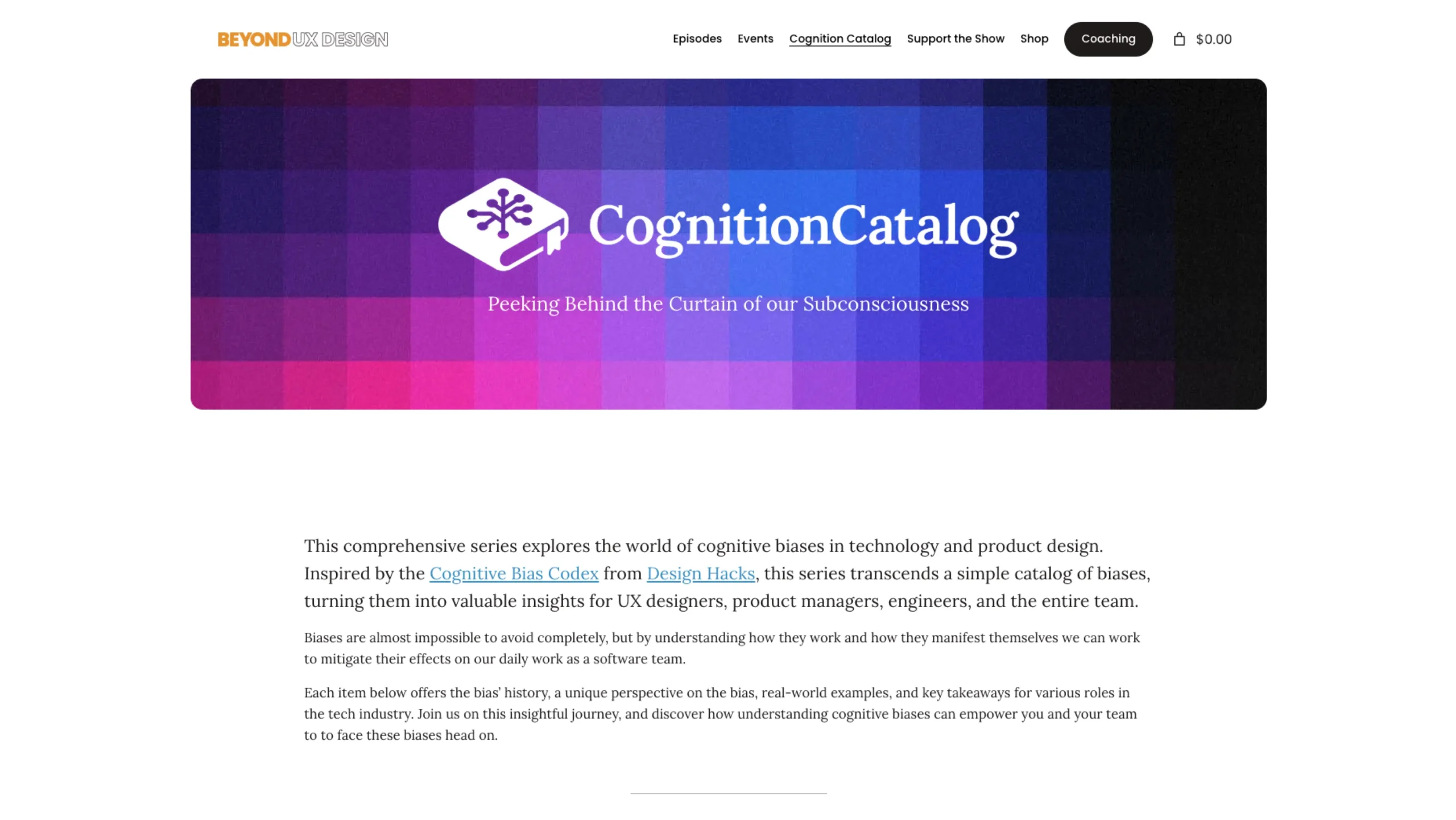
Created by Beyond UX Design, the Cognition Catalog is an ongoing series that dives deep into individual cognitive biases and how they play out in technology and product design.
Each issue focuses on a single bias and turns it into a practical, design-friendly resource rather than a theory-heavy psychology lesson.
The series is:
- Inspired by the Cognitive Bias Codex – that famous circular map of biases you’ve probably seen floating around design Twitter / X or LinkedIn.
- Tailored specifically for UX designers, PMs, engineers, and product teams.
- Delivered as bite-sized PDFs you can download (often “pay what you want”) and actually use in your day-to-day work.
It’s not trying to be a giant encyclopedia. Instead, it behaves more like a toolkit: one bias at a time, in a format that’s easy to read, share in a workshop, or drop into your team’s Notion.
“Peek Behind the Curtain of Your Subconscious”
The Catalog positions itself as a way to “peek behind the curtain of your subconscious,” and that’s a pretty accurate description. Gumroad
Cognitive biases aren’t just abstract psychological concepts. They influence:
- How we interpret data
- How users perceive interfaces and choices
- How teams decide what to build, prioritize, or ship
The Cognition Catalog takes each bias and asks questions like:
- What does this bias actually mean in plain language?
- How does it show up in product experiences?
- How might it distort research, decision-making, or metrics?
- What can designers and teams do to counteract it—or leverage it ethically?
So instead of a dry definition, you get context, examples, and implications that map directly to product work.
How the series works
Each entry in the Cognition Catalog is structured like a compact mini-guide. For example, the Insensitivity to Sample Size issue is a 9-page PDF available for download from Gumroad.
From what’s shared publicly, each issue typically includes things like:
- A clear explanation of the bias in everyday human language
- Real-world examples — often from digital products or everyday decision-making
- How the bias can mislead teams (e.g., overreacting to a few user comments or misreading early data)
- Design- or research-focused takeaways and tactics
- A structure that’s easy to skim, present, or paste into a deck
You can also subscribe to receive a new bias in your inbox every Friday, turning it into an ongoing learning habit rather than a one-time download.
Think of it like a slow-drip masterclass: one bias at a time, consistently, until your whole team starts casually saying, “I think we’re falling into [insert bias name] here…”
Why cognitive biases matter so much in product design
The power of the Cognition Catalog isn’t just in naming biases—it’s in showing where they quietly steer things off-course.
A few examples of how biases creep into product work:
- In UX research
- Over-weighting that one dramatic session because it was memorable (negativity bias, availability heuristic). Gumroad
- Making calls based on tiny sample sizes (insensitivity to sample size).
- In product strategy
- Sticking with a failing feature because the team is emotionally invested (sunk cost fallacy).
- Overestimating how much users care about a niche detail (e.g., egocentric bias).
- In interface design
- Overloading the user with options and assuming “more choice = more value” (choice overload).
- Designing error messages that feel cold or blaming, which can trigger negativity bias and churn.
What the Cognition Catalog does well is connect these dots—it turns biases from abstract terms into lenses you can use to audit your flows, copy, and decisions.
From “fun fact” to daily design lens
A lot of content about cognitive biases stops at the “fun fact” stage:
“Did you know humans do XYZ? Cool. Anyway…”
The Cognition Catalog goes a step further by framing biases as practical tools:
- You can use them to critique your own designs
- You can use them to explain trade-offs to stakeholders
- You can design around them to make products kinder, more transparent, and more ethical
Imagine:
- Reviewing a complex dashboard and asking, “Where might confirmation bias be pushing users to see only what they expect?”
- Looking at your onboarding flow and questioning, “Are we overwhelming people’s working memory?”
- Challenging a roadmap decision with, “Are we reacting to a loud minority because of availability bias?”
That’s where a resource like this becomes incredibly useful: it gives teams a shared vocabulary for the invisible forces shaping their work anyway.
Great for teams, not just individual designers
On its own, each issue is a nice read. But the Catalog really shines when used as a team resource:
- Design critiques
Pick a bias of the week and run a critique through that lens. It instantly changes the quality of the discussion. - Product reviews
Before a big release, walk through the main flows and ask, “Where could this bias show up—for users or for us?” - Workshops or learning sessions
The PDFs are short enough to share as pre-reads and then discuss in small groups. - Onboarding new designers or PMs
Instead of handing them a random list of articles, you can share a handful of Cognition Catalog entries to quickly level-set how your team thinks about users and behavior.
Inspired by the Cognitive Bias Codex—but more practical
The project is explicitly inspired by the Cognitive Bias Codex, that dense wheel diagram that maps out dozens of biases into categories.
The Codex is excellent as a reference, but it can also be… intimidating.
The Cognition Catalog does something different:
- It unwraps that huge map one tile at a time
- It contextualizes each bias inside product and UX work
- It gives you something you can actually use this week, not just admire as a nice infographic
So if the Codex is the atlas, the Cognition Catalog is like a series of guides to specific cities—how people move there, what to watch out for, and how to navigate.
Who will get the most out of it?
You’ll probably love the Cognition Catalog if:
- You’re a UX or product designer and want deeper thinking behind your design decisions.
- You’re a PM or founder trying to understand why users behave in unexpected ways.
- You’re a researcher who wants better language for explaining findings and limitations.
- You’re part of a team that cares about ethical, human-centered design, not just growth-at-all-costs.
Even if you already know a handful of biases, there’s something powerful about seeing them broken down slowly, one by one, with examples that live in the same world you work in: apps, dashboards, settings panels, onboarding, notifications, and experiments.
🧩 Why Cognitive Biases Matter in Design
If you’re building any digital product, chances are your users will fall into cognitive traps—because we all do.
Here are a few examples you’ll see unpacked inside the catalog:
Anchoring Bias
Users rely too heavily on the first piece of information they encounter.
→ Pricing tables and plan comparisons often depend on this.
Choice Overload
Too many options make decision-making harder, not easier.
→ Think SaaS feature lists, ecommerce filters, or customization screens.
Fitts’s Law
The target’s distance and size determine the time required to reach a target.
→ The foundation of button size, tap targets, and usable mobile interfaces.
The IKEA Effect
People value what they build themselves.
→ Onboarding personalization, dashboards, workflow configuration.
The Peak-End Rule
People remember experiences based on the peak and the final moment.
→ Why empty states, confirmations, and success animations matter so much.
The catalog covers dozens more—each broken down in a way that’s actionable, digestible, and directly tied to product teams’ real-world challenges.
Final thoughts
The Cognition Catalog sits in a lovely spot between a psychology design blog. It doesn’t overwhelm you with academic detail, and it doesn’t stay at the surface-level “Top 5 Biases You Should Know” listicles either.
Instead, it:
- Treats cognitive biases as fundamental tools for product teams
- Packages them into short, focused, visual PDFs
- Helps you build a more innovative, more reflective design practice over time
If you’re serious about designing technology that understands people—not just clicks and conversions—the Cognition Catalog is worth exploring, one bias at a time.