Exactly.ai is one of those products that instantly feels different from the usual “AI image generator”. It doesn’t scream “prompt magic”; it quietly says: this is for artists, illustrators, and brands who actually care about style, ownership, and craft.
Who Exactly.ai is
Exactly.ai is an AI-powered artwork platform built specifically for artists, illustrators, and visual creatives.
Instead of giving everyone the same generic model, they let creators train personal AI models on their own artwork, so the system learns their unique visual language and preserves it.
Their mission is pretty straightforward: enhance creativity, not replace it. The platform focuses on three big things:
- Style fidelity – the AI understands and respects an artist’s look and feel
- Ethical ownership – creators keep rights to their images and models
- Scalability – brands and studios can generate consistent, on-brand visuals at speed
For UI/UX designers, that means Exactly.ai sits in an interesting place: somewhere between a creative tool, a production system, and an ethical infrastructure.
First impression: clean, calm, “creative pro” energy
The homepage leans into a very modern, editorial feel:
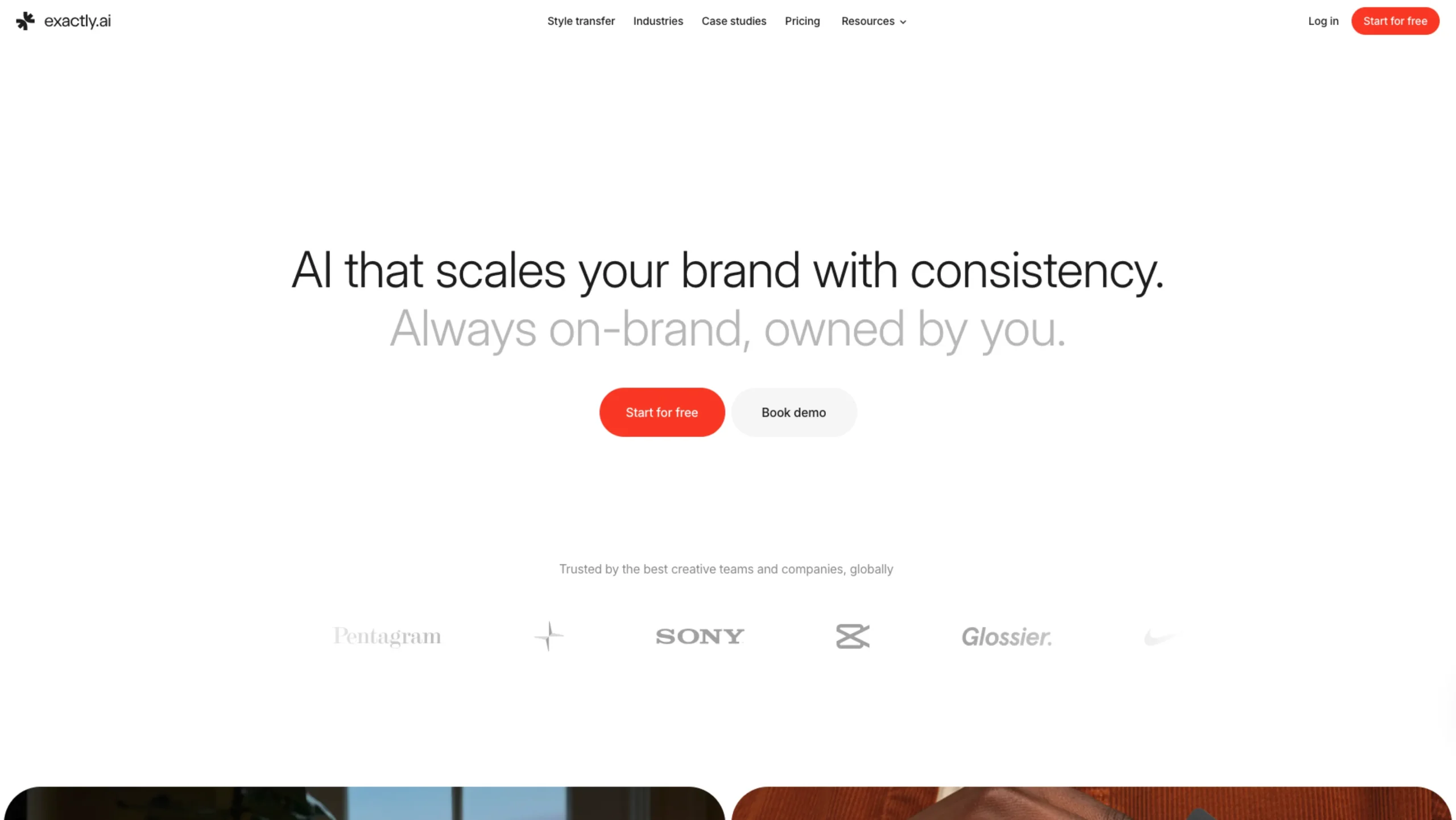
- Big, confident typography: Headlines like “Create stunning, brand-ready visuals” and “On-brand, owned, and scalable” sit in large, high-contrast type that feels more like a design studio site than a tech startup.
- Soft neutrals + a single accent: A mostly off-white background, black text, and an intense orange “Start for free” button create a clear visual hierarchy without overwhelming the artwork.
- Product-focused hero: Right under the hero copy, you see the actual interface: a style-training view with an oversized plus tile inviting you to “Add core images” and pastel swatches that hint at palettes and moods.
Primary CTAs are straightforward: “Start for free” and “Book a demo.” That dual path works nicely for both individual artists and brand-side teams.
The navigation (“Style library”, “Features”, “Who they serve”, “Pricing”, “Resources”) makes it clear they are speaking to both solo creators and larger organizations.
How Exactly.ai works (from a UX point of view)
Under the hood, Exactly.ai follows a simple but powerful journey:
1. Train a model in your own style
Creators upload a set of their own images—typically 10–20 or up to 50 artworks that best represent their style. These become the training set for a personal AI model.
The training flow is framed in a very human way:
- “Train a model in your style.”
- Guidance on image size and quality
- Clear feedback that the model is learning
After training, there’s even a “quiz” step where the creator scores generated images to help refine the model. That interaction is clever: it turns a technical evaluation step into a simple, opinion-based review that feels like part of the creative process.exactly.ai
2. Generate images that actually look like “you.”
Once the model is ready, users move into the main workspace:
- A prompt box to describe what they want (“a woman with glasses”, “brown pony walking on the beach”, etc.)
- A large canvas area where outputs appear
- A model selector so they can switch between styles (watercolour, 3D, illustration, more experimental looks, etc.)
The UI keeps things familiar for anyone who has used other image generators: text prompt, optional negative prompt, and image size settings. But the twist is that style is locked to the current model, so users don’t have to “prompt engineer” the look—they just describe the content.
There’s also sketch-to-image support: users can upload or draw a quick sketch and let the model turn it into a finished illustration with lighting, color, and texture.
3. Iterate, refine, and scale
Exactly.ai isn’t just about one-click generation. It’s built for iteration:
- Designers can test multiple models on the same brief to explore different directions.
- Brand teams can train private models for product packaging, corporate reports, social campaigns, and more, keeping everything aligned with existing visual language.
- Artists can keep generating in their style at a higher speed, treating the AI as a kind of concept art assistant.
The overall workflow feels like a loop: train → generate → score → refine → repeat.
Ethical focus: ownership, consent, and revenue
Exactly.ai leans heavily into ethics—and that comes through not just in messaging, but in product architecture.
Key principles they highlight:
- You (the artist) own the art and the model.
Creators retain copyright over the images they upload, the models trained on that artwork, and the outputs generated from those models. Exactly.ai’s role is to host and protect the models, not to claim ownership. - Models are trained on consented, original work.
The platform is designed to be a place where styles are used with permission, not scraped from the internet without artists’ knowledge. - Artists can earn passive income.
If creators choose to publish models in the marketplace, they can earn a share of revenue whenever clients use those models under commercial licences. Exactly.ai handles the licensing and payouts, so artists don’t have to negotiate every deal manually.
For brands, that means they can explore a model library knowing styles belong to actual artists who get paid—an important distinction from many generic AI tools.
Community and competitions
Exactly.ai also invests in a community layer:
- Competitions and open calls invite illustrators and designers to submit their models and generated images, with the chance to be featured on the Models page or promoted via partners like Art Lab.
- They’re building a shared library of community models so newer designers (who might not yet have a big portfolio) can still explore AI workflows using styles contributed by others.
That community angle makes the platform feel less like a closed tool and more like an ecosystem where artists can learn, experiment, and earn together.
Why Exactly.ai is interesting for designers
For UI/UX and product designers browsing UIUXshowcase, Exactly.ai is worth paying attention to for a few reasons:
- It treats style as a first-class primitive.
The whole UX is built around “your model, your style”, not around magic general models with prompts that might—or might not—hit the mark. - It combines creative control with ethical structure.
Ownership, licensing, and revenue sharing are integrated into the product rather than treated as an afterthought. - The interface respects creative workflows.
Training, scoring, and iterating are visually apparent and feel like part of a studio process, not a technical configuration screen. - It bridges artists and brands.
Individual illustrators can scale their style and income; brand teams can maintain consistency with private models and on-brand image generation at scale.
If you’re exploring how to bring AI into design systems, illustration pipelines, or brand workflows—without losing control of style or ethics—Exactly.ai is a strong reference point for both product thinking and visual design.