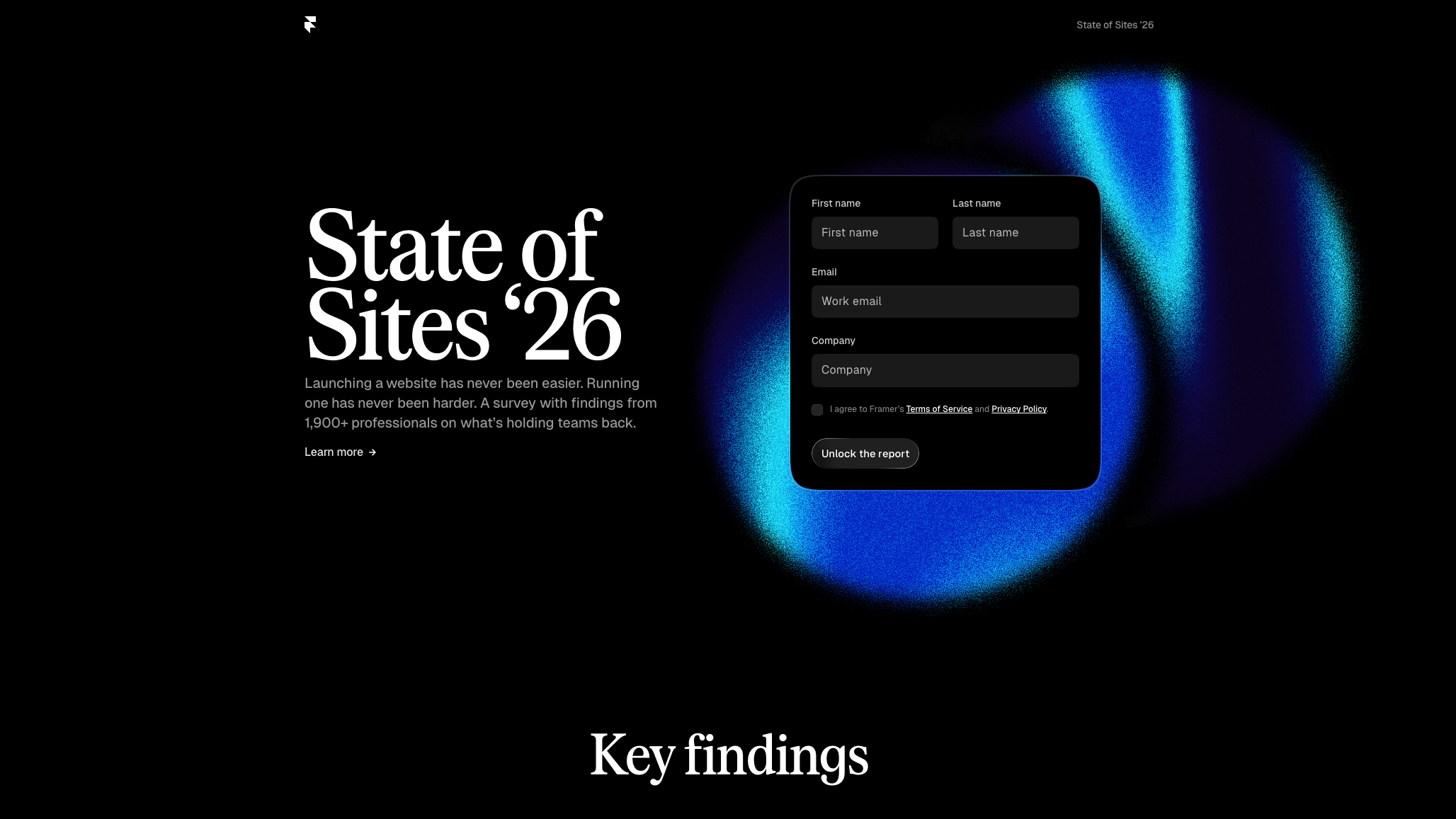
Framer: State of Sites 2026 is an in-depth data study and trend presentation titled “State of Sites ’26: Launching a website has never been easier. Running one has never been harder.”
While AI-driven generators and canvas-to-code builders have made launching initial web pages nearly instantaneous, this report pulls back the curtain on the intense organizational friction, tool deficits, and operational plateaus that teams encounter immediately after a site goes live.
Based on a global survey of more than 1,900 professionals—composed mostly of designers (65%), along with marketers, developers, and product leads—Framer quantifies the disconnect between a company’s website and its growth targets.
The report breaks down into four critical investigative chapters covering the post-launch maintenance tax, fragmented cross-team ownership, the difficulty of executing real-time conversion optimization, and why speed of iteration has replaced feature density as a company’s ultimate digital advantage.
Key Findings
- The Post-Launch Maintenance Trap: A staggering 53% of all website work is consumed by basic edits, minor tweaks, and bug fixes. Design remains the primary bottleneck, forcing most teams to publish updates monthly at best rather than iterating daily.
- The Shipping Blockade: 70% of website projects get completely deprioritized or abandoned before ever reaching production because the legacy design-to-development pipeline makes shipping them too slow or technically complex.
- The Conversion Tool Gap: While 71% of surveyed teams state that conversion rate is their primary KPI, the vast majority confess they lack the modern visual or operational tools required to actively test hypotheses and optimize for it.
- Fragmented Site Ownership: Website control is heavily siloed across disjointed design, marketing, content, and engineering departments. This lack of centralized ownership leads to excessive red tape and sluggish turnaround times.
- Iteration as an Advantage: The data confirms that the fastest-growing companies don’t look for more features; they look for fewer blockers. High-performing teams are actively minimizing the steps between an initial idea and a published page to outpace competitors.