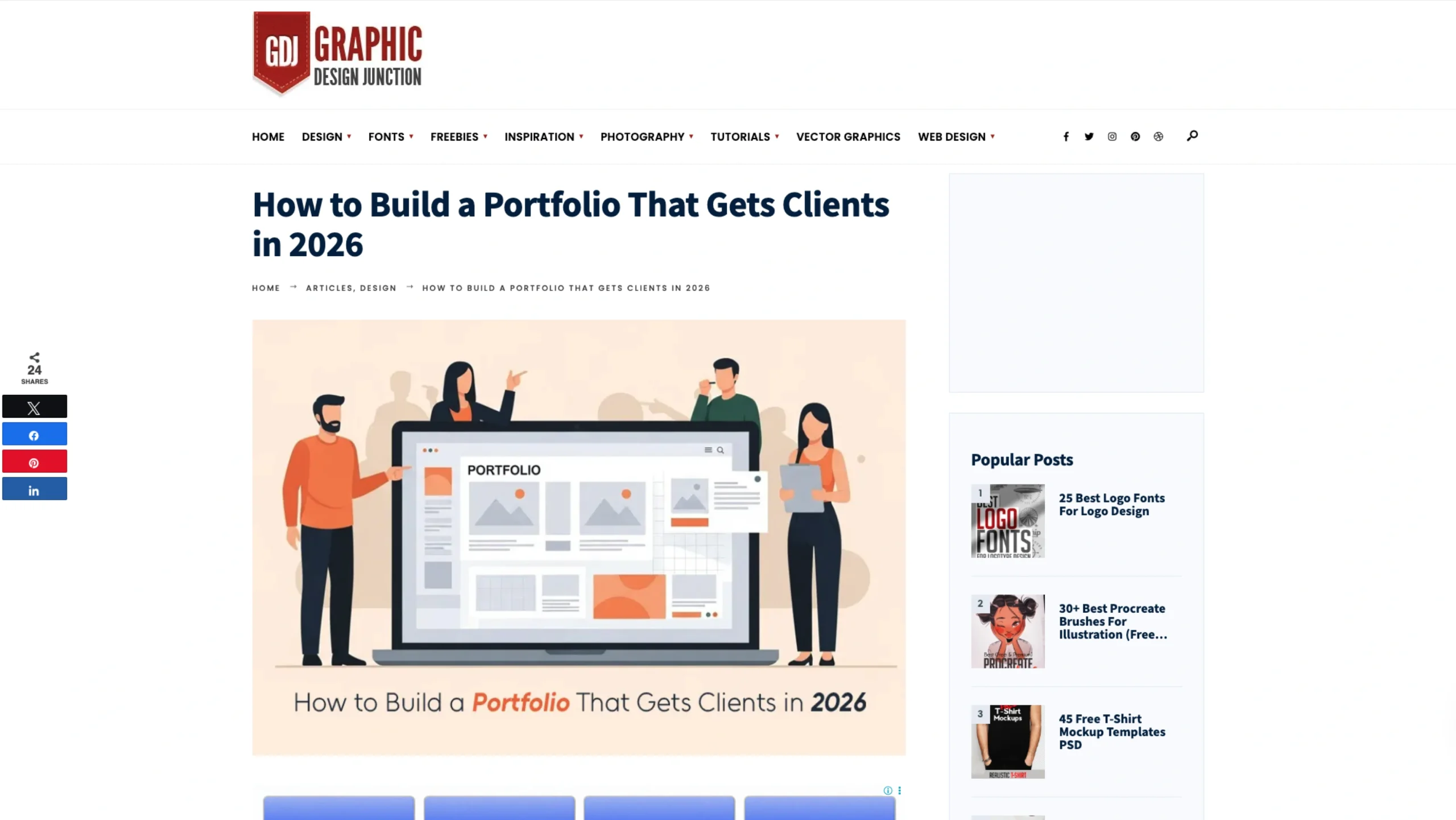
This article is a practical guide for designers who want to create a portfolio that attracts and convinces clients — not just impresses other designers.
In 2026, clients make quick decisions based on relevance and clarity, so your portfolio should help them decide to contact you with minimal friction.
A portfolio exists for one reason.
To help someone decide whether to contact you.
In 2026, that decision will happen fast. Very fast. Clients don’t open portfolios to explore. They open them to answer a question. Can this person resolve my issue without creating friction? If the answer isn’t clear, they move on.
Many portfolios fail here. Not because the work is bad. But they try to impress other designers rather than the person paying the bill.
A strong portfolio does not try to look clever.
It tries to be understood.
It answers basic questions quickly.
What do you do?
Who do you help?
What happens if someone hires you?
This article focuses on that reality. No tricks. No presentation hacks. Just structure, clarity, and proof. The goal isn’t praise. It’s trust. When a client finishes your portfolio, they should feel calm, informed, and ready to start a conversation.
A Portfolio Is a Decision Tool
Think of your portfolio as a decision aid, not a gallery. Clients scan before they read. This isn’t laziness. It’s time pressure. Most clients review several portfolios in one sitting. They’re looking for signals that reduce risk.
If your portfolio makes them work, it gets closed.
The first signal they look for is relevance.
Does this work look like my problem?
They care about project types, not artistic range. They don’t need ten styles. They need proof you understand their situation.
The second signal is clarity.
Clear structure suggests clear thinking.
Clear writing suggests clear communication.
Both matter because real projects involve questions, changes, and pressure.
The third signal is completion.
Clients want to see finished work. Full stories. Not fragments.
Two complete case studies beat ten unexplained screens every time.
How Clients Actually Read Portfolios
Clients don’t read top to bottom. They scan. Then they pause. Then they decide whether to continue.
They stay longer when they understand the context early.
They leave when information doesn’t help decision-making.
Strong engagement usually follows this order:
- Clear project title
- Plain explanation of the problem
- Reasoning behind decisions
- Final visuals
Tool lists and badges rarely matter at this stage.
Context keeps attention. Decoration does not.
What a Client-Ready Portfolio Looks Like
A client-ready portfolio is simple on purpose.
The top section states your role and focus. One direction. No guessing.
Project pages follow a pattern.
Problem. Decisions. Result.
Visuals show real usage. Real screens. No filler.
Writing stays plain. No performance tone.
Contact is obvious. One clear next step. No friction.
Choose One Clear Direction
Trying to serve everyone weakens your message. A portfolio should not feel like a menu. It should feel like a focus statement.
Choosing one direction doesn’t mean rejecting other work. It means deciding what you want to be hired for most often.
That decision shapes everything.
Which projects do you show?
How do you write?
How you structure pages?
When portfolios mix unrelated work, clients hesitate. They struggle to place you. That doubt costs you conversations.
If you work across areas, separation matters. Each category should feel intentional. Each should explain what problem you solve there.
Clarity removes doubt.
Show Fewer Projects. Tell Better Stories.
More projects don’t equal more trust. Often, they signal uncertainty.
Strong portfolios usually show five to seven projects. That’s enough to show range without overload. It also gives space to explain thinking.
Every project should earn its place.
If it only looks good but says nothing, remove it.
Editing is a skill. It shows confidence. Clients trust people who can decide what matters.
Removing work often improves a portfolio more than adding new work.
Start With the Problem
Never start with visuals. Start with context.
Clients want to know what was broken before you arrived. Say it plainly. Avoid drama. Be specific.
Then explain key decisions. Focus on moments that changed direction. Skip steps that didn’t affect outcomes.
The result matters more when the problem is clear.
Write Like a Person
Tone matters. A lot.
Avoid sales language. Avoid performance. Write like you’re explaining the work to someone who asked out of interest.
Short sentences help.
Clear statements help more.
Say what happened. Say why it mattered. If something changed mid-project, mention it.
Real language signals real experience.
Show Constraints and Limits
Perfect work feels fake. Real work has limits. Time. Budget. Systems. Internal pressure.
Mentioning constraints builds trust. It shows you understand real conditions.
It also explains decisions that might otherwise seem simple.
Constraints don’t weaken your work. They ground it.
Use Images That Answer Questions
Images are not decoration. They’re explanations.
Each image should answer something.
How does it work?
Where is it used?
What changed?
Avoid stock mockups that hide detail. Show real screens. Show flow. Show scale.
Fewer images with captions are more effective than many images without context.
Make Your Role Obvious
Clients care about what you did.
State your role early. Be honest. If you handled part of a project, say so.
Clear roles prevent confusion later. They also build trust faster.
Write an About Page That Sets Expectations
The about page isn’t a biography. It explains what working with you feels like.
Describe how projects start.
How communication works.
What do you expect from clients?
This filters mismatches early. That’s a good thing.
Make Contact Predictable
Contact should feel easy. And safe.
Offer one or two clear ways to reach you. Explain what happens next. Set expectations for response time.
Uncertainty creates hesitation. Predictability removes it.
Final Thought
A portfolio that works in 2026 doesn’t rely on style alone. It relies on clarity, honesty, and proof.
If your portfolio explains what you do, how you think, and how to start working with you, it’s doing its job.
Everything else is noise.