


The Logo Design Process: From Ideas to Identity
Let’s talk about logo design—because despite how small a logo might look on a screen or business card, the thinking behind it is anything but small.
One of the biggest misconceptions about logos is that they’re supposed to explain what a business does. They’re not.
A logo’s primary job is to identify, not to educate, describe, or tell a whole story.
That explanation comes later through brand messaging, visuals, tone of voice, and experience.
The logo needs to be recognizable, memorable, and uniquely tied to the brand.
If a logo can be identified at a glance and remembered after a quick interaction, it’s doing its job.
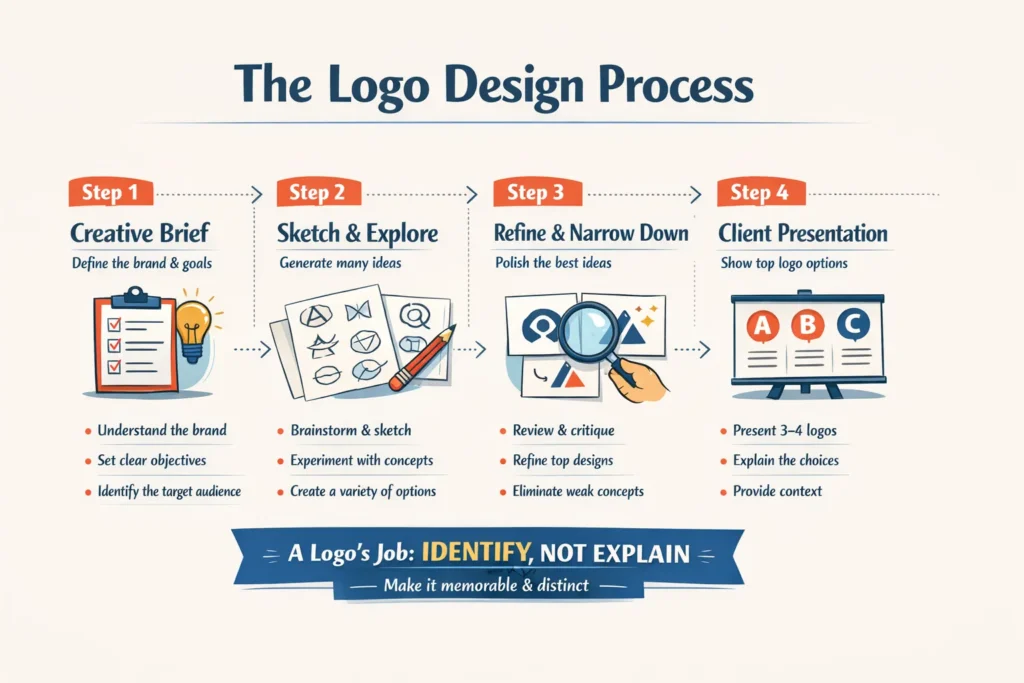
Step 1: Start With Clarity, Not Creativity
Before any sketching or designing happens, everything starts with a creative brief.
This is one of the most critical steps in the entire process—and often the most underestimated.
The brief sets the boundaries:
- Who is the brand for?
- What should it feel like?
- Where will the logo live (digital, print, signage, app icons)?
- What should it not be confused with?
This isn’t about limiting creativity. It’s about giving designers the right playground to work in. Without a clear brief, even the most beautiful logo can miss the mark.
Step 2: Exploration Without Overthinking
Once the brief is in place, designers are sent off to explore. Their job at this stage isn’t perfection—it’s volume and variety.
They sketch, experiment, and explore as many directions as possible within the given time:
- Abstract marks
- Wordmarks
- Symbol-based ideas
- Typographic explorations
- Subtle metaphors (not literal illustrations)
At this point, no idea is too weird or too rough. The goal is to explore the complete creative landscape before narrowing things down.
This phase is intentionally messy—and that’s a good thing.
Step 3: The Creative Director’s Role: Refinement, Not Reinvention
Once those ideas come back, the creative director’s role kicks in.
This is where refinement begins. Not redesigning everything. Not pushing personal taste. But asking the right questions:
- Is this distinctive?
- Does it scale well?
- Will it still work five years from now?
- Is it identifiable without explanation?
Many concepts get trimmed, merged, or evolved at this stage. Some ideas look exciting at first glance but fall apart when tested across real-world use cases. Others start simple but reveal strong long-term potential.
The job here is to turn raw ideas into presentable, confident logo directions.
Step 4: Fewer Options, Stronger Thinking
Although designers may create dozens of concepts internally, clients don’t need to see all of them.
In fact, showing too many options usually creates confusion rather than clarity.
That’s why, in most professional studios, only three or four logo options are presented to the client. Each option is:
- Thought through
- Refined
- Aligned with the brief
- Clearly differentiated from the others
Every logo direction should be defensible—not just visually appealing, but strategically sound.
Step 5: Presenting to the Client With Context
When presenting logos, it’s not just about showing marks on a white background. Context matters.
Clients need to see:
- How the logo behaves at small sizes
- How it works in real scenarios
- How it feels alongside brand colors and typography
The conversation should focus on why a logo works, not just whether it looks “nice.”
This is also where reminding clients of a key truth helps:
A logo doesn’t need to explain everything. It needs to be recognizable and ownable.
Why Refinement Matters More Than Ideas
Anyone can come up with logo ideas. The real value lies in knowing what to remove, what to sharpen, and what to push forward.
The difference between an average logo and a great one often comes down to:
- Subtle proportions
- Thoughtful spacing
- Strong simplicity
- Clear intent
That refinement phase—where many ideas are reduced to just a few—is where strong identities are born.
Final Thought
A successful logo isn’t loud. It doesn’t try to tell the whole story. It quietly and confidently says, “This is us.”
When the process is done right—from a solid brief to thoughtful refinement—the final logo doesn’t just look good. It lasts.
Logo inspiration for designers, thinkers, and founders who value clarity and character
A hand-picked collection of logo designs, practical insights, and standout portfolios—made for those who believe the best logos are simple, intentional, and unforgettable.