


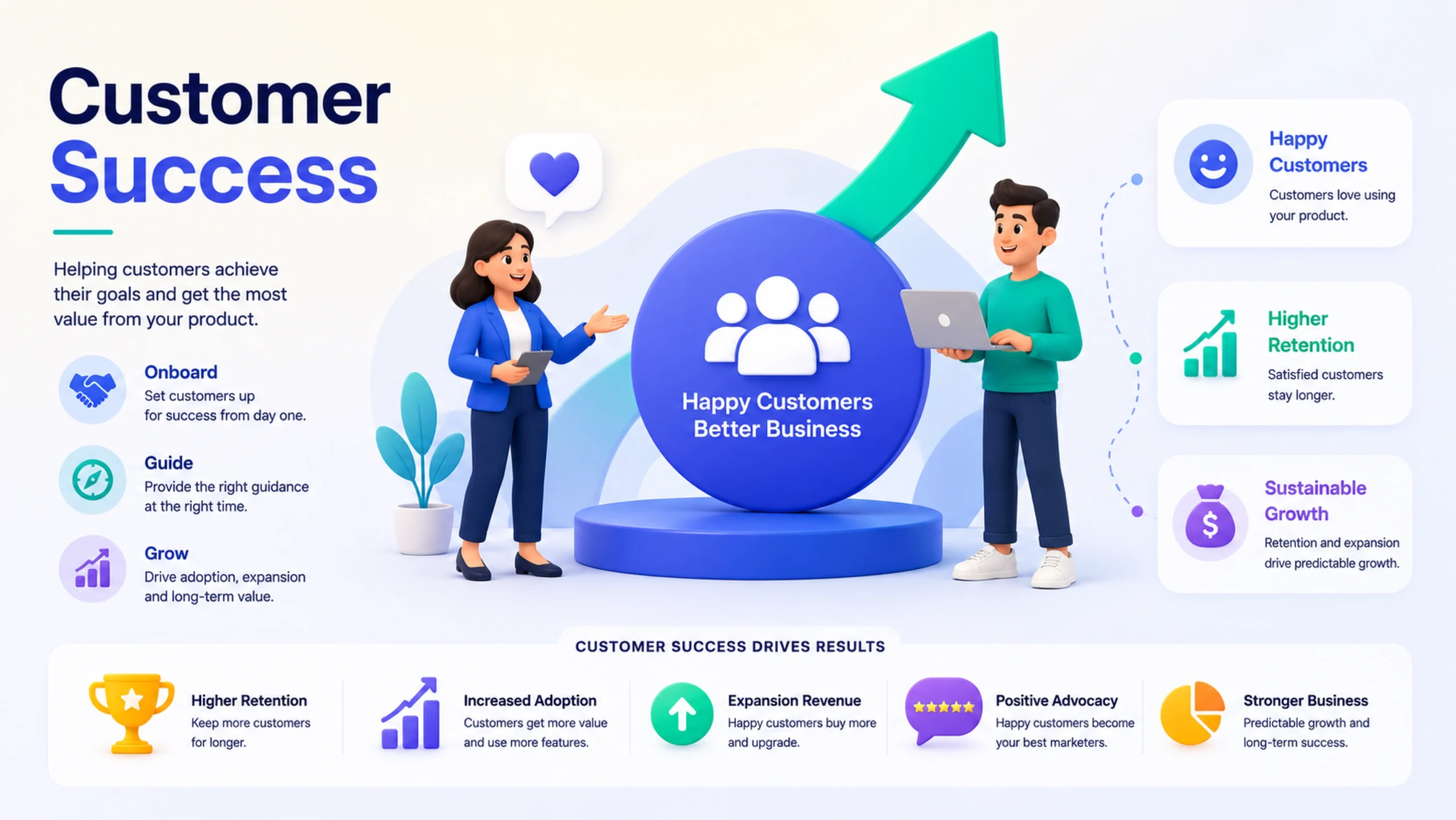
What Is Customer Success?
Customer Success is the process of helping customers get the value they expect from a product or service. The goal is simple: customers should achieve their desired outcomes and continue seeing benefits over time.
Think of it this way. Selling a product is like handing someone the keys to a car. Customer Success helps them learn how to drive it, use it effectively, and reach their destination.
Many companies once believed that customer service alone was enough. Then they discovered something interesting. Customers often left even after receiving good support. The missing piece was helping customers succeed before problems appeared.
That’s where Customer Success comes in.
Why Customer Success Matters
A company can spend thousands of dollars acquiring new customers.
If those customers leave after a few months, growth becomes difficult.
Customer Success helps businesses reduce churn, improve retention, and increase customer loyalty. It shifts the focus from solving problems after they happen to helping customers avoid them altogether.
Businesses with strong Customer Success programs often see:
- Higher customer retention
- Increased customer satisfaction
- Better product adoption
- More referrals
- Greater recurring revenue
In subscription-based businesses, these outcomes can have a direct impact on profitability.
How Customer Success Works
Customer Success begins shortly after a customer signs up or makes a purchase.
The process often includes:
Onboarding
Customers learn how to use the product and achieve early wins.
Education
Training sessions, tutorials, webinars, and documentation help customers gain confidence.
Ongoing Guidance
Customer Success teams regularly check progress and offer recommendations.
Relationship Building
Teams stay connected with customers and help them reach evolving goals.
Renewal and Expansion
Satisfied customers often renew subscriptions, upgrade plans, or purchase additional services.
The focus remains on helping customers achieve meaningful results rather than simply providing technical assistance.
Customer Success vs Customer Support
These terms are often confused.
They work closely together but serve different purposes.
| Customer Success | Customer Support |
|---|---|
| Proactive approach | Reactive approach |
| Helps customers achieve goals | Solves customer problems |
| Focuses on long-term value | Focuses on immediate issues |
| Builds relationships | Resolves tickets and requests |
For example, Customer Support helps a customer fix a login issue.
Customer Success helps that same customer use the product effectively over the next year.
The Main Responsibilities of Customer Success Teams
Customer Success Managers, often called CSMs, handle a wide range of activities.
Customer Onboarding
Helping customers get started quickly.
Product Adoption
Encouraging customers to use key features.
Relationship Management
Building trust through regular communication.
Health Monitoring
Tracking customer engagement and identifying risks.
Renewal Management
Supporting subscription renewals and contract extensions.
Strategic Guidance
Providing recommendations based on customer goals and business objectives.
The role combines communication, product knowledge, business strategy, and problem-solving.
Why Customer Success Creates Business Growth
Here’s the thing—happy customers often stay longer.
Customers who stay longer typically spend more.
Customers who spend more often recommend the product to others.
That chain reaction can create sustainable growth.
A strong Customer Success strategy can influence:
- Revenue growth
- Customer retention
- Customer lifetime value
- Expansion revenue
- Brand reputation
This is one reason many SaaS companies invest heavily in Customer Success teams.
Key Customer Success Metrics
Customer Success teams rely on data to measure performance.
Customer Retention Rate
Measures how many customers remain active over time.
Churn Rate
Tracks the percentage of customers who leave.
Customer Satisfaction Score (CSAT)
Measures customer happiness after interactions.
Net Promoter Score (NPS)
Evaluates customer loyalty and willingness to recommend a product.
Customer Lifetime Value (LTV)
Estimates the revenue generated throughout the customer relationship.
Product Adoption Rate
Measures how frequently customers use key product features.
Together, these metrics provide a clear picture of customer health.
Common Customer Success Challenges
Customer Success sounds straightforward, but it comes with challenges.
Customer Expectations
Customers often expect results quickly.
Product Complexity
Some products require significant training and onboarding.
Limited Resources
Growing companies may struggle to provide personalized attention to every customer.
Communication Gaps
Misunderstandings between customers and teams can slow progress.
Measuring Success
Different customers define success differently, making it difficult to apply one standard approach.
Strong Customer Success teams adapt to these challenges through communication and continuous improvement.
How Companies Build Strong Customer Success Programs
Successful programs often share several characteristics.
Clear Onboarding Processes
Customers know exactly what steps to take after signing up.
Regular Communication
Consistent check-ins help maintain engagement.
Customer Education
Knowledge bases, webinars, and tutorials support long-term success.
Data-Driven Insights
Usage data helps identify opportunities and risks.
Cross-Team Collaboration
Customer Success often works closely with sales, product, marketing, and support teams.
The goal is creating a seamless customer experience from start to finish.
Customer Success in SaaS Companies
Customer Success plays a particularly important role in SaaS businesses.
Subscription models rely heavily on renewals and recurring revenue.
A customer who leaves after one month generates far less value than a customer who stays for several years.
That’s why many SaaS companies treat Customer Success as a core growth function rather than a support department.
For these businesses, helping customers succeed directly contributes to revenue growth.
The Future of Customer Success
Customer expectations continue to evolve.
Companies increasingly use automation, customer health scoring, AI-powered insights, and predictive analytics to identify potential issues before they become serious problems.
Yet one thing remains unchanged.
Customers stay with businesses that help them achieve meaningful results.
Technology may improve the process, but relationships and customer outcomes remain at the center.
Final Thoughts
Customer Success is the practice of helping customers achieve their desired outcomes while using a product or service. It focuses on long-term relationships, customer value, retention, and business growth.
For modern businesses—especially SaaS companies—Customer Success has become a major driver of customer loyalty and recurring revenue. When customers succeed, businesses often succeed right alongside them.
Frequently Asked Questions (FAQs)
1. What is Customer Success?
Customer Success is a proactive strategy focused on helping customers achieve their goals and gain value from a product or service.
2. Why is Customer Success important?
It helps improve customer satisfaction, retention, loyalty, and long-term revenue growth.
3. What is the difference between Customer Success and Customer Support?
Customer Success focuses on helping customers achieve outcomes proactively, while Customer Support resolves problems and technical issues reactively.
4. What does a Customer Success Manager do?
A Customer Success Manager guides onboarding, monitors customer health, provides strategic advice, and helps customers achieve their objectives.
5. Which metrics are used in Customer Success?
Common metrics include customer retention rate, churn rate, customer satisfaction score (CSAT), Net Promoter Score (NPS), and customer lifetime value (LTV).
6. Is Customer Success only for SaaS companies?
No. While it is widely used in SaaS, Customer Success can benefit any business that values long-term customer relationships and retention.