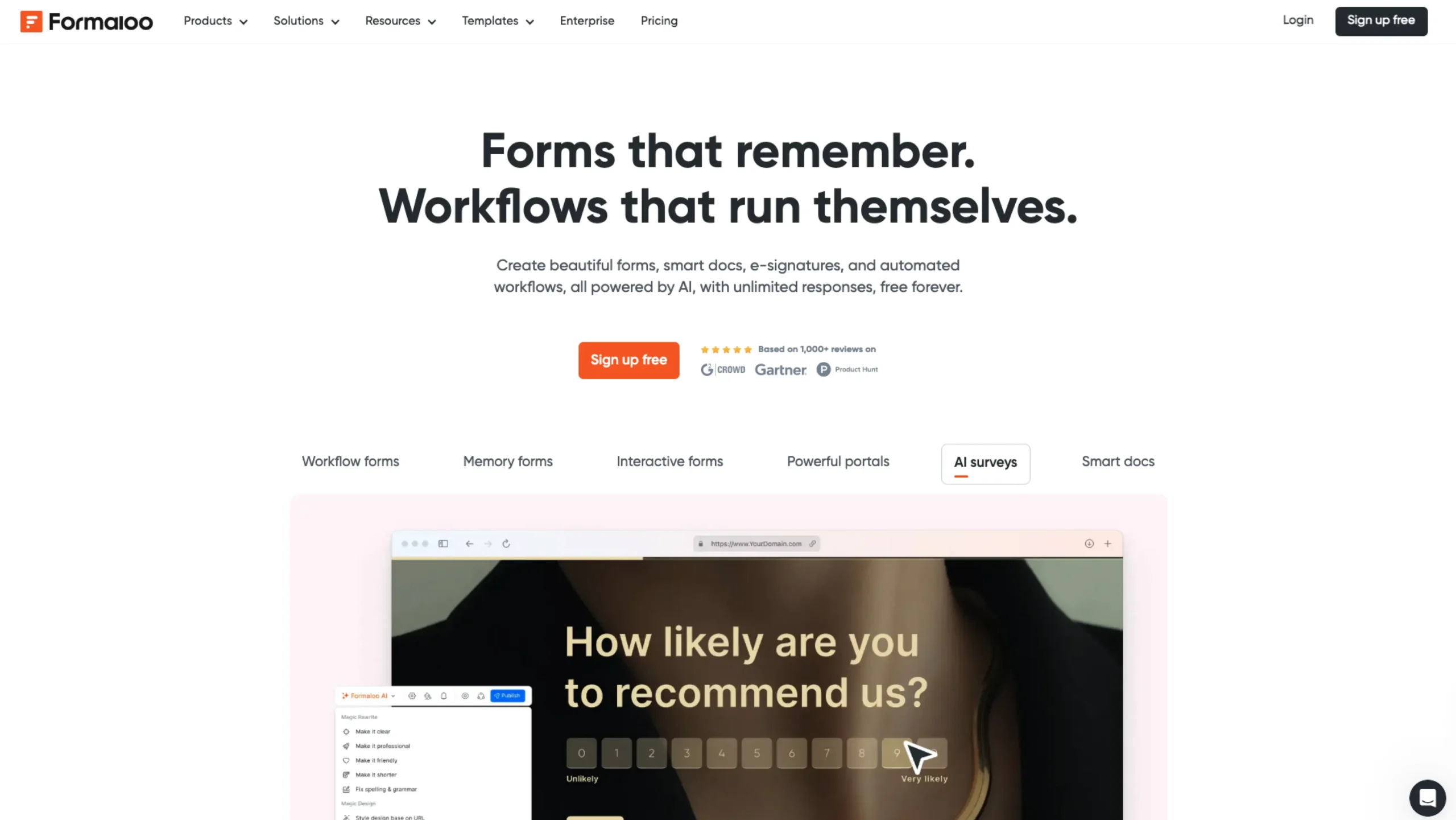
At first glance, Formaloo looks like another form builder. And sure—it can build forms. But once you spend a bit of time with it, you realize that calling it “just a form tool” really undersells what it’s trying to do.
Formaloo sits in that interesting space between forms, workflows, mini-apps, and data tools. It’s built for teams that want to collect data, make decisions from it, and actually do something with it—without relying on developers for every minor change.
A form builder that thinks beyond forms
Most form tools stop at “submit → spreadsheet.” Formaloo doesn’t.
You can start with a simple form, but from there you can layer on logic, branching, validation, approvals, calculations, and even user-specific experiences. It feels less like filling out a survey and more like interacting with a lightweight product.
This makes it especially useful for:
- Lead qualification and onboarding
- Internal tools and approval flows
- Surveys that adapt based on answers
- Customer feedback systems that trigger actions
- Data collection that actually feeds real workflows
Instead of forcing you into a rigid template, Formaloo lets you shape the experience around your process.
No-code, but not limiting
Formaloo leans hard into no-code—and mostly gets the balance right.
You don’t need to write code to:
- Build complex forms
- Add conditional logic
- Create multi-step workflows
- Connect responses to dashboards
- Share access with teammates
At the same time, it doesn’t feel like a “toy” tool. There’s depth here. You can model real business logic without feeling boxed in by oversimplified options.
For designers and product folks, this is where Formaloo shines. You can prototype real flows, test ideas with users, and iterate quickly—without waiting on engineering bandwidth.
Customization that actually matters
A common frustration with form tools is how quickly they start to look… generic.
Formaloo puts a lot of emphasis on visual customization and branding. You can adjust layouts, styles, and structure so forms don’t scream “third-party embed.” That’s especially important if the form is customer-facing or part of a product experience.
You can also control how and where forms are embedded, making them feel like a natural part of your website or app instead of an awkward add-on.
Built-in analytics and dashboards
Collecting data is only half the job. Making sense of it is the hard part.
Formaloo includes dashboards and reporting tools that help you:
- Track responses in real time
- Filter and segment data
- Spot trends without exporting everything to another tool
- Share insights with teammates
It’s not trying to replace a full analytics platform—but for operational and workflow-driven data, it’s surprisingly capable. And more importantly, it keeps everything in one place.
Collaboration and access control
Formaloo is clearly built with teams in mind.
You can:
- Invite collaborators
- Control who can view, edit, or manage data
- Set up approval flows
- Use forms internally or externally
This makes it useful not just for marketing or research, but also for ops, HR, customer support, and internal tooling. It’s flexible enough to live across departments without turning into a mess.
Where Formaloo fits best
Formaloo really clicks if you’re someone who asks:
- “Can we automate this process without building a full app?”
- “Can we validate this idea before engineering touches it?”
- “Can we give non-technical teams more control?”
It’s a strong fit for startups, product teams, agencies, and growing companies that need structure without friction.
If all you need is a basic contact form, this might feel like overkill. But if you want forms that do things—trigger logic, guide users, power workflows—Formaloo earns its place.
Final thoughts
Formaloo feels like a tool designed by people who understand that data collection is rarely the end goal. The real value comes from what happens after someone clicks “Submit.”
It gives designers and teams a way to move faster, test smarter, and build structured experiences without turning everything into a development project. That’s not flashy—but it’s incredibly useful.
For anyone exploring modern no-code tools that sit between forms, workflows, and lightweight products, Formaloo is absolutely worth a closer look—and a spot on UIUXshowcase.