


Acceptance Criteria: What It Is, Why It Matters, and How It Helps Teams Build the Right Product.
Imagine ordering a custom dining table.
You tell the carpenter:
“I’d like a beautiful wooden table.”
The request sounds clear.
At least initially.
A few weeks later, the table arrives.
It’s beautiful.
The craftsmanship is excellent.
The problem?
It’s too small for your family.
The wood isn’t the color you expected.
The shape doesn’t fit your dining room.
Nobody made a mistake.
Yet everyone is disappointed.
What happened?
The expectations were never clearly defined.
This is exactly the kind of problem Acceptance Criteria helps prevent in product development.
Acceptance Criteria acts as a shared agreement between stakeholders, product managers, designers, developers, testers, and clients. It defines what success looks like before work begins.
And honestly, that simple idea can save countless hours of confusion later.
What Is Acceptance Criteria?
Acceptance Criteria are specific conditions that a feature, user story, product enhancement, or software requirement must satisfy before it can be considered complete and accepted.
Think of acceptance criteria as a checklist.
If all conditions are met, the work is approved.
If conditions are not met, the work requires further refinement.
Acceptance criteria answer questions such as:
- What should the feature do?
- How should it behave?
- What outcomes are expected?
- What conditions must be satisfied?
- How will success be verified?
Without these answers, teams often interpret requirements differently.
That’s where problems begin.
Why Acceptance Criteria Matter
Here’s the thing.
People hear the same words and imagine different outcomes.
Ask ten people to picture a “simple dashboard.”
You’ll probably get ten slightly different mental images.
One person imagines charts.
Another imagines reports.
Someone else imagines analytics and filters.
None of them are necessarily wrong.
They’re simply filling in missing details.
Acceptance criteria removes much of that ambiguity.
Instead of relying on assumptions, teams work from shared expectations.
That clarity can dramatically improve project outcomes.
A Real-Life Example
Imagine booking a hotel room online.
The product team creates a user story:
“As a traveler, I want to book a hotel room online.”
That’s a good start.
But it’s incomplete.
Acceptance criteria might specify:
- Users can search by destination.
- Users can select check-in and check-out dates.
- Available rooms display pricing.
- Payment can be completed securely.
- Confirmation emails are sent after booking.
Now the team knows exactly what “book a hotel room online” means.
The difference is significant.
Acceptance Criteria Creates a Shared Definition of Success
One of the biggest challenges in software development involves interpretation.
Product managers interpret requirements one way.
Developers interpret them another way.
Designers see different possibilities.
QA testers focus on different scenarios.
Acceptance criteria act as a common reference point.
Everyone works from the same expectations.
This doesn’t eliminate all misunderstandings.
It reduces many of them.
And that’s valuable.
Very valuable.
How Acceptance Criteria Works
Acceptance criteria is usually created before development begins.
The process often follows a simple pattern.
Step 1: Define the User Need
What problem is being solved?
What outcome should the user achieve?
Step 2: Describe Expected Behavior
How should the system behave?
What should happen during normal usage?
Step 3: Identify Success Conditions
What specific conditions indicate completion?
Step 4: Validate Against the Criteria
Once development is complete, the feature is evaluated against the criteria.
If the requirements are met, the feature can proceed.
Acceptance Criteria vs Requirements
These two terms are often confused.
They’re closely related.
Yet they’re not the same thing.
Requirements
Requirements describe what needs to be built.
For example:
“The application must allow users to reset their passwords.”
Acceptance Criteria
Acceptance criteria define how success will be measured.
For example:
- Users can request a password reset email.
- Reset links expire after 24 hours.
- Passwords must meet security requirements.
- Successful resets display confirmation messages.
Requirements define the destination.
Acceptance criteria define how you know you’ve arrived.
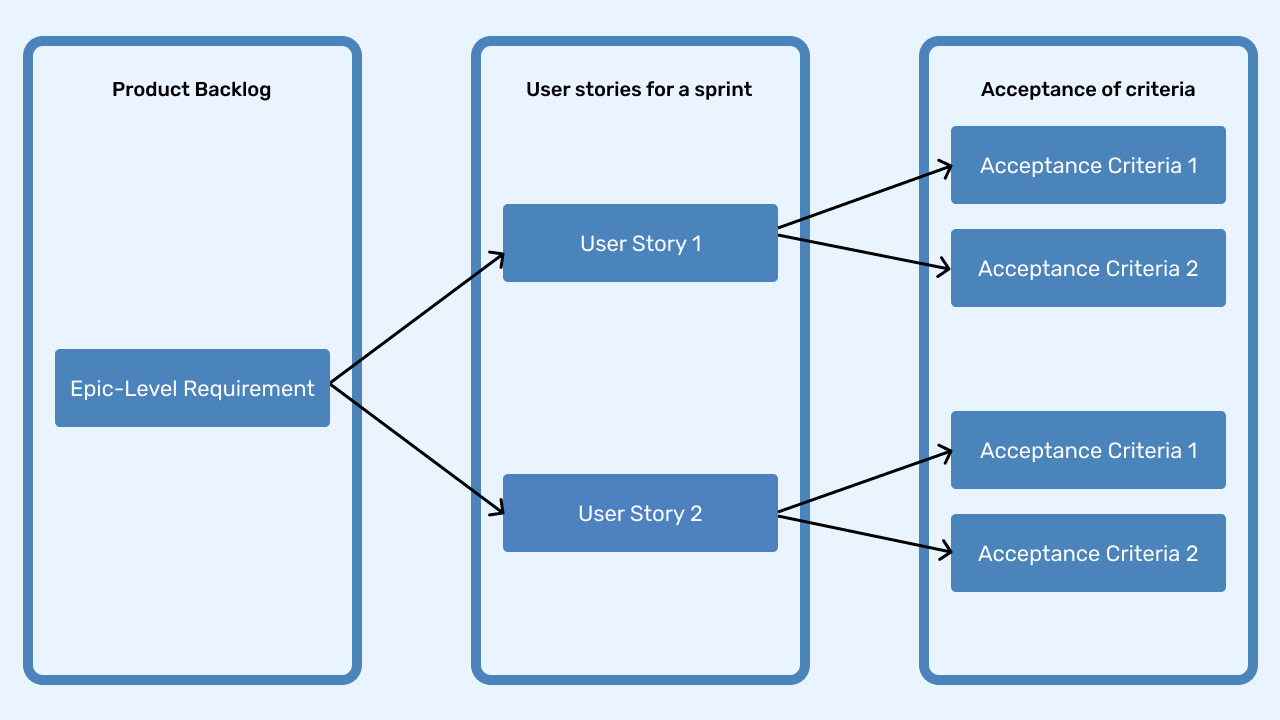
Acceptance Criteria in Agile Development
Acceptance criteria play a major role in Agile teams.
User stories often include acceptance criteria as part of their definition.
A typical user story may look like this:
“As a customer, I want to save products to a wishlist so I can purchase them later.”
The acceptance criteria provide the details.
Without those details, the story remains incomplete.
Many Agile teams consider acceptance criteria a core part of backlog refinement and sprint planning.
It helps everyone understand what needs to be delivered.
Common Formats for Writing Acceptance Criteria
Teams use several approaches.
Let’s look at the most common.
Simple Checklist Format
This is perhaps the easiest approach.
Example:
Wishlist Feature Acceptance Criteria:
- Users can add products to a wishlist.
- Users can remove products from a wishlist.
- Wishlist items persist after logout.
- Wishlist items appear in the user account area.
Clear.
Simple.
Easy to validate.
Given-When-Then Format
Popular within Agile and behavior-driven development.
Example:
Given a logged-in user
When the user clicks “Add to Wishlist”
Then the selected product appears in the wishlist
This format helps describe specific scenarios and expected outcomes.
Rule-Based Format
Some teams define business rules directly.
Example:
- Discounts apply only to active customers.
- Coupons cannot be combined.
- The maximum discount value is $100.
This format works well for business logic.
What Makes Good Acceptance Criteria?
Strong acceptance criteria typically share several characteristics.
Clear
Anyone reading the criteria should understand it without additional explanation.
Specific
Vague language creates confusion.
Specific language reduces interpretation.
Testable
The criteria should be measurable and verifiable.
If success cannot be validated, the criteria may be incomplete.
User-Focused
Acceptance criteria should support user outcomes whenever possible.
The goal is not simply building features.
The goal is to help users accomplish tasks.
Realistic
Criteria should align with available resources and project scope.
Acceptance Criteria in UX Design
Acceptance criteria aren’t limited to developers and QA teams.
UX designers rely on it heavily.
Imagine designing a registration flow.
The acceptance criteria may include:
- Users can create accounts in under three minutes.
- Error messages appear when required fields are empty.
- Password requirements are clearly displayed.
- Mobile and desktop experiences function correctly.
These expectations directly influence design decisions.
Acceptance criteria helps connect business requirements with user experience outcomes.
Benefits of Acceptance Criteria
Organizations continue using acceptance criteria because the advantages are substantial.
Better Communication
Teams share a common understanding of expectations.
Reduced Rework
Clear expectations reduce misunderstandings and revisions.
Faster Testing
QA teams know exactly what conditions require validation.
Improved Product Quality
Defined success criteria help maintain consistency.
Better Stakeholder Alignment
Stakeholders know what will be delivered before development begins.
Common Acceptance Criteria Mistakes
Even experienced teams occasionally struggle here.
Let’s look at a few common issues.
Being Too Vague
Statements like:
“The page should load quickly.”
Quickly means different things to different people.
Specific metrics work better.
Including Technical Solutions
Acceptance criteria should focus on outcomes rather than implementation details.
For example:
“The user receives a confirmation email.”
Not:
“The system must use SMTP configuration X.”
Writing Too Much
Overly detailed criteria can become difficult to maintain.
Balance matters.
Missing Edge Cases
Users don’t always behave as expected.
Error conditions deserve attention, too.
Creating Criteria After Development
Acceptance criteria work best when created before implementation begins.
Otherwise, teams may unintentionally shape the criteria around the completed solution.
Acceptance Criteria and Quality Assurance
QA teams rely heavily on acceptance criteria.
In many organizations, acceptance criteria form the foundation of testing activities.
Each criterion becomes a validation point.
If the feature satisfies every condition, confidence increases.
If gaps appear, issues can be addressed before release.
This relationship explains why strong acceptance criteria often leads to smoother testing cycles.
How AI Is Influencing Acceptance Criteria
AI-powered tools are beginning to assist product teams with requirement management.
Some systems can:
- Generate acceptance criteria drafts
- Identify missing scenarios
- Suggest edge cases
- Convert requirements into test cases
- Analyze user stories for ambiguity
These capabilities can save time.
Human review remains important.
Context matters.
Business goals matter.
User needs matter.
AI can assist the process.
It doesn’t replace thoughtful product thinking.
A Common Misconception
Some people assume acceptance criteria exist solely for developers.
That’s not accurate.
Acceptance criteria benefits:
- Product managers
- Designers
- Developers
- QA testers
- Stakeholders
- Clients
Everyone involved in product delivery gains clarity from well-defined expectations.
The more complex a project becomes, the more valuable that clarity tends to be.
Final Thoughts
Acceptance Criteria defines the conditions that must be satisfied before a feature, product enhancement, or user story can be considered complete.
It transforms broad ideas into measurable expectations.
It helps teams align around shared definitions of success.
And it reduces one of the biggest challenges in product development:
Assumptions.
When expectations remain unclear, misunderstandings thrive.
When expectations become visible, teams move forward with greater confidence.
That’s why acceptance criteria remain one of the most important tools in Agile development, UX design, product management, and quality assurance.
It doesn’t simply describe what should be built.
It defines what “done” actually means.
Frequently Asked Questions (FAQs)
What are the acceptance criteria in Agile?
Acceptance criteria are specific conditions that must be met before a user story, or feature, can be considered complete and accepted by stakeholders.
Why is acceptance criteria important?
Acceptance criteria create shared expectations, reduce misunderstandings, improve communication, support testing, and help teams deliver the intended outcome.
What is the difference between requirements and acceptance criteria?
Requirements describe what needs to be built, while acceptance criteria define the conditions that determine whether the work has been completed successfully.
Who writes acceptance criteria?
Acceptance criteria are often written by product managers, product owners, business analysts, or UX professionals, with input from developers, testers, and stakeholders.
What makes good acceptance criteria?
Good acceptance criteria are clear, specific, testable, measurable, user-focused, and easy for the entire team to understand.
Can acceptance criteria be used outside software development?
Yes. Acceptance criteria can be applied to design projects, business processes, marketing campaigns, operational initiatives, and many other situations where clear success conditions are needed.