


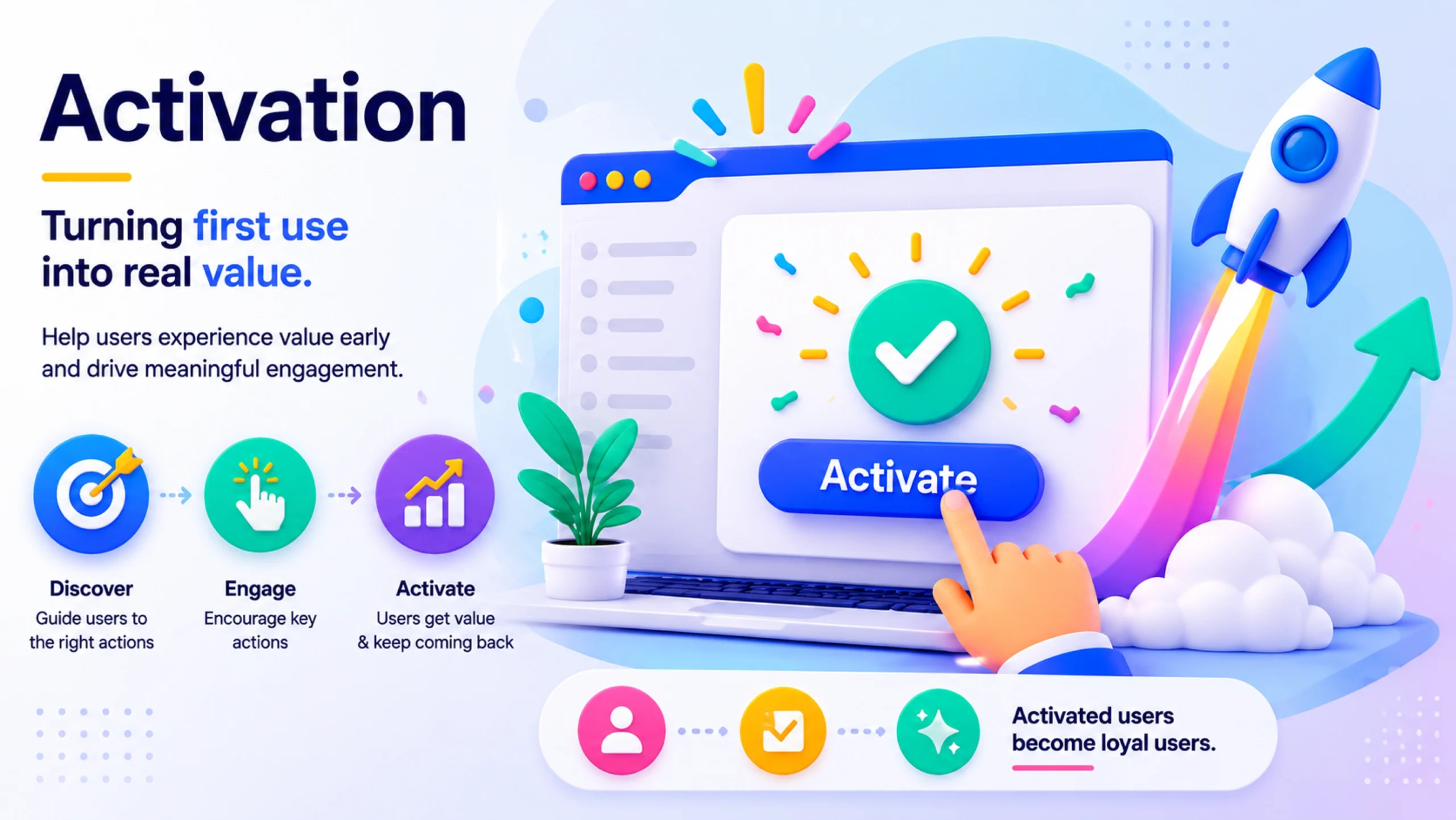
What Is Activation?
Activation is a product growth and customer success metric that measures the moment a user first experiences meaningful value from a product or service.
Think of it this way. Someone signs up for a project management tool. Registration alone doesn’t mean success. Creating their first project, inviting team members, and completing a task might be the moment they finally understand why the product matters.
That moment is activation.
In simple terms, activation happens when a user moves beyond curiosity and starts receiving real value.
For many businesses, activation marks the transition from a visitor or trial user into an engaged customer.
Why Activation Matters
Getting people to sign up is exciting.
Keeping them interested is harder.
Many companies spend significant time and money attracting new users. Yet a large percentage leave before discovering the product’s benefits.
This is where activation becomes important.
When users reach activation quickly, they are more likely to:
- Continue using the product
- Return regularly
- Upgrade to paid plans
- Recommend the product to others
- Become long-term customers
A weak activation experience often leads to high abandonment rates and lower retention.
Activation Is Different From Acquisition and Retention
These terms are often mentioned together, though they represent different stages of growth.
Acquisition
Acquisition focuses on bringing new users into the product.
Examples include:
- Paid advertising
- Search engine traffic
- Social media campaigns
- Referrals
Activation
Activation occurs when users experience meaningful value after joining.
Retention
Retention measures how many users continue returning and using the product over time.
You can think of these stages as a sequence:
Acquire users → Activate users → Retain users
If activation fails, retention usually suffers as well.
The Activation Moment
Every product has its own activation moment.
This is the action or milestone that indicates a user understands the product’s value.
For example:
Email Marketing Platform
Activation may occur when a user sends their first campaign.
Design Tool
Activation could happen when a user publishes their first design.
CRM Software
Activation might be reached after adding contacts and tracking customer interactions.
Project Management Software
Activation often happens when users create projects and collaborate with teammates.
The exact event differs, though the goal remains consistent: help users experience success quickly.
How Businesses Measure Activation
Activation requires a clear definition.
Companies typically identify specific actions that indicate meaningful engagement.
Common activation events include:
- Completing account setup
- Publishing content
- Uploading files
- Inviting team members
- Creating a project
- Making a first transaction
- Connecting integrations
Activation Rate is commonly calculated as:
Activation Rate = Activated Users ÷ Total New Users × 100
A higher activation rate usually suggests users are finding value efficiently.
Real-World Examples of Activation
Let’s make it more practical.
Imagine someone signs up for a fitness app.
Reading the dashboard isn’t activation.
Completing their first workout plan may be activation.
Now consider an online learning platform.
Creating an account doesn’t indicate value.
Finishing the first lesson may represent activation.
The pattern appears repeatedly across industries.
Users must experience results, not simply access features.
Common Activation Challenges
Many products struggle with activation.
The reasons vary, though some problems appear frequently.
Too Much Complexity
Users become overwhelmed by lengthy setup processes.
Unclear Value
People don’t immediately understand how the product helps them.
Information Overload
Presenting every feature at once often creates confusion.
Slow Time-to-Value
Users wait too long before experiencing benefits.
Poor Onboarding
Without guidance, many users abandon products before reaching meaningful outcomes.
Interestingly, products often fail because they’re difficult to understand, not because they’re ineffective.
Improving Activation Rates
Here’s the thing.
Most users want quick progress.
They don’t want lengthy tutorials or complicated instructions.
Businesses can improve activation by focusing on simplicity.
Streamline Onboarding
Reduce unnecessary steps during setup.
Highlight Core Features
Show users the fastest path to success.
Create Checklists
Simple progress indicators encourage completion.
Personalize Experiences
Different users may have different goals.
Use Product Tours
Interactive guidance can reduce confusion.
Celebrate Early Wins
Acknowledging achievements reinforces positive behavior.
Small improvements often create noticeable gains in activation performance.
Activation in SaaS Products
Activation plays a particularly important role in SaaS businesses.
Subscription-based products rely heavily on long-term customer relationships.
If users fail to experience value early, they may cancel before becoming paying customers.
This is why many SaaS teams closely monitor activation metrics.
Popular SaaS companies frequently analyze:
- Time-to-value
- Activation rate
- Feature adoption
- Trial-to-paid conversions
- Retention after activation
Many growth teams consider activation one of the strongest indicators of future success.
Key Metrics Connected to Activation
Activation rarely exists in isolation.
Several related metrics help businesses evaluate performance.
Activation Rate
Measures the percentage of users reaching activation.
Time-to-Value
Measures how quickly users achieve meaningful results.
Retention Rate
Shows how many activated users continue returning.
Churn Rate
Measures customer loss over time.
Conversion Rate
Tracks how many activated users become paying customers.
Together, these metrics provide a clearer picture of product health.
Why Activation Matters More Than Ever
Digital products compete for attention every day.
Users have countless alternatives.
If they don’t understand a product quickly, they’ll often move on.
Activation helps businesses bridge the gap between curiosity and commitment.
A strong activation experience creates confidence. It helps users solve problems faster and builds momentum during those critical early interactions.
That’s why many successful companies spend as much effort improving activation as they do acquiring new customers.
Final Thoughts
Activation is the moment when users experience the core value of a product for the first time. It marks the shift from simple sign-up activity to meaningful engagement and often predicts long-term customer success.
Businesses that focus on activation can improve retention, increase conversions, reduce churn, and create stronger customer relationships. In many cases, helping users achieve one meaningful outcome quickly can make the difference between a loyal customer and a lost opportunity.
Frequently Asked Questions (FAQs)
1. What is activation in SaaS?
Activation is the point where a user experiences meaningful value from a SaaS product, often after completing a key action or milestone.
2. Why is activation important?
Activation helps businesses determine whether users are successfully engaging with a product and finding value early in their experience.
3. How is activation rate calculated?
Activation rate is calculated by dividing activated users by total new users and multiplying by 100.
4. What is an activation event?
An activation event is a specific action that signals a user has reached meaningful engagement, such as publishing content or inviting teammates.
5. What is the difference between activation and retention?
Activation measures initial value realization, while retention measures continued usage over time.
6. How can businesses improve activation?
Businesses can improve activation through better onboarding, simplified setup processes, personalized guidance, and faster paths to value.