


What Is an AI Agent?
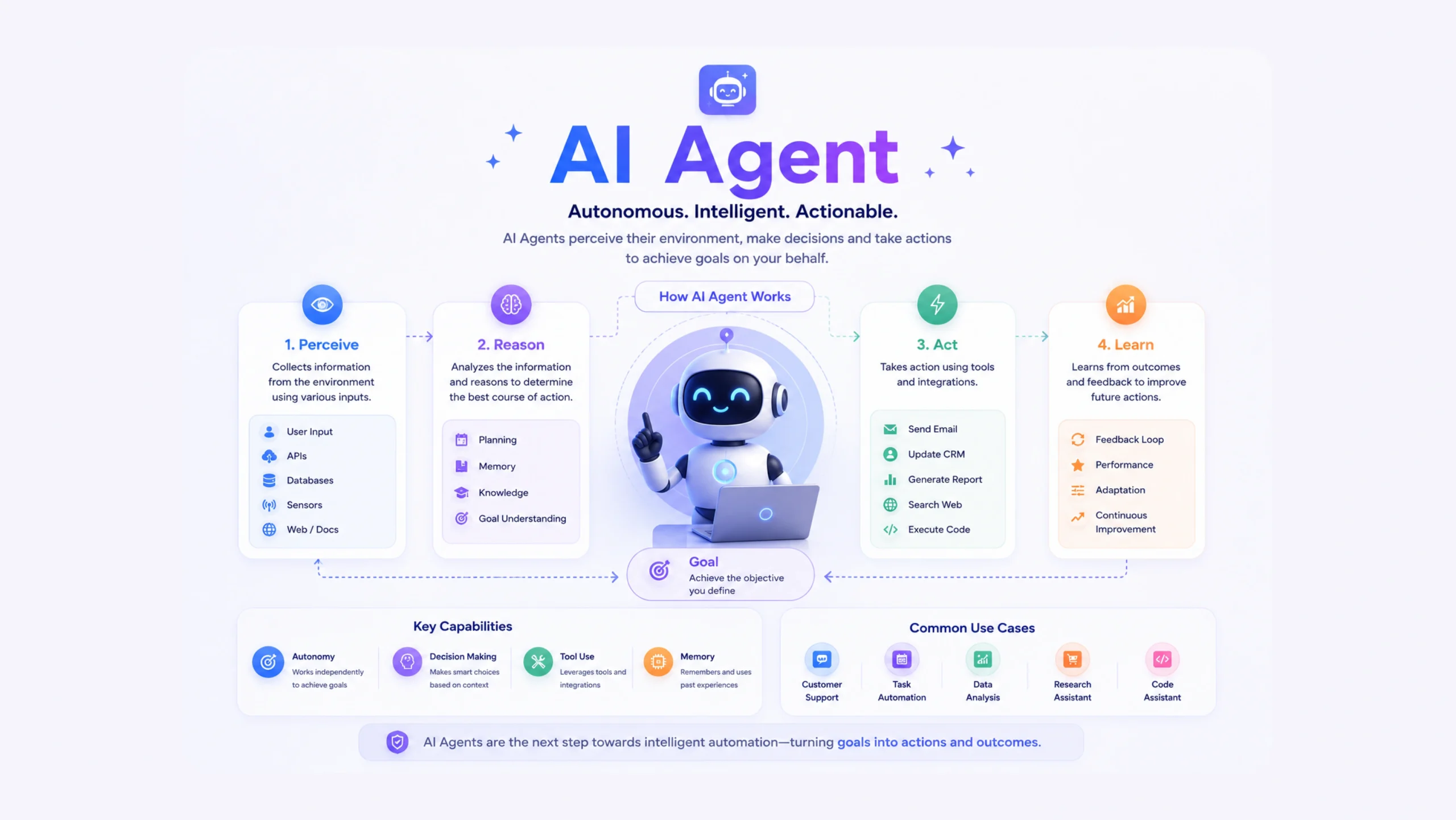
An AI Agent is an artificial intelligence system that can perceive information, make decisions, take actions, and work toward a specific goal with limited or no human intervention.
Unlike traditional software that waits for instructions at every step, an AI agent can analyze a situation, determine what needs to happen next, and execute tasks on its own.
Think of it as the difference between a calculator and a personal assistant.
A calculator gives answers when you ask. A personal assistant can understand a goal, plan the steps, and carry out the work.
That’s the core idea behind AI agents.
So, What Makes an AI Agent Different?
Let’s imagine you’re planning a business trip.
A traditional AI chatbot might answer questions like:
- What’s the weather in London?
- What flights are available?
- What hotels are nearby?
An AI agent goes much further.
It could:
- Check your calendar
- Find suitable flights
- Compare hotel options
- Book reservations
- Update your schedule
- Send confirmation emails
All from a single request.
Instead of answering questions, it performs actions.
That’s a significant shift.
Why Are AI Agents Getting So Much Attention?
The recent growth of advanced language models has made AI agents far more capable than earlier automation systems.
Companies are now exploring agents that can:
- Conduct research
- Manage workflows
- Analyze data
- Handle customer support
- Generate reports
- Coordinate multiple software tools
For businesses, that means less repetitive work.
For individuals, it means more time spent on creative and strategic activities.
How Does an AI Agent Work?
At a high level, an AI agent follows a simple cycle.
Observe
The agent gathers information from its environment.
This information might come from:
- User inputs
- Documents
- Databases
- Websites
- APIs
- Software platforms
Think
The agent analyzes the information and determines the next action.
This decision-making process often uses:
- Large Language Models
- Rules
- Planning systems
- Machine learning algorithms
Act
The agent performs a task.
Examples include:
- Sending messages
- Updating records
- Creating content
- Scheduling meetings
- Running calculations
Learn or Adjust
Some agents improve their performance over time by analyzing outcomes and refining future decisions.
The cycle then repeats until the objective is completed.
The Building Blocks of an AI Agent
Several components work together to make an AI agent effective.
Goals
Every agent needs a goal.
Without a goal, the agent has no direction.
Examples include:
- Answer customer questions
- Book appointments
- Generate sales reports
- Monitor system performance
The goal drives every decision.
Memory
Memory allows agents to retain information during tasks.
For example, an agent helping a customer may remember:
- Previous conversations
- Preferences
- Account details
- Past actions
This creates more personalized interactions.
Planning
Planning helps agents determine the sequence of actions required to reach a goal.
A complex task may involve dozens of smaller steps.
The agent breaks the problem into manageable pieces and executes them one by one.
Tools
Many AI agents interact with external tools.
Examples include:
- Email platforms
- Calendars
- CRM systems
- Project management software
- Databases
- Search engines
The more tools an agent can access, the more useful it becomes.
AI Agent vs AI Assistant
People often use these terms interchangeably.
They are related, but they’re not identical.
AI Assistant
An AI assistant mainly responds to user requests.
Examples include:
- Chatbots
- Virtual assistants
- Writing assistants
The user remains in control of each step.
AI Agent
An AI agent actively pursues goals and performs actions.
It can make decisions, execute tasks, and coordinate multiple systems.
In simple terms:
- Assistants answer.
- Agents act.
Modern systems increasingly combine both capabilities.
Different Types of AI Agents
Not all agents work the same way.
Several categories exist.
Reactive Agents
These agents respond directly to current conditions.
They don’t rely heavily on memory or long-term planning.
Simple customer service bots often fall into this category.
Goal-Based Agents
Goal-based agents evaluate possible actions and select the one most likely to achieve the desired outcome.
Many modern AI systems operate this way.
Utility-Based Agents
These agents compare multiple options and choose the one expected to produce the most favorable result.
For example, an agent might evaluate cost, speed, and quality before making a recommendation.
Learning Agents
Learning agents improve through experience.
They analyze previous outcomes and adjust future behavior accordingly.
This makes them more adaptable over time.
Multi-Agent Systems
Sometimes multiple agents work together.
One agent may handle research.
Another may write content.
A third may review quality.
Together, they accomplish tasks that would be difficult for a single agent.
Real-World Examples of AI Agents
AI agents are already appearing across many industries.
Customer Support
Agents can:
- Answer inquiries
- Process refunds
- Update customer records
- Escalate complex cases
This reduces support workloads and shortens response times.
Software Development
Development agents can:
- Write code
- Review code
- Detect bugs
- Generate documentation
- Run tests
Developers increasingly use AI agents as collaborative teammates.
Marketing
Marketing teams use agents to:
- Research audiences
- Generate campaign ideas
- Analyze performance
- Create reports
Tasks that once took hours can often be completed much faster.
Project Management
Agents can monitor deadlines, organize tasks, update stakeholders, and identify risks before they become major problems.
Personal Productivity
Individuals use AI agents for:
- Scheduling
- Travel planning
- Research
- Content creation
- Email management
Many professionals already rely on them daily.
Why Businesses Are Investing in AI Agents
Organizations see several potential advantages.
Increased Efficiency
Routine work can be completed without constant human involvement.
Teams spend less time on repetitive activities.
Faster Decision-Making
Agents can gather and analyze information rapidly.
This helps organizations respond more quickly to changing conditions.
Continuous Operation
Unlike humans, agents can operate around the clock.
Tasks continue even outside normal business hours.
Cost Savings
Automation can reduce operational expenses for many repetitive processes.
This is one reason enterprises are rapidly exploring agent-based systems.
Challenges and Limitations
AI agents are powerful, but they’re not perfect.
Incorrect Decisions
Agents can misunderstand instructions or make poor choices when information is incomplete.
Human oversight remains important.
Security Risks
An agent connected to business systems may gain access to sensitive information.
Proper safeguards are necessary.
Reliability Issues
If an external tool fails, the agent may struggle to complete its task.
Complex workflows often introduce additional points of failure.
Ethical Concerns
Questions continue to emerge around:
- Accountability
- Transparency
- Privacy
- Bias
Organizations must address these concerns carefully.
AI Agents and the Future of Work
Many experts believe AI agents will become a standard part of daily work.
The future may involve teams made up of both humans and AI systems.
Humans provide:
- Creativity
- Judgment
- Strategy
- Emotional intelligence
Agents handle:
- Repetitive tasks
- Data gathering
- Process execution
- Routine decision-making
Rather than replacing people entirely, many organizations are exploring how agents can support human productivity.
The Rise of Autonomous Systems
A few years ago, most AI tools acted like sophisticated search engines.
Today, AI agents can plan, reason, coordinate tools, and execute actions.
Tomorrow’s systems may manage entire workflows with minimal supervision.
We’re already seeing early examples in software development, customer support, operations, finance, healthcare, and research.
The pace of change is remarkable.
Final Thoughts
AI agents represent the next stage in the evolution of artificial intelligence. Instead of simply answering questions, these systems can pursue goals, make decisions, interact with software, and complete tasks autonomously. As language models, automation tools, and reasoning capabilities continue to improve, AI agents are becoming increasingly capable partners for businesses and individuals alike.
The technology is still developing, and challenges remain. Yet one thing is becoming clear: AI agents are moving from experimental tools to practical systems that help people get meaningful work done faster and more efficiently.
Frequently Asked Questions (FAQs)
1. What is an AI agent?
An AI agent is an intelligent system that can analyze information, make decisions, and perform actions autonomously to achieve a specific goal.
2. How is an AI agent different from an AI assistant?
An AI assistant mainly responds to user requests, while an AI agent can plan tasks, make decisions, and take actions independently.
3. What are examples of AI agents?
Examples include customer support agents, coding agents, research agents, scheduling agents, and workflow automation agents.
4. Do AI agents use Large Language Models?
Many modern AI agents use Large Language Models (LLMs) for reasoning, language understanding, and decision-making.
5. Can AI agents work without human supervision?
Some AI agents can operate with limited supervision, though human oversight is often recommended for important decisions.
6. What industries use AI agents?
AI agents are used in customer service, healthcare, software development, finance, marketing, education, research, and business operations.