


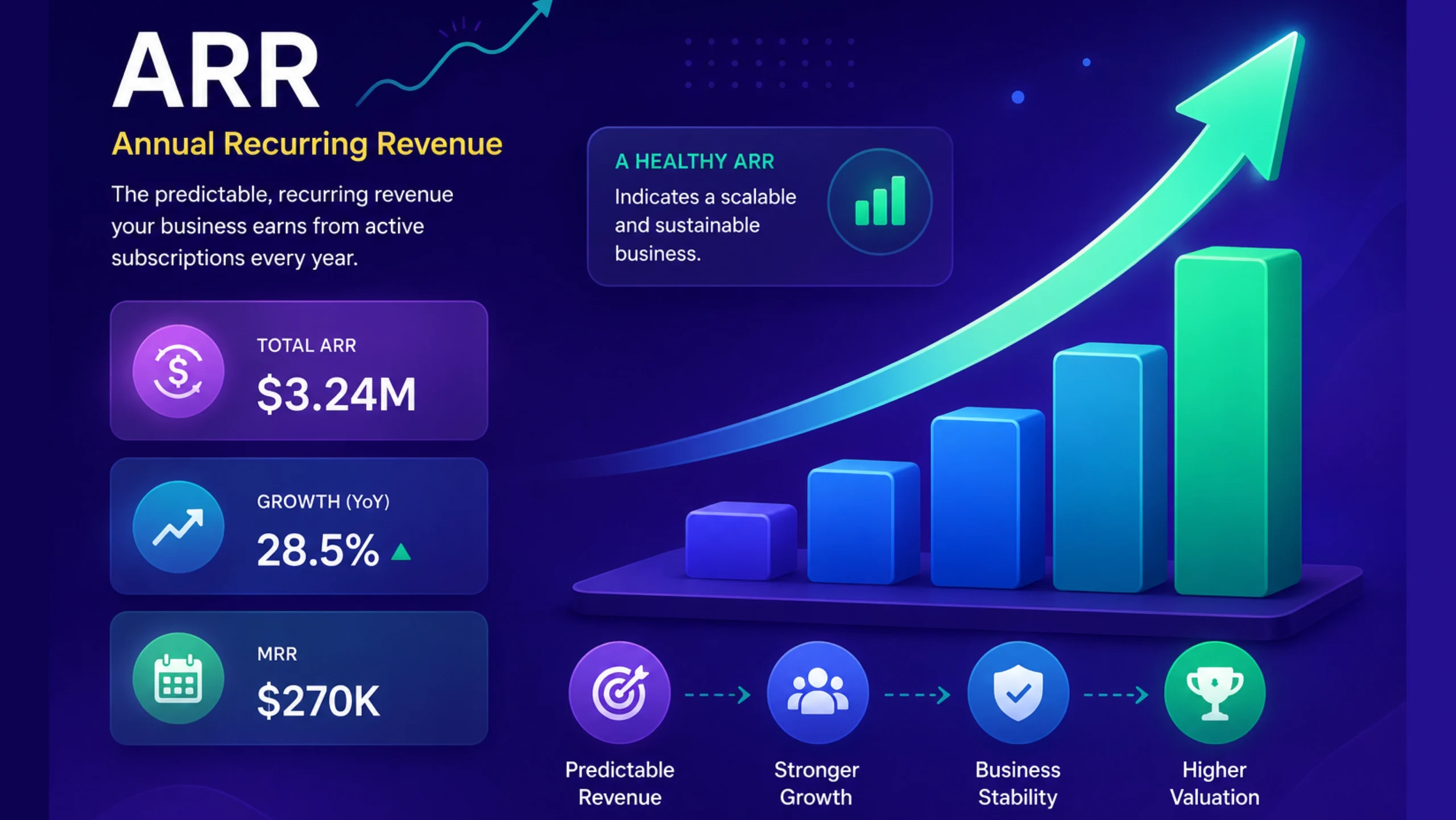
What Is ARR (Annual Recurring Revenue)?
ARR, short for Annual Recurring Revenue, is one of the most important metrics in subscription-based businesses, especially SaaS companies.
It measures the amount of recurring revenue a company expects to earn from customers over a year. The key word here is recurring. ARR focuses on predictable income generated from subscriptions, contracts, memberships, or other ongoing payments.
For example, if a customer pays $1,200 per year for a software subscription, that customer contributes $1,200 to the company’s ARR.
Simple enough. Yet this single metric often becomes the number investors, founders, and executives watch most closely.
Why ARR Matters So Much
Imagine running a business where revenue changes dramatically every month. Planning growth would feel like driving through fog.
ARR helps remove some of that uncertainty.
Since recurring revenue tends to be predictable, ARR gives companies a clearer view of future income. It helps leadership teams make smarter decisions about hiring, marketing budgets, product development, and expansion plans.
Investors pay close attention to ARR as well. A company with strong recurring revenue often appears more stable than one relying on one-time sales.
How ARR Works
ARR tracks active recurring contracts over a 12-month period.
Let’s say a SaaS company has:
- 100 customers
- Each customer pays $1,000 annually
The ARR would be:
$100,000
Now imagine the company gains 20 new customers.
Its ARR grows to:
$120,000
If some customers upgrade to higher plans, ARR increases further. If customers cancel subscriptions, ARR decreases.
This constant movement makes ARR a valuable indicator of business health.
ARR Formula
The basic formula is straightforward:
ARR = Total Annual Subscription Revenue
A common calculation looks like this:
ARR = Monthly Recurring Revenue (MRR) × 12
For example:
- MRR = $10,000
- ARR = $120,000
Companies often adjust ARR calculations to account for:
- New customer revenue
- Expansion revenue
- Renewals
- Customer churn
- Downgrades
The goal is to measure recurring income as accurately as possible.
ARR vs MRR: What’s the Difference?
ARR and MRR are closely connected.
MRR stands for Monthly Recurring Revenue and measures recurring income on a monthly basis.
ARR measures the same revenue across an entire year.
Here’s a simple comparison:
| Metric | Meaning |
|---|---|
| MRR | Monthly recurring revenue |
| ARR | Annual recurring revenue |
Many SaaS startups monitor both metrics together.
MRR helps track short-term performance.
ARR provides a broader view of long-term growth.
Why Businesses Track ARR
ARR offers several valuable insights.
Predictable Growth
Recurring revenue creates visibility into future earnings.
Business leaders can plan with greater confidence.
Investor Confidence
Many venture capital firms use ARR as a key performance indicator when evaluating SaaS companies.
A growing ARR often signals a healthy business.
Revenue Quality
Not all revenue carries equal value.
One-time project revenue may disappear after a single transaction.
Recurring revenue tends to be more reliable.
Strategic Planning
ARR helps companies forecast future cash flow and allocate resources effectively.
What Impacts ARR?
Several factors influence annual recurring revenue.
New Customers
Every new subscription adds recurring revenue.
Customer Retention
Keeping existing customers often has a significant impact on ARR growth.
Upsells
Customers moving to higher-priced plans increase ARR.
Cross-Selling
Additional products or services can increase recurring revenue per customer.
Churn
When customers cancel subscriptions, ARR declines.
This is one reason SaaS companies focus heavily on retention.
Common ARR Mistakes
ARR sounds simple, yet mistakes happen frequently.
Including One-Time Revenue
Setup fees, consulting projects, and one-off purchases should usually remain outside ARR calculations.
ARR focuses on recurring revenue only.
Ignoring Churn
Looking only at new revenue can create an unrealistic picture of growth.
Lost customers matter just as much.
Counting Future Revenue Too Early
Revenue should generally be recognized based on active contracts rather than assumptions.
Using Different ARR Definitions
Some companies calculate ARR differently, making comparisons difficult.
Consistency matters.
How SaaS Companies Grow ARR
Growing ARR rarely happens through customer acquisition alone.
Successful SaaS companies often focus on several growth levers simultaneously.
Improve Customer Retention
Retaining customers increases recurring revenue and reduces churn.
Increase Product Value
Customers stay longer when they continue receiving value.
Expand Existing Accounts
Many companies generate substantial ARR growth through upgrades and additional services.
Refine Pricing
Pricing adjustments can significantly affect annual revenue.
Enter New Markets
Expanding into new industries or regions creates fresh growth opportunities.
ARR and Company Valuation
ARR plays a major role in how many SaaS companies are valued.
Investors often apply revenue multiples when estimating company value.
A business generating $5 million in ARR may receive a valuation several times higher than its annual revenue, depending on growth rate, retention, profitability, and market conditions.
This explains why founders frequently discuss ARR during fundraising conversations.
It’s more than a financial metric. It often becomes a signal of business momentum.
Is ARR Always Perfect?
Not quite.
ARR provides a strong view of recurring revenue, but it doesn’t tell the whole story.
A company may have impressive ARR growth while struggling with profitability.
Another company may generate steady ARR but face customer satisfaction issues.
That’s why ARR works best alongside other metrics such as:
- Customer Acquisition Cost (CAC)
- Lifetime Value (LTV)
- Churn Rate
- Net Revenue Retention (NRR)
- Gross Margin
Together, these metrics create a more complete picture.
Final Thoughts
ARR, or Annual Recurring Revenue, measures the predictable revenue a subscription business expects to generate over a year. It helps companies evaluate growth, forecast future income, attract investors, and make informed business decisions.
For SaaS companies especially, ARR serves as one of the clearest indicators of long-term business performance. A growing ARR often reflects strong customer demand, healthy retention, and a business model built for sustainable growth.
Frequently Asked Questions (FAQs)
1. What does ARR stand for?
ARR stands for Annual Recurring Revenue, which measures the recurring revenue a business expects to earn over a year.
2. How is ARR calculated?
ARR is typically calculated by multiplying Monthly Recurring Revenue (MRR) by 12 or by totaling annual subscription revenue from active customers.
3. Why is ARR important?
ARR helps businesses track growth, forecast future revenue, evaluate performance, and attract investors.
4. What is the difference between ARR and MRR?
MRR measures recurring revenue each month, while ARR measures recurring revenue across an entire year.
5. Does ARR include one-time payments?
No. ARR generally excludes one-time fees, consulting charges, setup costs, and non-recurring revenue.
6. Which companies use ARR the most?
ARR is most commonly used by SaaS companies, subscription businesses, membership platforms, and recurring-service providers.