


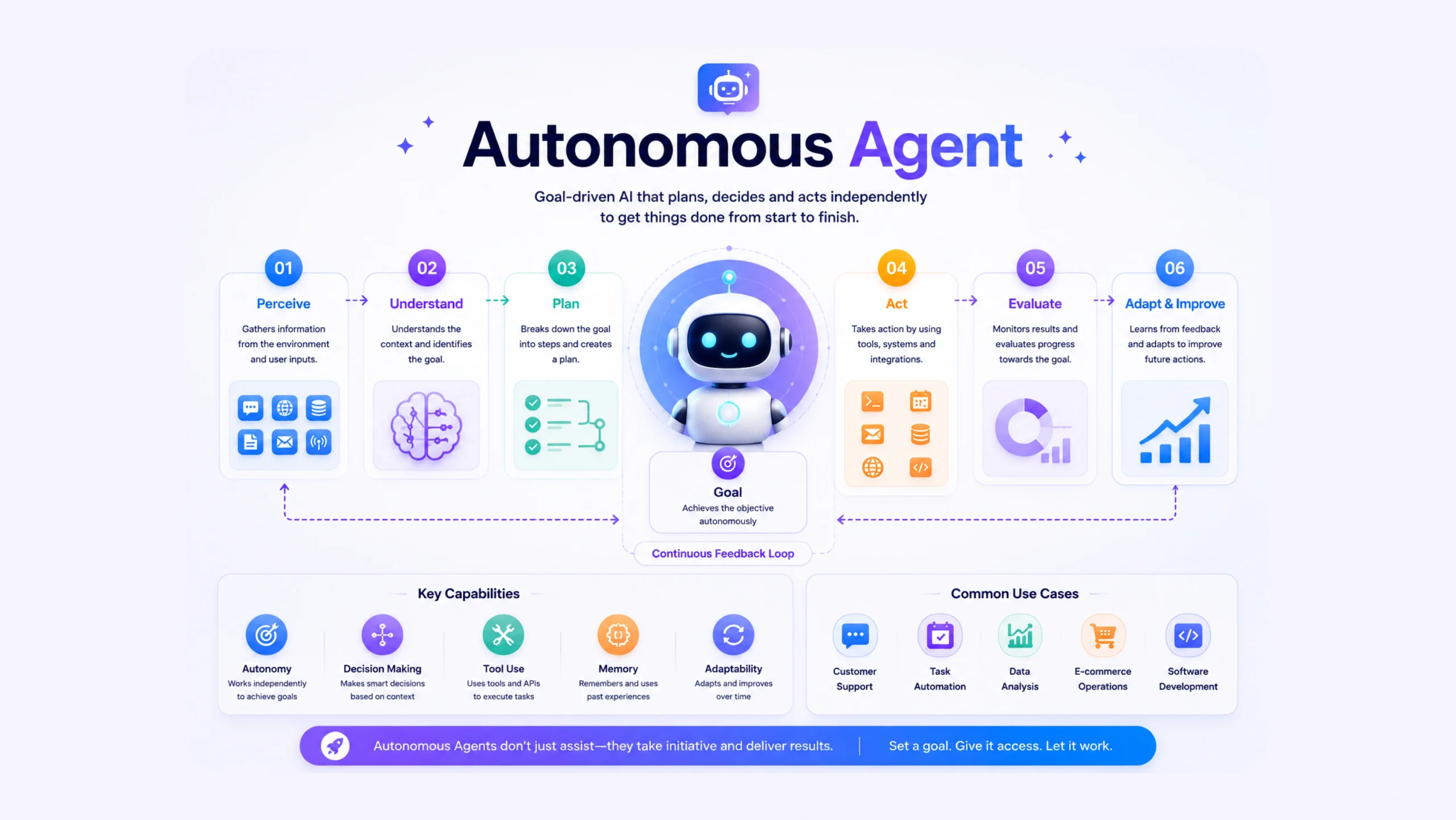
What Is an Autonomous Agent?
An Autonomous Agent is an intelligent software system that can make decisions, take actions, and pursue goals independently with minimal human involvement.
Unlike traditional software that follows predefined instructions step by step, an autonomous agent can assess situations, determine what needs to happen next, and execute actions without requiring constant supervision.
Think about hiring an employee and giving them a goal rather than a detailed checklist. Instead of asking for instructions every few minutes, they figure out the process and work toward the objective.
That’s essentially what autonomous agents aim to do.
Why Are Autonomous Agents Becoming Important?
For many years, software operated like a vending machine.
You pressed a button and received a specific result.
Modern AI systems are becoming something different.
Organizations now want systems that can:
- Handle repetitive workflows
- Conduct research
- Monitor business processes
- Coordinate software tools
- Make routine decisions
- Complete multi-step tasks
Instead of automating a single action, autonomous agents automate entire processes.
That difference is what makes them so interesting.
Understanding the Word “Autonomous”
The key term here is autonomy.
Autonomy means the ability to operate independently.
A GPS app provides directions but waits for you to drive.
A self-driving vehicle interprets road conditions, adjusts its route, and makes driving decisions.
Both use technology.
One is autonomous.
The other is not.
The same principle applies to software agents.
An autonomous agent doesn’t simply provide suggestions. It actively works toward completing objectives.
How Does an Autonomous Agent Work?
Most autonomous agents follow a continuous cycle.
Observe
The agent gathers information from its environment.
This may include:
- User requests
- Documents
- Databases
- APIs
- Websites
- Software platforms
- Sensor data
The more context available, the better the agent can perform.
Analyze
The system evaluates the information and determines what actions are required.
This stage may involve:
- Reasoning
- Planning
- Prioritization
- Decision-making
Modern agents often rely on advanced language models during this process.
Plan
Instead of immediately acting, autonomous agents frequently create plans.
For example:
Goal: Launch a marketing campaign.
The agent may decide to:
- Research competitors
- Analyze audience segments
- Generate campaign concepts
- Draft content
- Schedule publication
- Track results
The objective is broken into manageable steps.
Act
The agent executes actions through connected tools and systems.
Actions might include:
- Sending emails
- Updating databases
- Generating reports
- Scheduling meetings
- Creating content
- Triggering workflows
Evaluate
After acting, the system reviews outcomes.
If something fails, the agent may revise its plan and try another approach.
This feedback loop helps the agent continue progressing toward its goal.
The Core Components of an Autonomous Agent
Several elements work together behind the scenes.
Goal Definition
Every autonomous agent starts with a goal.
Without a goal, there is no direction.
Examples include:
- Resolve support tickets
- Schedule appointments
- Analyze customer feedback
- Produce monthly reports
The goal influences every decision.
Memory
Memory helps agents retain context.
For example, an agent may remember:
- Previous conversations
- User preferences
- Completed actions
- Historical data
This allows more consistent performance.
Planning Engine
Planning systems help determine which actions should happen and in what order.
Complex objectives often require dozens of smaller tasks.
The planning engine coordinates those tasks.
Decision-Making System
Autonomous agents constantly evaluate options.
The system selects actions based on available information and expected outcomes.
This decision-making capability separates autonomous agents from simple automation scripts.
Tool Integration
Most autonomous agents interact with external systems.
Examples include:
- Email platforms
- Calendars
- CRM software
- Project management tools
- Databases
- Cloud services
These connections allow agents to produce real-world results.
Autonomous Agent vs AI Agent
The terms often overlap.
Still, there is a subtle distinction.
AI Agent
An AI agent can reason, respond, and perform actions.
Many require regular user guidance.
The user often remains involved throughout the process.
Autonomous Agent
An autonomous agent takes independence further.
After receiving a goal, it can:
- Create plans
- Make decisions
- Execute tasks
- Adapt to changing conditions
With less ongoing human input.
You can think of autonomous agents as a more advanced category within the broader AI agent family.
Different Types of Autonomous Agents
Autonomous agents come in several forms.
Task Automation Agents
These agents focus on operational work.
Examples include:
- Scheduling meetings
- Processing invoices
- Managing workflows
They reduce repetitive administrative tasks.
Research Agents
Research agents gather information, summarize findings, compare sources, and organize insights.
Many businesses use them to accelerate information gathering.
Customer Service Agents
Support agents can handle inquiries, resolve common issues, and escalate complex situations when needed.
This allows human teams to focus on higher-value interactions.
Development Agents
Software engineering agents assist with:
- Writing code
- Testing applications
- Detecting bugs
- Creating documentation
Development teams increasingly use these systems as productivity partners.
Multi-Agent Systems
Some environments use several autonomous agents working together.
One agent may research.
Another may write.
A third may verify results.
The collaboration creates more capable systems.
Real-World Examples of Autonomous Agents
Autonomous agents are already appearing across industries.
Business Operations
Organizations use agents to monitor processes, track performance, and generate reports automatically.
Marketing
Marketing teams use autonomous agents to:
- Analyze audience behavior
- Create campaign drafts
- Schedule content
- Monitor performance metrics
Tasks that once consumed entire afternoons can often be completed much faster.
Healthcare
Healthcare organizations are exploring agents for:
- Appointment scheduling
- Administrative assistance
- Documentation support
Human oversight remains critical, particularly for medical decisions.
Finance
Financial institutions use agents for:
- Fraud monitoring
- Risk analysis
- Data processing
- Reporting
These environments often require strict controls and compliance measures.
Personal Productivity
Individuals use autonomous agents to:
- Manage calendars
- Organize travel plans
- Research topics
- Handle emails
- Track tasks
The goal is simple: spend less time on routine work.
Why Businesses Are Investing in Autonomous Agents
Several factors drive adoption.
Greater Efficiency
Autonomous agents can complete repetitive workflows without continuous supervision.
Teams gain more time for creative and strategic work.
Faster Execution
Many tasks that previously required multiple employees can now be coordinated automatically.
This reduces delays and bottlenecks.
Continuous Operation
Autonomous systems don’t stop working at the end of a business day.
They can monitor processes and perform actions around the clock.
Improved Scalability
Organizations can handle growing workloads without expanding operational teams at the same pace.
This is particularly attractive for rapidly growing businesses.
Challenges and Risks
The technology is powerful, but it isn’t perfect.
Incorrect Decisions
An agent may misunderstand information or choose an ineffective course of action.
Human review remains valuable for critical tasks.
Security Concerns
Agents often access sensitive systems and business data.
Poor security practices can introduce significant risks.
Reliability Problems
External systems sometimes fail.
When connected tools experience outages, the agent’s workflow may be interrupted.
Ethical Questions
Organizations continue discussing issues related to:
- Accountability
- Transparency
- Privacy
- Bias
These conversations will likely become even more important as autonomous systems become more capable.
Autonomous Agents and the Future of Work
Many people wonder if autonomous agents will replace workers.
The reality is often more nuanced.
Most organizations are exploring collaboration rather than replacement.
Humans remain strong in areas such as:
- Creativity
- Empathy
- Leadership
- Strategic thinking
- Ethical judgment
Autonomous agents excel at:
- Repetitive tasks
- Data analysis
- Process execution
- Information gathering
The combination of both often produces the strongest results.
What’s Next for Autonomous Agents?
Technology companies are rapidly improving reasoning, planning, memory, and tool integration capabilities.
Future autonomous agents may:
- Handle increasingly complex projects
- Work across multiple business systems
- Collaborate with other agents
- Maintain long-term memory
- Adapt more effectively to changing environments
Many experts believe autonomous agents will become a standard part of everyday software over the coming years.
We’re still in the early chapters of that story.
Final Thoughts
Autonomous agents represent a major step forward in artificial intelligence. Rather than simply responding to commands, these systems can independently pursue goals, make decisions, coordinate tools, and complete multi-step tasks. Their ability to operate with limited supervision makes them valuable across industries ranging from customer support and software development to marketing and business operations.
As the technology matures, autonomous agents are likely to become common digital coworkers, helping people manage routine work while freeing up time for creativity, problem-solving, and strategic thinking.
Frequently Asked Questions (FAQs)
1. What is an autonomous agent?
An autonomous agent is an intelligent system that independently plans, makes decisions, and performs actions to achieve specific goals with minimal human supervision.
2. How is an autonomous agent different from an AI agent?
An autonomous agent has a higher degree of independence and can complete multi-step tasks with less ongoing human guidance.
3. What are examples of autonomous agents?
Examples include research agents, coding agents, scheduling agents, customer support agents, and workflow automation systems.
4. Do autonomous agents use Large Language Models?
Many modern autonomous agents use Large Language Models (LLMs) for reasoning, planning, communication, and decision-making.
5. Can autonomous agents learn from experience?
Some autonomous agents can adapt based on previous outcomes, feedback, and historical data to improve future performance.
6. What industries use autonomous agents?
Autonomous agents are used in software development, healthcare, finance, marketing, customer support, operations, and productivity applications.