


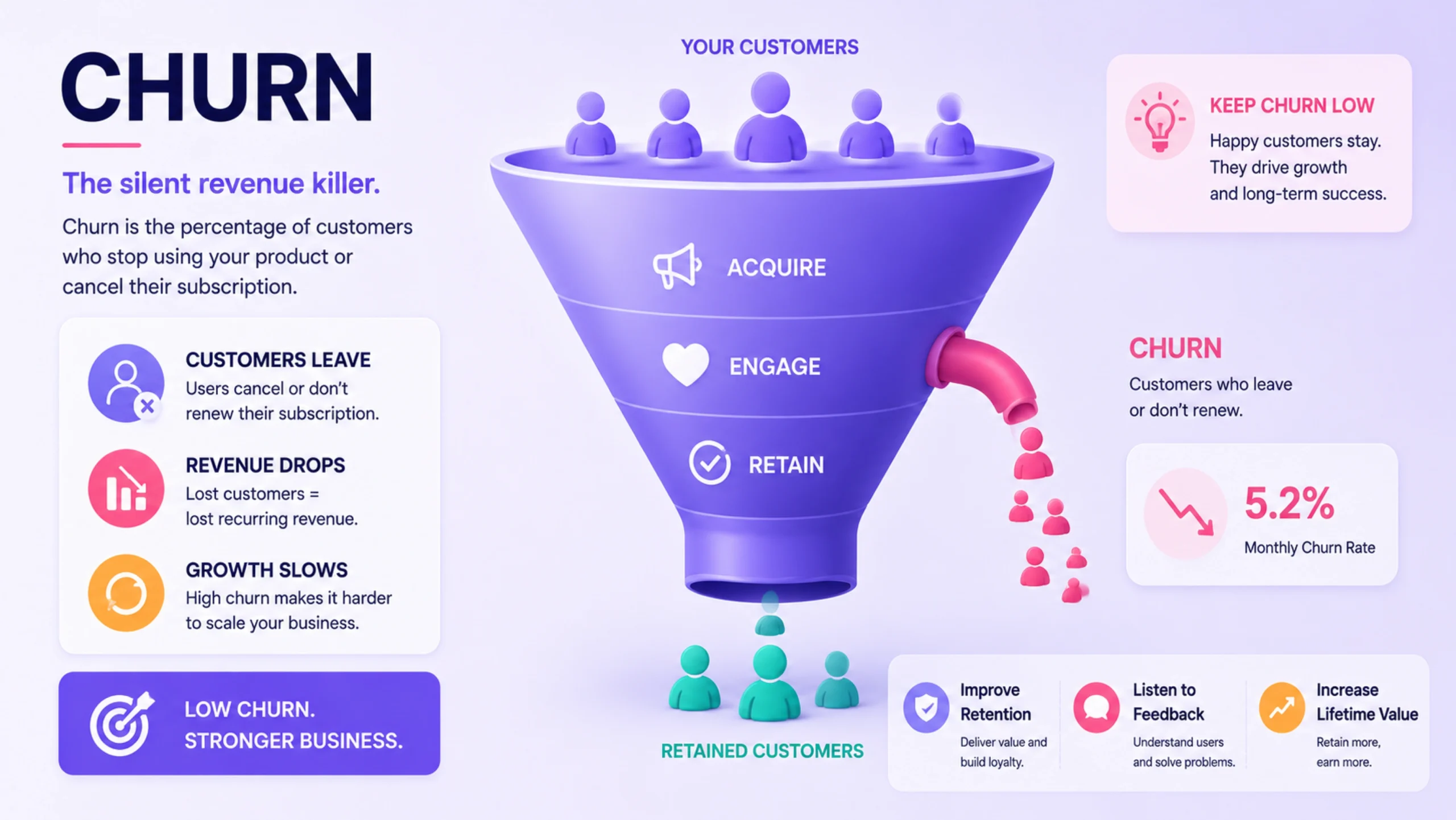
What Is Churn?
Churn refers to the rate at which customers stop doing business with a company. In subscription-based businesses, it usually means customers cancel their plans, stop renewing contracts, or leave for a competitor.
Think of a bucket filled with water. New customers pour in from the top, while churn creates holes at the bottom. No matter how much new business arrives, growth becomes difficult if too many customers keep leaving.
That’s why churn is one of the most watched metrics in SaaS, membership platforms, streaming services, telecom companies, and subscription-based businesses.
Why Churn Matters
Getting a new customer often requires marketing spend, sales efforts, and onboarding resources.
When a customer leaves, that investment can disappear along with future revenue.
A high churn rate can signal deeper problems, such as:
- Poor customer experience
- Weak product value
- Pricing concerns
- Strong competition
- Lack of customer support
A low churn rate usually suggests customers are satisfied and continue receiving value from the product.
How Churn Works
Let’s say a software company starts the month with 1,000 customers.
During the month:
- 50 customers cancel their subscriptions.
The company loses 50 out of 1,000 customers.
Its churn rate becomes 5%.
Even if the business gains new customers, tracking churn remains important because customer departures directly affect revenue and long-term growth.
Types of Churn
Churn isn’t always measured the same way.
Different businesses track different forms of customer loss.
Customer Churn
Customer churn measures the percentage of customers who leave during a specific period.
Example:
- Starting customers: 1,000
- Lost customers: 50
Customer churn = 5%
Revenue Churn
Revenue churn measures recurring revenue lost from cancellations or downgrades.
This is particularly important for SaaS companies with multiple pricing plans.
Losing one large enterprise account may have a bigger financial impact than losing several smaller customers.
Voluntary Churn
Customers actively decide to cancel.
Reasons may include pricing, poor experience, or finding a better alternative.
Involuntary Churn
Customers leave unintentionally due to failed payments, expired cards, or billing issues.
Churn Formula
The standard customer churn formula looks like this:
Churn Rate = (Customers Lost During Period ÷ Total Customers at Start of Period) × 100
Example:
- Starting customers = 500
- Lost customers = 25
Churn Rate = (25 ÷ 500) × 100
Churn Rate = 5%
This percentage helps businesses compare performance across different months, quarters, or years.
Why SaaS Companies Focus on Churn
Subscription businesses live on recurring revenue.
A customer who stays for years may generate significantly more value than someone who leaves after a few weeks.
That’s why churn often receives as much attention as customer acquisition.
Investors frequently examine churn rates before evaluating growth potential.
A company adding thousands of customers each month may still struggle if large numbers continue leaving.
Common Causes of Churn
Customers rarely leave without a reason.
Several factors contribute to churn.
Poor Product Experience
If a product fails to solve customer problems, cancellations become more likely.
Lack of Customer Support
Slow responses and unresolved issues can frustrate users.
Pricing Concerns
Customers may feel a product costs more than the value it provides.
Strong Competition
Competitors constantly introduce new features, pricing models, and innovations.
Weak Onboarding
Customers who never fully understand a product often abandon it early.
Missing Features
Sometimes customers simply outgrow a product and need capabilities it doesn’t offer.
Churn vs Retention
Churn and retention are closely related.
Churn measures customers who leave.
Retention measures customers who stay.
For example:
- Churn Rate = 10%
- Retention Rate = 90%
Most successful subscription businesses focus heavily on improving retention since retaining customers often costs less than acquiring new ones.
How Businesses Reduce Churn
Reducing churn requires understanding why customers leave in the first place.
Improve Onboarding
Helping users reach value quickly can increase long-term retention.
Deliver Better Support
Responsive customer service builds trust and loyalty.
Gather Customer Feedback
Exit surveys, interviews, and support conversations often reveal hidden problems.
Improve Product Quality
Continuous product improvements help customers remain engaged.
Build Strong Relationships
Regular communication keeps customers connected to the brand.
Monitor User Activity
Behavior analytics can help identify at-risk customers before they cancel.
Common Churn Mistakes
Many businesses make mistakes when evaluating churn.
Looking Only at New Customers
Acquiring customers matters, but retention matters just as much.
Ignoring Revenue Churn
Customer churn and revenue churn tell different stories.
A business may lose few customers while losing significant revenue.
Measuring Too Infrequently
Churn trends can change quickly.
Regular monitoring provides better insights.
Focusing Only on Cancellations
Understanding the reasons behind cancellations is often more valuable than simply tracking the number.
Why Churn Impacts Growth
Here’s the thing—growth isn’t only about gaining customers.
It’s about keeping them too.
A company acquiring 100 new customers every month but losing 90 isn’t growing very quickly.
Meanwhile, a company acquiring 100 and losing only 10 builds a much stronger foundation.
This is why many SaaS leaders treat churn reduction as one of their highest priorities.
Final Thoughts
Churn measures the percentage of customers or revenue a business loses during a specific period. It serves as one of the clearest indicators of customer satisfaction, product value, and long-term business health.
For subscription-based businesses, reducing churn often has a direct impact on revenue growth, profitability, and customer lifetime value. By understanding why customers leave and addressing those issues, companies can build stronger relationships and create more sustainable growth.
Frequently Asked Questions (FAQs)
1. What is churn in business?
Churn is the percentage of customers who stop using a product, cancel subscriptions, or discontinue services during a specific period.
2. Why is churn important?
Churn helps businesses measure customer retention, predict revenue trends, and identify potential product or service issues.
3. How do you calculate churn rate?
Churn rate is calculated by dividing lost customers by the total number of customers at the start of a period and multiplying by 100.
4. What is a good churn rate?
A good churn rate varies by industry, though lower churn generally indicates stronger customer retention and satisfaction.
5. What causes customer churn?
Common causes include poor user experience, pricing concerns, weak customer support, missing features, and competitive alternatives.
6. What is the difference between churn and retention?
Churn measures customers who leave, while retention measures customers who continue using a product or service.