


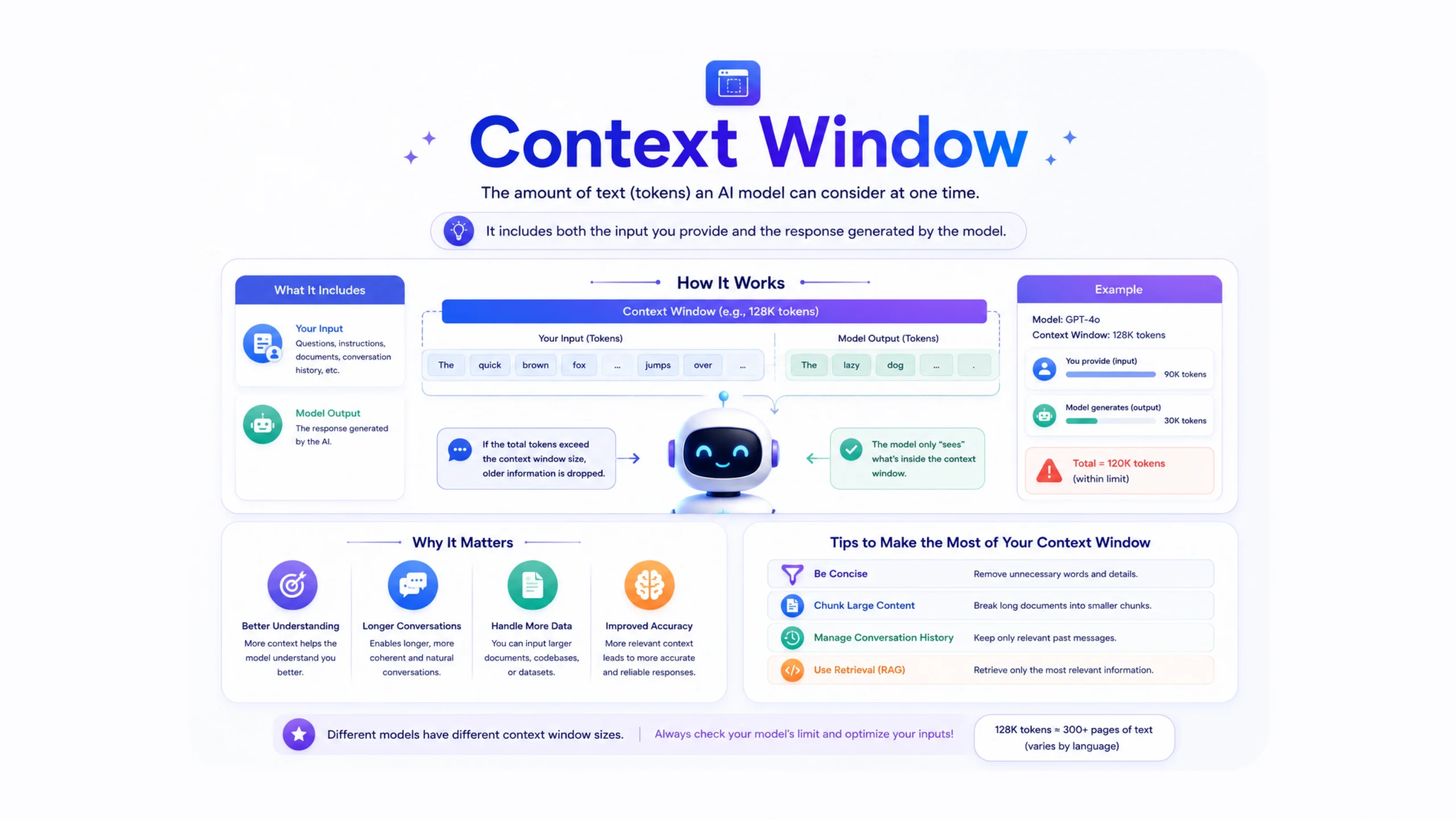
What Is a Context Window?
A context window is the amount of text, instructions, conversation history, and other information an AI model can consider at a single moment while generating a response.
Think of it as the AI’s working memory.
When you chat with an AI assistant, upload documents, paste code, or ask follow-up questions, all of that information occupies space inside the context window. The AI uses that information to understand what you’re asking and generate relevant answers.
Once the context window reaches its limit, older information may be removed or compressed, making it harder for the model to reference earlier details accurately.
In simple terms, the context window determines how much information the AI can “see” at one time.
Think of It Like a Desk
Imagine you’re working on a large project.
Your desk can only hold a certain number of papers.
If the desk is small, you’ll eventually need to remove older documents to make room for new ones.
If the desk is large, you can keep more notes, reports, sketches, and references in front of you.
A context window works in a similar way.
The larger the context window, the more information the AI can access simultaneously.
Why Context Windows Matter
Context windows play a major role in AI performance.
A larger context window allows an AI system to:
- Understand longer conversations
- Analyze lengthy documents
- Follow detailed instructions
- Maintain consistency across interactions
- Work with large codebases
- Summarize extensive reports
Without enough context, an AI may lose track of important details, repeat information, or provide answers that feel disconnected from earlier discussions.
That’s why context window size has become a major selling point for modern AI platforms.
How Does a Context Window Work?
When you send a prompt, the AI processes:
- Your current message
- Previous messages
- System instructions
- Uploaded content
- Relevant contextual information
All of this content is combined into a temporary working space.
The model uses that information to predict and generate the next response.
As new content enters the conversation, older content may eventually fall outside the available context window.
When that happens, the AI can no longer directly reference that information.
Let’s Talk About Tokens
Context windows are usually measured in tokens.
A token is a small unit of text.
Depending on the language and content, a token might be:
- Part of a word
- A complete word
- A punctuation mark
- A number
For example, the sentence:
“Artificial intelligence is changing software.”
contains multiple tokens rather than a single block of text.
AI companies often describe context window sizes using token counts.
Examples include:
- 8,000 tokens
- 32,000 tokens
- 128,000 tokens
- 1 million tokens or more
A larger token limit allows more information to remain available during processing.
Small Context Window vs Large Context Window
The difference can be dramatic.
Small Context Window
With a smaller context window:
- Long conversations may lose earlier details
- Document analysis becomes limited
- Complex instructions may be forgotten
- Multi-step tasks become harder
Imagine reading only the last two pages of a novel and trying to explain the entire story.
That’s essentially the challenge.
Large Context Window
With a larger context window:
- Long documents remain accessible
- Extended conversations stay coherent
- Code reviews become easier
- Research analysis improves
- Multi-document workflows become practical
It’s like having the entire book open instead of only a few pages.
Real-World Examples
Context windows affect many everyday AI use cases.
Document Analysis
A lawyer uploads a 200-page contract.
A larger context window allows the AI to examine the full document instead of small sections.
Software Development
Developers often work with thousands of lines of code.
Large context windows help AI assistants understand broader project structures.
Research
Researchers frequently combine:
- Reports
- Academic papers
- Datasets
- Notes
The more information the model can process simultaneously, the better it can identify relationships and insights.
Customer Support
AI assistants serving customers benefit from access to longer conversation histories.
This helps avoid repetitive questions and improves continuity.
Bigger Isn’t Always Better
Here’s something interesting.
A larger context window is valuable, but it doesn’t automatically make an AI smarter.
Many people assume bigger equals better.
That’s only partially true.
A model still needs strong reasoning abilities, accurate retrieval methods, and high-quality training.
A huge context window paired with weak reasoning may still produce poor answers.
Think of it like having a giant library.
The books are available, but finding the right information still matters.
Common Challenges
Even large context windows come with limitations.
Information Overload
Too much information can make it harder to identify what’s truly important.
Increased Processing Costs
Larger context windows often require more computing resources.
Slower Performance
Handling more data can increase response times.
Context Dilution
Important details may become less influential when buried among massive amounts of text.
This challenge is often called the “needle in a haystack” problem.
The information exists within the context, yet locating it becomes harder.
Context Window vs Memory
People often confuse these concepts.
They are related but different.
Context Window
Temporary information available during a conversation.
Memory
Information retained across separate conversations or sessions.
A context window exists during active processing.
Memory persists beyond a single interaction.
You can think of context as a whiteboard and memory as a filing cabinet.
The whiteboard gets erased.
The filing cabinet stores information for later use.
Why Context Windows Matter for AI Agents
AI agents often perform multi-step tasks.
For example, an agent may:
- Read documentation
- Analyze requirements
- Create a plan
- Generate code
- Review results
- Make revisions
Each step creates additional information.
A larger context window helps the agent maintain awareness across the entire workflow.
This leads to better consistency and fewer mistakes.
The Race for Bigger Context Windows
Many AI companies are actively increasing context window sizes.
Recent systems can process hundreds of thousands or even millions of tokens.
This trend reflects growing demand for:
- Enterprise document analysis
- Software engineering assistance
- Legal research
- Financial analysis
- Academic research
- Autonomous AI agents
As context windows expand, AI systems become capable of handling larger and more sophisticated tasks.
Final Thoughts
A context window is the amount of information an AI model can process and reference at a single time. It acts like a temporary workspace that helps the model understand conversations, documents, instructions, and tasks.
Larger context windows make it easier for AI systems to handle long conversations, extensive documents, and complex workflows. Even so, context size alone doesn’t determine intelligence. Strong reasoning, quality data, and effective retrieval methods remain equally important.
As AI technology continues to evolve, context windows are becoming larger and more capable, allowing AI systems to work with increasingly complex information while maintaining greater consistency and accuracy.
Frequently Asked Questions (FAQs)
1. What is a context window in AI?
A context window is the amount of information an AI model can process and reference at one time while generating a response.
2. Why is a context window important?
It helps AI maintain conversation continuity, understand documents, and follow detailed instructions.
3. What are tokens in a context window?
Tokens are small units of text used to measure how much information an AI model can process.
4. Does a larger context window make AI smarter?
No. A larger context window provides access to more information, but reasoning quality still depends on the model itself.
5. What happens when the context window is full?
Older information may be removed, compressed, or become inaccessible to make room for new content.
6. What is the difference between a context window and memory?
A context window stores temporary information during a conversation, while memory refers to information retained across interactions.