


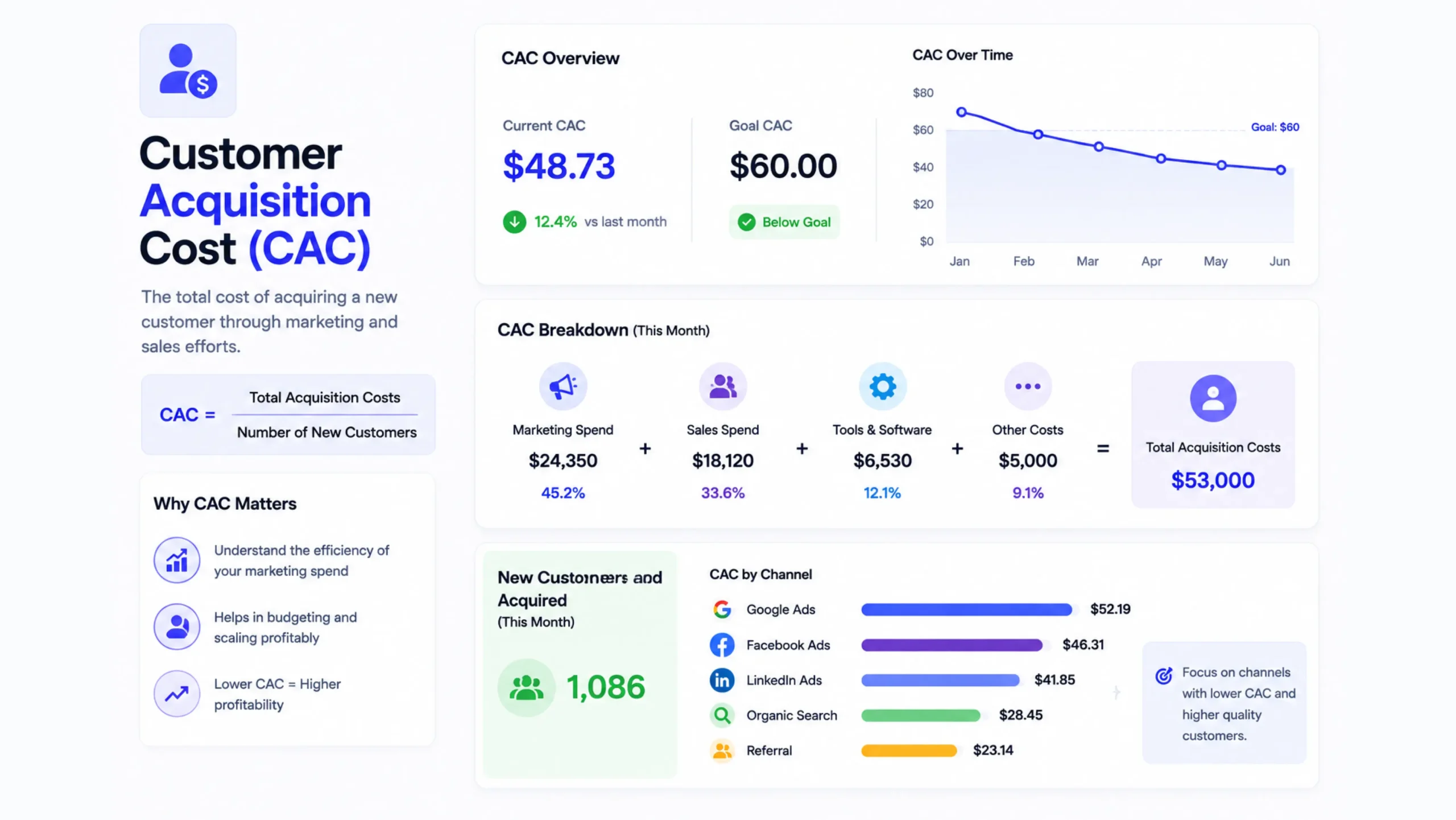
What Is Customer Acquisition Cost (CAC)?
Customer Acquisition Cost, often shortened to CAC, measures how much money a company spends to gain one paying customer.
Think of it like this: if you’re running a coffee shop and spend money on social media ads, flyers, local promotions, and sales efforts, CAC tells you how much those activities cost for each new customer who walks through your door and makes a purchase.
For online businesses, CAC is one of the most watched growth metrics. Startups, SaaS companies, eCommerce stores, agencies, and subscription businesses use it constantly to understand if their marketing efforts are actually profitable.
A business can attract thousands of visitors. That’s great. Yet traffic alone doesn’t pay the bills. Customers do.
That’s where CAC enters the picture.
Why CAC Matters
Many companies focus heavily on growth. More visitors. More leads. More sign-ups.
Growth sounds exciting, but growth can become expensive very quickly.
A company spending $100,000 to gain customers worth only $50,000 is moving in the wrong direction, no matter how impressive its traffic numbers look.
CAC helps businesses answer important questions:
- Are marketing campaigns profitable?
- Is advertising spending under control?
- Which acquisition channels work best?
- Can the business grow sustainably?
- Is the sales team operating efficiently?
Without CAC, companies often make decisions based on assumptions rather than data.
How CAC Works
Every customer acquisition effort costs money.
A business may invest in:
- Google Ads
- Social media advertising
- SEO content
- Email marketing
- Sales representatives
- Affiliate programs
- Marketing software
- Creative production
All these expenses contribute to customer acquisition.
CAC simply divides total acquisition costs by the number of customers gained during a specific period.
The result shows how much each customer costs to acquire.
The CAC Formula
The standard formula is:
For example:
- Marketing spend = $8,000
- Sales costs = $2,000
- New customers acquired = 100
CAC = $10,000 ÷ 100
CAC = $100
This means the company spends $100 to acquire each customer.
Simple on paper. Powerful in practice.
A Simple Example
Imagine an online course creator launches a campaign.
During one month:
- Facebook Ads: $3,000
- Content creation: $1,000
- Email software: $500
- Sales support: $500
Total acquisition cost = $5,000
The campaign generates 50 paying customers.
CAC = $5,000 ÷ 50
CAC = $100
Each customer costs $100 to acquire.
If the average customer spends $500, the acquisition effort looks healthy.
If customers spend only $80, the business loses money.
That’s why CAC rarely stands alone. It needs context.
What Costs Are Included in CAC?
Companies calculate CAC differently, but most include expenses directly tied to acquiring customers.
Common costs include:
- Advertising spend
- Marketing salaries
- Sales salaries
- Agency fees
- Software subscriptions
- Content creation costs
- SEO expenses
- Event sponsorships
- Affiliate commissions
- Marketing tools and platforms
Some businesses include every acquisition-related expense. Others use a narrower approach.
Consistency matters more than perfection.
Different Types of CAC
Not every customer costs the same amount to acquire.
Businesses often track multiple versions of CAC.
Paid CAC
Measures customers acquired through paid campaigns such as Google Ads or Meta Ads.
Organic CAC
Measures acquisition costs through channels like SEO, referrals, and content marketing.
Blended CAC
Combines all acquisition channels into one overall metric.
Channel-Specific CAC
Calculates acquisition costs for individual channels.
For example:
- SEO CAC
- LinkedIn CAC
- Email CAC
- Paid Search CAC
This helps marketers identify where their budget works hardest.
CAC and Customer Lifetime Value: The Relationship That Matters
Here’s the thing.
CAC alone doesn’t reveal profitability.
A company could spend $500 acquiring a customer and still perform extremely well.
Why?
Because that customer might spend thousands of dollars over time.
That’s where Customer Lifetime Value (LTV) comes into play.
LTV estimates the total revenue a customer generates throughout their relationship with a business.
Many companies aim for an LTV-to-CAC ratio of 3:1 or higher.
Example:
- CAC = $100
- Customer Lifetime Value = $300
Ratio = 3:1
This suggests healthy customer economics.
What Is a Good CAC?
There isn’t a universal answer.
A good CAC depends on:
- Industry
- Product pricing
- Profit margins
- Customer retention
- Business model
A software company selling annual subscriptions may comfortably spend hundreds of dollars acquiring a customer.
A low-cost eCommerce store often needs a much lower CAC.
What matters is profitability, not the CAC number alone.
Factors That Influence CAC
Several variables affect acquisition costs.
Competition
Competitive industries often have higher advertising costs.
Brand Awareness
Recognized brands generally acquire customers more cheaply.
Product Pricing
Premium products can often support higher CAC levels.
Conversion Rates
Better conversion rates reduce acquisition costs.
Sales Cycle Length
Longer sales cycles usually increase CAC.
Marketing Efficiency
Stronger campaigns generate more customers from the same budget.
How to Reduce Customer Acquisition Cost
Reducing CAC doesn’t always mean spending less.
Sometimes it means converting more visitors from existing traffic.
A few practical methods include:
Improve Landing Pages
Better messaging and stronger calls-to-action often improve conversion rates.
Strengthen SEO
Organic traffic can lower dependence on paid advertising.
Refine Audience Targeting
Showing ads to the right people reduces wasted spending.
Improve User Experience
A smoother website experience often increases conversions.
Use Marketing Automation
Automation reduces manual effort and improves efficiency.
Encourage Referrals
Happy customers can become a powerful acquisition channel.
Small improvements often create surprisingly large results over time.
Common CAC Mistakes
Many businesses calculate CAC incorrectly.
Some common mistakes include:
Ignoring Hidden Costs
Software, salaries, and creative production often get overlooked.
Looking at CAC Alone
CAC without revenue or LTV provides an incomplete picture.
Measuring Too Early
Some campaigns take time before generating customers.
Combining Unrelated Channels
Mixing all channels together can hide poor-performing campaigns.
Chasing Cheap Customers
The cheapest customers aren’t always the most valuable.
A customer who stays for years may justify a higher acquisition cost.
CAC in SaaS and Digital Businesses
CAC is especially important for SaaS companies.
Subscription businesses often spend heavily upfront and recover those costs over months or years.
Investors closely monitor:
- CAC
- Customer Lifetime Value
- Payback Period
- Retention Rate
- Revenue Growth
A company with strong acquisition economics often attracts more investment and grows more predictably.
That’s one reason CAC appears in nearly every SaaS dashboard.
Tools Used to Measure CAC
Businesses use several tools to track acquisition costs.
Popular options include:
- Google Analytics
- HubSpot
- Salesforce
- Mixpanel
- Hotjar
- Amplitude
- Adobe Analytics
- Tableau
- Looker Studio
These platforms help connect marketing spending with customer acquisition results.
Final Thoughts
Customer Acquisition Cost (CAC) is one of the most important business metrics for measuring growth efficiency. It reveals how much a company spends to gain each new customer and helps determine if marketing and sales efforts are producing profitable results.
Companies that closely monitor CAC can make smarter decisions, allocate budgets effectively, and grow with greater confidence. Paired with metrics like Customer Lifetime Value, CAC becomes a powerful indicator of long-term business health.
Traffic is helpful. Leads are helpful. Customers matter most. CAC tells you what it costs to earn them.
Frequently Asked Questions (FAQs)
1. What does Customer Acquisition Cost (CAC) mean?
Customer Acquisition Cost measures the average amount a business spends to acquire a new customer through marketing and sales activities.
2. How do you calculate CAC?
CAC is calculated by dividing total sales and marketing costs by the number of new customers acquired during a specific period.
3. Why is CAC important?
CAC helps businesses understand marketing efficiency, profitability, and growth sustainability.
4. What is a good CAC?
A good CAC varies by industry, pricing model, and customer value. Many businesses compare CAC with Customer Lifetime Value to evaluate performance.
5. What is the difference between CAC and LTV?
CAC measures acquisition cost, while LTV estimates the total revenue a customer generates over time.
6. How can businesses lower CAC?
Businesses can lower CAC by improving conversion rates, strengthening SEO efforts, refining audience targeting, improving user experience, and increasing customer referrals.