


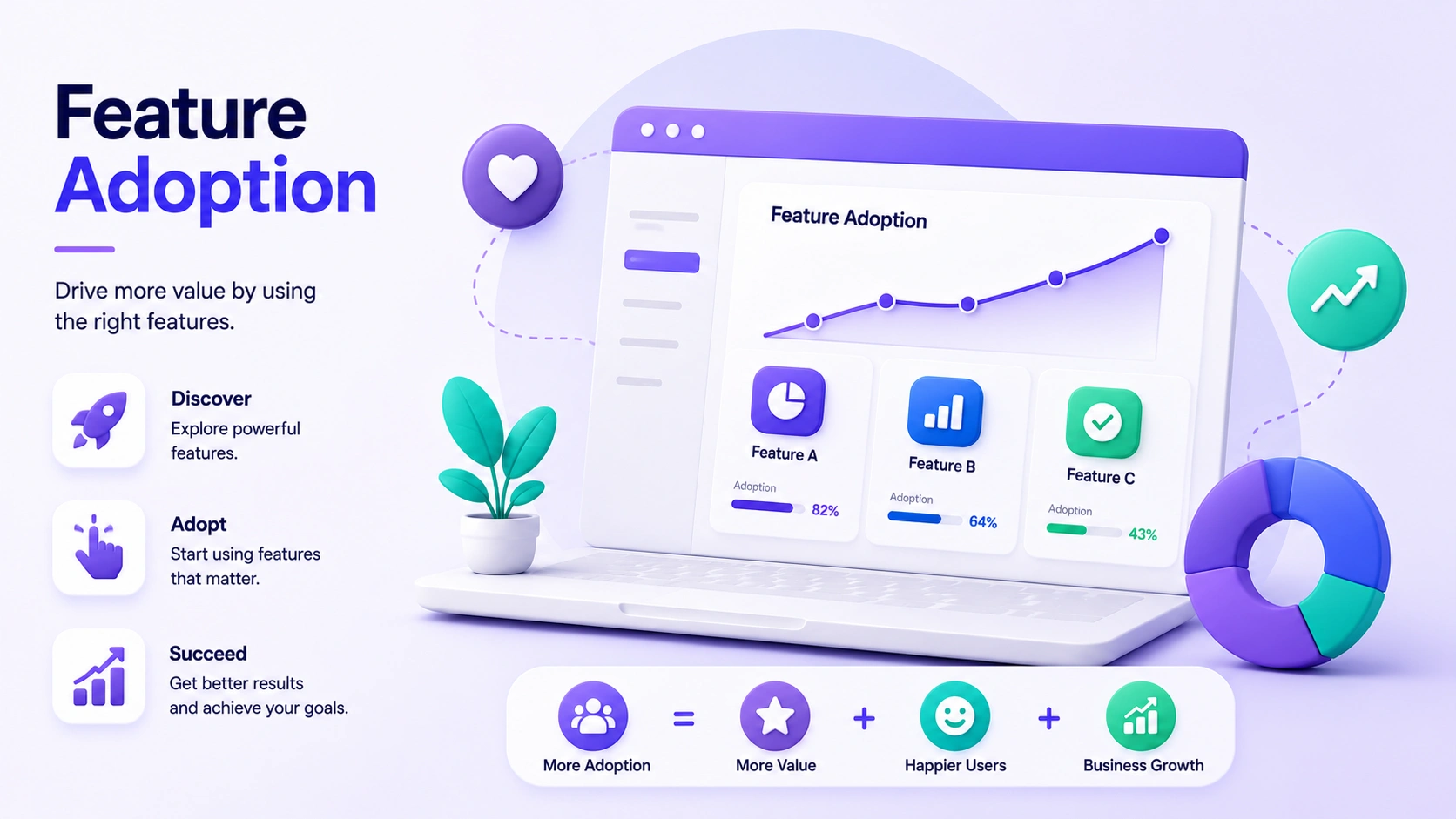
What Is Feature Adoption?
Feature Adoption refers to the rate and extent to which users discover, try, and continue using a specific feature within a product.
Think about downloading a new smartphone app. You might create an account and explore the dashboard. Yet many features remain untouched. A feature is considered adopted when users actively use it because it helps them achieve a goal.
In simple terms, feature adoption measures whether people find a feature useful enough to include it in their regular workflow.
For product teams, it’s one of the clearest signals that a feature is creating value.
Why Feature Adoption Matters
Building features takes time, money, and effort.
Yet launching a feature doesn’t automatically mean people will use it.
That’s where feature adoption becomes important.
A new feature may look impressive during development. If customers ignore it after release, it contributes little to business growth.
Strong feature adoption can lead to:
- Better customer satisfaction
- Increased product engagement
- Higher retention rates
- Stronger customer loyalty
- Improved subscription renewals
- Greater return on product investments
The goal isn’t simply creating features. The goal is helping users benefit from them.
How Feature Adoption Works
Feature adoption typically follows a sequence.
Awareness
Users first learn that a feature exists.
Exploration
They become curious and decide to try it.
First Use
Users interact with the feature for the first time.
Repeated Usage
The feature becomes part of their routine.
Long-Term Adoption
Users consistently rely on the feature because it solves a real problem.
This process may happen quickly or take weeks, depending on the complexity of the feature.
Feature Adoption vs Product Adoption
These terms sound similar, though they measure different things.
Product Adoption
Product adoption focuses on whether users embrace the product as a whole.
Feature Adoption
Feature adoption focuses on specific capabilities inside the product.
For example:
A company may successfully adopt a project management platform.
Yet only a portion of users may adopt advanced reporting features.
Both metrics matter because they reveal different user behaviors.
Real-World Examples of Feature Adoption
Let’s make this easier to visualize.
Collaboration Tools
A team messaging platform introduces video conferencing.
Feature adoption occurs when users regularly start and join video meetings.
CRM Software
A CRM launches automated workflows.
Adoption happens when sales teams actively build and use automation rules.
Design Platforms
A design tool releases AI-assisted editing.
The feature is adopted when designers consistently incorporate it into their projects.
Analytics Software
A new reporting dashboard becomes adopted when users repeatedly rely on it for decision-making.
The common thread is repeated usage, not simple exposure.
Why Some Features Fail to Gain Adoption
Not every feature succeeds.
Sometimes teams spend months building capabilities that receive very little attention.
Several factors can contribute to poor adoption.
Lack of Awareness
Users may not know the feature exists.
Poor Onboarding
People aren’t shown how or when to use the feature.
Limited Value
The feature doesn’t solve an important problem.
High Learning Curve
Users find the feature confusing or difficult.
Workflow Disruption
The feature doesn’t fit naturally into existing habits.
Interestingly, many adoption problems stem from communication rather than functionality.
Improving Feature Adoption
Here’s the thing.
People rarely use a feature simply because it exists.
They use it because they understand its value.
Companies often improve adoption by focusing on user education and guidance.
Introduce Features Contextually
Show features when they’re most relevant.
Create Interactive Walkthroughs
Guided experiences reduce confusion.
Highlight Benefits
Explain outcomes rather than technical details.
Use Tooltips and In-App Messages
Small prompts can encourage discovery.
Share Success Stories
Real examples help users understand practical applications.
Reduce Complexity
Simple experiences typically gain adoption faster.
Sometimes a minor adjustment in presentation can dramatically improve usage.
How Feature Adoption Is Measured
Product teams track several metrics to understand adoption performance.
Adoption Rate
The percentage of users actively using a feature.
Frequency of Use
How often users engage with the feature.
Time to Adoption
The time between signup and first feature use.
Retention After Adoption
Whether users continue using the feature over time.
Engagement Depth
How extensively users interact with feature capabilities.
Together, these measurements provide a clearer picture of feature success.
Feature Adoption in SaaS Products
Feature adoption plays a major role in SaaS growth.
Many subscription businesses rely on customers experiencing continuous value.
When users adopt multiple features, they often become more invested in the product.
This can lead to:
- Higher renewal rates
- Increased customer lifetime value
- Lower churn
- Greater customer satisfaction
Many SaaS companies carefully analyze which features correlate with long-term retention.
Those insights often shape future product decisions.
The Connection Between Adoption and Retention
Feature adoption and retention are closely linked.
A user who discovers and benefits from important features is more likely to continue using the product.
Think of a streaming platform.
Someone who watches one video might leave.
Someone who creates playlists, follows creators, receives recommendations, and engages regularly is much more likely to stay.
The same principle applies to business software, mobile apps, marketplaces, and online platforms.
The more value users experience, the stronger the relationship becomes.
Why Feature Adoption Matters More Than Ever
Software products are becoming increasingly feature-rich.
Ironically, having more features doesn’t always create better experiences.
Too many options can overwhelm users.
Successful companies focus on helping customers discover the right features at the right time.
Feature adoption provides valuable insight into what customers truly value rather than what teams assume they value.
That distinction can influence product strategy, customer success efforts, and future development priorities.
Final Thoughts
Feature Adoption measures how successfully users discover, use, and continue engaging with specific product features. It serves as an important indicator of feature value, product engagement, and customer satisfaction.
For product managers, growth teams, and SaaS companies, feature adoption offers valuable insight into user behavior and product effectiveness. Features that achieve strong adoption often contribute directly to retention, loyalty, and long-term business growth.
Frequently Asked Questions (FAQs)
1. What is feature adoption?
Feature adoption is the process by which users discover, begin using, and repeatedly engage with a specific product feature.
2. Why is feature adoption important?
It helps businesses understand whether product features provide value and contribute to customer engagement and retention.
3. How is feature adoption measured?
Common metrics include adoption rate, usage frequency, time to adoption, engagement levels, and retention after feature use.
4. What is the difference between product adoption and feature adoption?
Product adoption measures overall product usage, while feature adoption focuses on the usage of individual features within a product.
5. Why do some features fail to gain adoption?
Poor awareness, limited value, difficult user experiences, weak onboarding, or workflow disruption can reduce adoption.
6. How can companies improve feature adoption?
Companies can improve adoption through user education, contextual guidance, interactive tutorials, clear communication, and simplified experiences.