


What Is Feature Prioritization?
Feature prioritization is the process of deciding which product features should be built, improved, delayed, or removed based on business goals, customer needs, technical effort, and expected impact.
Every product team faces the same challenge.
There are always more ideas than time.
More requests than resources.
More opportunities than developers can handle.
That’s where feature prioritization comes in.
It helps teams focus on the work that delivers the highest value instead of trying to build everything at once.
Think of it as creating a roadmap for product decisions. Without it, teams often move in too many directions and struggle to create meaningful progress.
Why Feature Prioritization Matters
Imagine walking into a restaurant with a menu containing 5,000 dishes.
Sounds impressive at first.
A few minutes later, it becomes overwhelming.
Products can suffer from the same problem.
When teams continuously add features without clear priorities, products become bloated, confusing, and difficult to maintain.
Feature prioritization helps prevent that.
It creates clarity around what matters most right now.
For businesses, it protects budgets and development resources.
For customers, it creates better experiences.
For product teams, it reduces uncertainty and helps everyone focus on the same goals.
It’s About Focus, Not Feature Quantity
Here’s something many teams learn the hard way.
Successful products aren’t usually the ones with the most features.
They’re often the ones with the right features.
A simple calculator app solves a problem quickly.
A complicated calculator with dozens of hidden menus may frustrate users.
More isn’t always better.
Feature prioritization helps teams identify the features that create the greatest impact rather than the longest feature list.
How Feature Prioritization Works
The process usually starts with gathering ideas.
These ideas can come from:
- Customers
- Stakeholders
- Product managers
- Sales teams
- Customer support teams
- User research sessions
- Analytics data
The challenge begins after the ideas arrive.
Teams must decide:
- What should be built first?
- What can wait?
- What should never be built?
- What creates the most value?
The answers depend on business objectives and customer needs.
Prioritization creates a structured way to make those decisions.
The Questions Product Teams Ask
Before approving a feature, teams often ask several questions:
- Does this solve a real customer problem?
- How many users will benefit?
- Does it support business goals?
- How difficult is it to build?
- What revenue opportunities exist?
- Does it improve retention?
- Will it reduce customer frustration?
The strongest features usually score well across several areas.
Ideas that provide little value often move lower on the roadmap.
Popular Feature Prioritization Frameworks
Product teams rarely rely on intuition alone.
Many use structured frameworks.
RICE Framework
RICE stands for:
- Reach
- Impact
- Confidence
- Effort
Each feature receives a score based on these factors.
Features with higher scores often receive higher priority.
This framework helps reduce personal bias during decision-making.
MoSCoW Method
The MoSCoW method categorizes features into four groups:
- Must Have
- Should Have
- Could Have
- Won’t Have Right Now
The approach works particularly well for product releases with fixed deadlines.
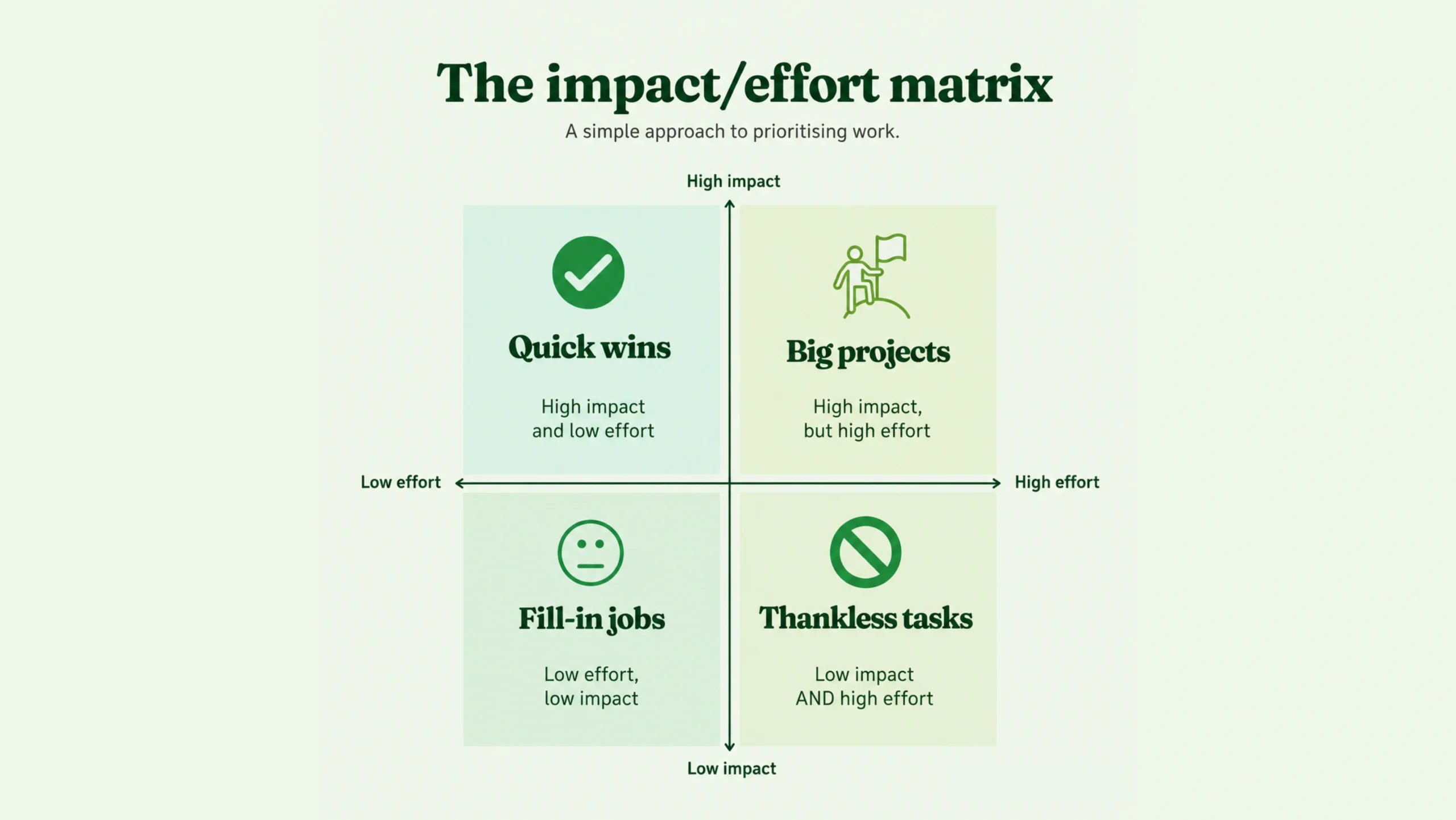
Value vs Effort Matrix
This framework compares expected value against implementation effort.
Features typically fall into four categories:
- High value, low effort
- High value, high effort
- Low value, low effort
- Low value, high effort
The first category often receives immediate attention.
Kano Model
The Kano Model examines how different features influence customer satisfaction.
Some features are expected.
Some create excitement.
Others may have little effect on satisfaction at all.
This helps teams understand emotional responses to product improvements.
Customer Needs Should Lead the Conversation
One common mistake is prioritizing features based solely on internal opinions.
Customers usually provide the strongest signals.
User interviews, usability studies, support tickets, and behavioral analytics often reveal problems that deserve attention.
You know what?
Customers rarely ask for solutions.
They describe frustrations.
Great product teams identify the underlying problems and create solutions that address them.
Feature Prioritization in Agile Teams
Agile teams practice prioritization continuously.
Product backlogs change.
Customer expectations shift.
Market conditions evolve.
A feature that seemed important six months ago may no longer matter.
This is why backlog grooming, sprint planning, and roadmap reviews play such important roles.
Prioritization isn’t a one-time exercise.
It’s an ongoing conversation.
Business Goals Matter Too
Customer requests are important.
Business goals are equally important.
Imagine customers asking for ten new reporting features.
The company, meanwhile, wants to improve subscription retention.
If reporting features don’t contribute to retention, they may not deserve immediate attention.
Strong prioritization balances:
- Customer value
- Business value
- Technical feasibility
Ignoring any one of these areas can create problems.
The Hidden Cost of Building Everything
Many teams fear saying no.
Rejecting feature requests can feel uncomfortable.
Yet every feature introduces costs.
There are development costs.
Testing costs.
Maintenance costs.
Support costs.
Documentation costs.
Training costs.
A feature doesn’t stop requiring attention after launch.
In many cases, saying no is one of the healthiest product decisions a team can make.
Common Prioritization Mistakes
Feature prioritization sounds straightforward.
Reality can be messy.
Several mistakes appear repeatedly.
Prioritizing the Loudest Voice
Senior stakeholders sometimes push for features based on personal opinions.
Without customer evidence, those decisions can create unnecessary work.
Ignoring Data
Analytics often reveal behavior patterns that challenge assumptions.
Teams that ignore data may prioritize the wrong opportunities.
Building for Edge Cases
Every product has special requests.
Building features for small groups while neglecting broader customer needs often creates clutter.
Chasing Competitors
Competitor analysis is useful.
Blindly copying features isn’t.
Customers choose products for specific reasons.
Differentiation matters.
Focusing Only on New Features
New functionality attracts attention.
Fixing usability issues often creates greater value.
Sometimes improving an existing feature delivers stronger results than creating a new one.
Real-World Example
Imagine a project management platform.
Customers request:
- Dark mode
- Advanced reporting
- AI-generated summaries
- Faster loading times
- Better mobile navigation
At first glance, every request appears valuable.
Research reveals that slow performance is causing customer churn.
The team prioritizes performance improvements first.
Why?
Fixing performance directly affects customer retention.
The other features may still matter, but performance creates the largest immediate impact.
That’s feature prioritization in action.
Feature Prioritization and Product Roadmaps
A roadmap communicates where a product is heading.
Prioritization determines what gets placed on that roadmap.
Without prioritization, roadmaps become wish lists.
With prioritization, roadmaps become strategic plans.
Product managers use prioritization to balance:
- Long-term vision
- Customer requests
- Business objectives
- Available resources
This balance helps products grow with purpose rather than randomness.
Why Prioritization Never Ends
Here’s an interesting contradiction.
The better a product becomes, the more feature requests it often receives.
Success creates new opportunities.
Customers suggest improvements.
Markets change.
Technology evolves.
Teams must continuously reevaluate priorities.
A feature considered low value today may become critical next year.
A high-priority initiative may lose relevance after market conditions shift.
Product decisions require regular review.
Final Thoughts
Feature prioritization is the process of deciding what product work deserves attention first based on customer needs, business goals, expected impact, and implementation effort.
It helps teams focus on meaningful outcomes rather than feature volume.
The strongest products aren’t built by adding every requested feature. They’re built by carefully selecting the features that create the greatest value for users and the business.
When prioritization is done well, product teams move faster, spend resources more wisely, and create experiences that customers genuinely appreciate.
Good prioritization isn’t about saying yes to everything.
It’s about knowing when to say yes, when to say later, and when to say no.
Frequently Asked Questions (FAQs)
1. What is feature prioritization?
Feature prioritization is the process of deciding which product features should be developed first based on customer value, business goals, and implementation effort.
2. Why is feature prioritization important?
It helps teams focus resources on the most valuable opportunities, reduce wasted effort, and improve product outcomes.
3. What factors influence feature prioritization?
Customer demand, business objectives, technical feasibility, development effort, revenue impact, and strategic goals often influence prioritization decisions.
4. What is the RICE framework?
RICE is a prioritization method that evaluates features based on Reach, Impact, Confidence, and Effort.
5. How often should product teams prioritize features?
Feature prioritization should be reviewed regularly as customer needs, business goals, and market conditions change.
6. Is feature prioritization only for software products?
No. The approach can be applied to digital products, physical products, services, and internal business initiatives.