


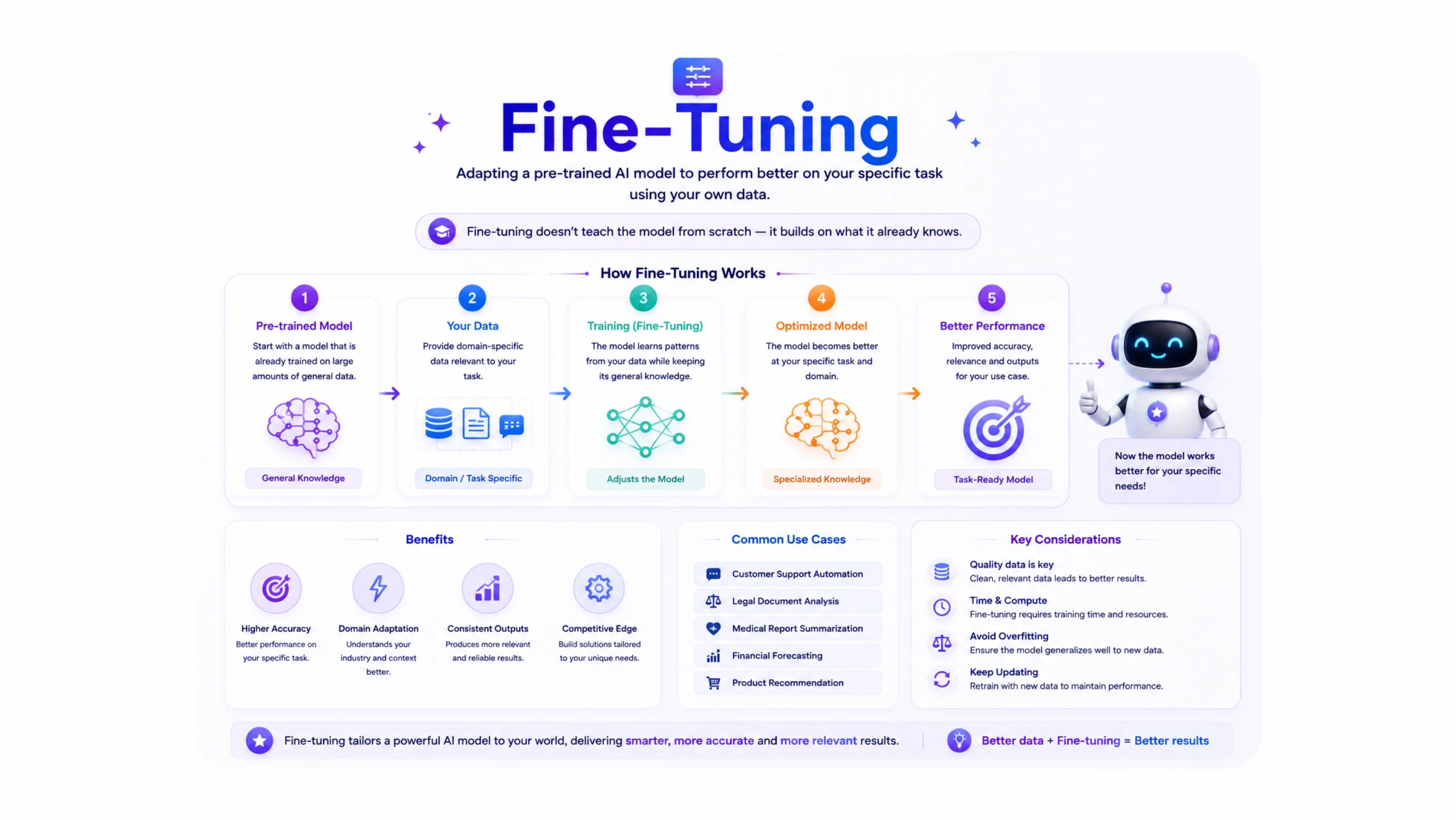
What Is Fine-Tuning?
Fine-tuning is the process of taking an already-trained artificial intelligence model and teaching it additional knowledge or behaviours using specialised data.
Think of it like hiring an experienced employee rather than training someone from day one.
The employee already understands communication, problem-solving, and general workplace skills. You simply teach them the specific processes, terminology, and knowledge needed for their new role.
AI models work in a similar way.
A large language model may already understand language, grammar, reasoning, and general knowledge. Fine-tuning helps adapt that model for a particular industry, business, or use case.
Why Fine-Tuning Matters
General-purpose AI models are impressive, but they aren’t experts in every subject.
A healthcare company may need an AI system familiar with medical terminology.
A law firm may want a model that understands legal language.
A software company may need stronger coding assistance.
This is where fine-tuning becomes valuable.
Instead of building a completely new model, organizations can customize an existing one using carefully selected data.
The result is often more accurate, more relevant, and more consistent responses.
How Does Fine-Tuning Work?
The process starts with a pre-trained model.
That model has already learned language patterns from massive amounts of data.
Developers then provide additional training examples that focus on a specific objective.
For example:
- Customer support conversations
- Technical documentation
- Medical records
- Legal contracts
- Product information
- Industry-specific terminology
The model learns from this specialized data and adjusts its internal parameters.
Over time, it becomes better at producing responses related to that particular domain.
Think of It Like Professional Training
Imagine someone who already knows how to drive.
Teaching them to operate a delivery truck is much easier than teaching driving from the beginning.
The foundational skills already exist.
Fine-tuning follows the same idea.
The model already understands language. The additional training helps it perform better in a specialized area.
Fine-Tuning vs Training From Scratch
People often confuse these concepts.
They are very different.
Training From Scratch
Training from scratch means building an AI model from the ground up.
This process requires:
- Massive datasets
- Significant computing power
- Large budgets
- Extensive training time
Only a limited number of organizations can afford this approach.
Fine-Tuning
Fine-tuning starts with an existing model.
The organization adds targeted training data to improve performance for specific tasks.
This approach is usually:
- Faster
- Less expensive
- More practical
- Easier to deploy
For many businesses, fine-tuning is the preferred option.
Real-World Examples of Fine-Tuning
Fine-tuning appears in many industries.
Healthcare
Medical organizations can train models using clinical terminology, treatment guidelines, and healthcare workflows.
This helps improve the relevance of AI-generated responses.
Customer Support
Businesses often fine-tune models using support tickets, FAQs, and chat transcripts.
The AI learns how the company communicates with customers.
Legal Services
Law firms may train models using contracts, regulations, and legal documents.
This allows the system to better understand legal language.
Software Development
Technology companies often fine-tune coding models using internal code repositories and engineering standards.
This can improve code suggestions and documentation quality.
Financial Services
Financial institutions may use specialized datasets to help AI understand industry-specific terminology and processes.
Benefits of Fine-Tuning
There are several reasons organizations invest in fine-tuning.
Better Domain Knowledge
The model becomes more familiar with industry-specific concepts.
More Consistent Responses
Fine-tuned systems often follow preferred communication styles and terminology.
Improved Accuracy
Specialized knowledge can reduce irrelevant or generic responses.
Stronger Brand Voice
Companies can teach AI systems to communicate in a way that reflects their brand.
Better User Experiences
Users receive answers that feel more relevant to their needs.
A Common Misconception
Many people assume fine-tuning teaches entirely new intelligence.
That’s not quite true.
Fine-tuning improves performance within specific areas.
It doesn’t magically solve every problem.
A fine-tuned healthcare model may excel at medical topics while remaining weak in unrelated areas.
The specialization is the goal.
Challenges of Fine-Tuning
Like any technology, fine-tuning comes with trade-offs.
Data Quality Matters
Poor training data can produce poor results.
If incorrect information enters the training process, mistakes may become more common.
Cost
Fine-tuning can be less expensive than building a model from scratch, yet it still requires resources.
Maintenance
Industries evolve.
Regulations change.
Products change.
Training data may need regular updates.
Risk of Over-Specialization
A model that becomes too focused on one area may lose flexibility in broader conversations.
Finding balance is important.
Fine-Tuning vs Prompt Engineering
These concepts often appear together.
They solve different problems.
Prompt Engineering
Prompt engineering improves results by changing the instructions given to the model.
The model itself remains unchanged.
Example:
A user provides better prompts to get better outputs.
Fine-Tuning
Fine-tuning changes the model itself.
The model learns new patterns through additional training.
Prompt engineering adjusts the conversation.
Fine-tuning adjusts the underlying behavior.
Fine-Tuning vs RAG
Another comparison appears frequently in AI discussions.
Fine-Tuning
Knowledge becomes part of the model through additional training.
Retrieval-Augmented Generation (RAG)
The model retrieves information from external sources during runtime.
Imagine two students.
One memorizes information before an exam.
The other brings a reference book and looks up answers during the test.
Fine-tuning resembles memorization.
RAG resembles consulting reference materials.
Many modern AI systems combine both approaches.
Why Fine-Tuning Matters for Businesses
Organizations increasingly want AI systems that understand their products, customers, and processes.
Generic answers are useful.
Customized answers are often better.
A fine-tuned model can:
- Support employees
- Improve customer service
- Assist developers
- Analyze documents
- Generate specialized content
This is why fine-tuning has become a major part of enterprise AI strategies.
The Future of Fine-Tuning
The AI industry continues to develop faster and more efficient fine-tuning methods.
New approaches aim to:
- Reduce training costs
- Improve accuracy
- Require less data
- Support faster deployment
- Simplify customization
As AI adoption grows, businesses are increasingly looking for ways to personalize models without building entirely new systems.
Fine-tuning remains one of the most effective ways to achieve that goal.
Final Thoughts
Fine-tuning is the process of adapting a pre-trained AI model using specialized data so it performs better for a specific task, industry, or audience. Rather than creating a model from scratch, organizations build upon existing knowledge and customize it for their needs.
From healthcare and legal services to customer support and software development, fine-tuning helps AI systems become more accurate, consistent, and relevant. Combined with techniques such as prompt engineering and retrieval systems, it plays an important role in creating practical AI solutions for real-world applications.
Frequently Asked Questions (FAQs)
1. What is fine-tuning in AI?
Fine-tuning is the process of training a pre-trained AI model on specialized data to improve performance for a specific task or domain.
2. Why is fine-tuning important?
It helps AI models provide more relevant, accurate, and consistent responses for particular industries or use cases.
3. How is fine-tuning different from training a model from scratch?
Training from scratch builds a model entirely from the beginning, while fine-tuning adapts an already trained model using additional data.
4. What types of data are used for fine-tuning?
Organizations often use customer conversations, documentation, contracts, support tickets, code repositories, or industry-specific content.
5. Is fine-tuning better than prompt engineering?
Neither is universally better. Prompt engineering changes instructions, while fine-tuning changes the model itself. Many systems use both approaches together.
6. Can fine-tuning eliminate AI errors?
No. Fine-tuning can improve performance and relevance, but AI systems can still make mistakes and require monitoring and validation.