


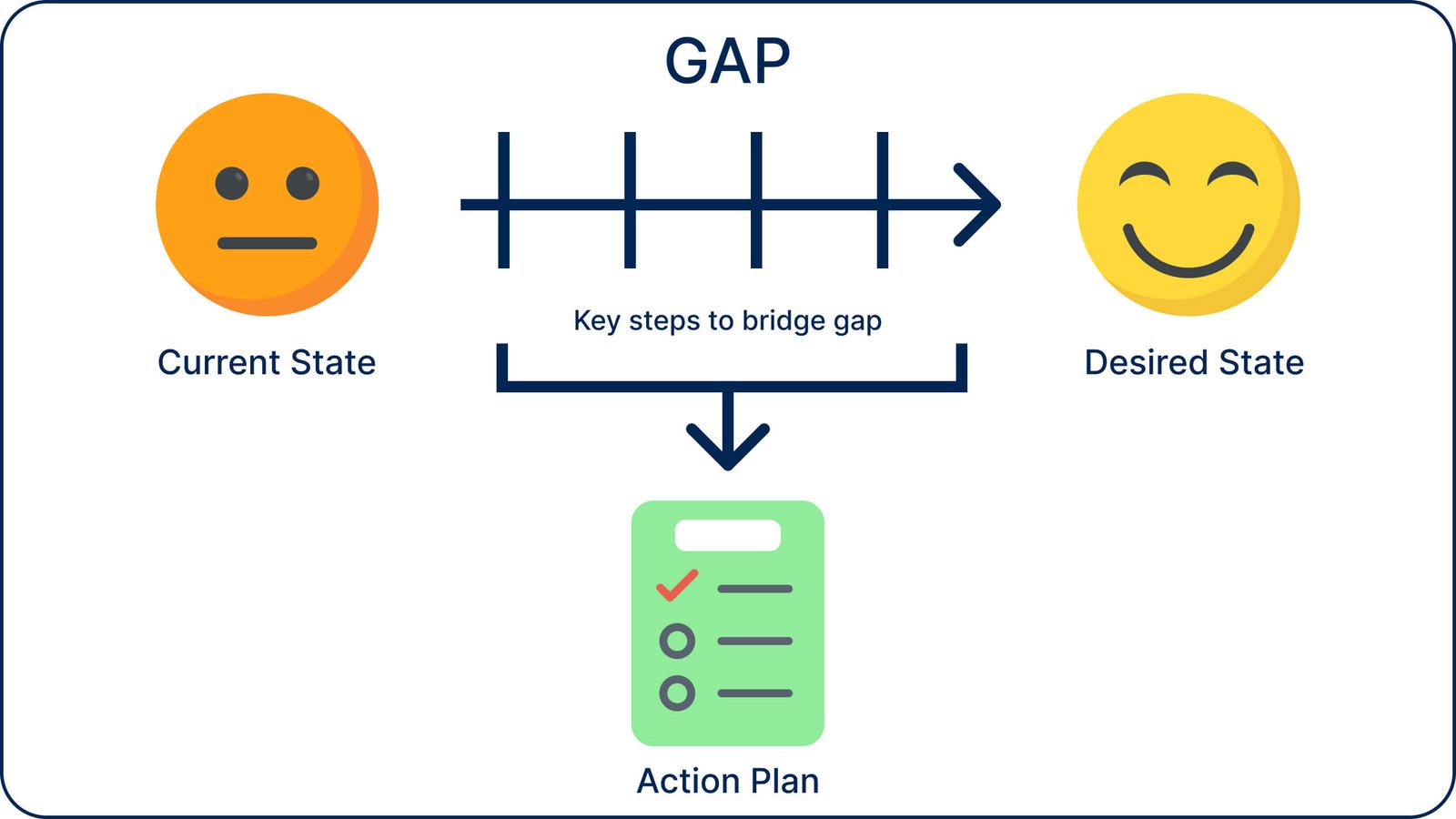
Gap Analysis: What It Is, Why It Matters, and How It Helps Teams Move From Current State to Desired State.
Imagine you’re planning a road trip.
You know where you want to go.
You know where you are right now.
The missing piece is figuring out the distance between those two points and deciding how to get there.
That gap matters.
Without understanding it, planning becomes guesswork.
Businesses, product teams, UX designers, marketers, and organizations face a similar challenge every day.
They have goals.
They have targets.
They have a vision of where they want to be.
Yet reality often looks different.
The process of identifying and understanding that difference is called Gap Analysis.
It’s a simple concept on the surface, though its impact can be surprisingly significant.
What Is Gap Analysis?
Gap Analysis is a method used to compare a current state with a desired future state to identify what is missing, what needs improvement, and what actions are required to close the gap.
In simple terms, it answers three questions:
- Where are we now?
- Where do we want to be?
- What is preventing us from getting there?
The difference between the current state and the desired state is known as the gap.
Once that gap becomes visible, teams can create plans to reduce or eliminate it.
Why Gap Analysis Matters
Here’s the thing.
People often focus heavily on goals.
Revenue goals.
Growth goals.
Product goals.
Career goals.
Goals are important.
Yet goals alone don’t reveal what’s standing in the way.
Imagine a company wants to double customer retention.
That’s a clear objective.
The challenge is figuring out why retention isn’t already at that level.
Are users confused?
Are competitors offering better experiences?
Is onboarding ineffective?
Are performance issues causing frustration?
Gap analysis helps uncover those answers.
Without that visibility, teams may spend time solving the wrong problems.
A Simple Everyday Example
Let’s step away from business for a moment.
Imagine someone wants to run a marathon.
Their goal is clear.
Run 42.2 kilometers.
Current reality?
They can comfortably run 5 kilometers.
The gap isn’t mysterious.
It’s measurable.
They need:
- More endurance
- Better training
- Consistent practice
- Improved nutrition
- Recovery routines
Once the gap becomes visible, a plan can be created.
Businesses use the same thinking.
Only the goals look different.
How Gap Analysis Works
Gap analysis follows a straightforward process.
The details vary depending on the project, though the general approach remains consistent.
Step 1: Define the Current State
First, teams identify where things stand today.
This often involves gathering data such as:
- Performance metrics
- User feedback
- Analytics
- Customer satisfaction scores
- Revenue figures
- Operational reports
The goal is to create an honest picture of reality.
Assumptions can be dangerous here.
Facts matter.
Step 2: Define the Desired State
Next, teams describe where they want to be.
This future state should be specific and measurable whenever possible.
Examples include:
- Increase conversion rates by 20%
- Reduce support tickets by 30%
- Improve onboarding completion rates
- Increase employee productivity
A vague destination creates a vague plan.
Clear goals create clearer pathways.
Step 3: Identify the Gap
Now the comparison begins.
Current state.
Desired state.
Difference.
That’s the gap.
Sometimes the gap is small.
Sometimes it’s surprisingly large.
Either way, visibility creates opportunities for improvement.
Step 4: Analyze Root Causes
This step often produces the most valuable insights.
Teams ask:
Why does the gap exist?
Possible causes might include:
- Missing skills
- Poor processes
- Technical limitations
- Resource shortages
- Weak communication
- Poor user experience
- Market changes
Treating symptoms without understanding causes rarely produces lasting improvement.
Step 5: Create an Action Plan
Once the causes become clear, teams can develop solutions.
The action plan may include:
- Process improvements
- Product enhancements
- Training programs
- New technologies
- Additional resources
- Strategic changes
The goal shifts from identifying problems to creating progress.
The Core Formula Behind Gap Analysis
At its simplest, gap analysis can be expressed like this:
Desired State – Current State = Gap
The formula sounds almost too simple.
Yet many organizations skip this exercise entirely.
They focus on future ambitions without clearly understanding present realities.
That’s often where projects begin drifting off course.
Different Types of Gap Analysis
Gap analysis appears across many industries and disciplines.
The specific focus changes depending on the objective.
Business Gap Analysis
Organizations use business gap analysis to compare current performance against strategic goals.
Examples include:
- Revenue growth
- Market share
- Profitability
- Operational efficiency
Executives frequently rely on this type of analysis when planning future initiatives.
Skills Gap Analysis
This type focuses on people and capabilities.
Questions might include:
- What skills do employees currently have?
- What skills are needed?
- What training is required?
Skills gap analysis is particularly common during digital transformation initiatives.
Product Gap Analysis
Product teams often compare current product capabilities against customer expectations or competitor offerings.
This process helps identify:
- Missing features
- Usability issues
- Performance concerns
- Market opportunities
UX Gap Analysis
UX professionals frequently conduct gap analyses to identify differences between user expectations and actual experiences.
Examples include:
- Users expect faster onboarding
- Users struggle with navigation
- Users cannot find critical features
The analysis helps prioritize design improvements.
Competitive Gap Analysis
Businesses compare themselves against competitors.
The goal is to identify areas where competitors may offer stronger experiences, better products, or more attractive services.
This approach often reveals opportunities for differentiation.
Gap Analysis in UX Design
Gap analysis plays an important role in user experience work.
Design teams constantly evaluate experiences against user needs.
Imagine users expect to complete account registration within two minutes.
Analytics reveal that most users take seven minutes and many abandon the process entirely.
There’s a gap.
The current experience fails to match expectations.
The analysis may uncover issues such as:
- Confusing forms
- Excessive steps
- Poor instructions
- Technical problems
Once identified, improvements become easier to prioritize.
Popular Tools Used During Gap Analysis
Teams use various tools to support the process.
Examples include:
User Interviews
Direct conversations often reveal hidden pain points.
Surveys
Surveys help gather broader feedback from larger audiences.
Analytics Platforms
Tools such as Google Analytics, Mixpanel, and Amplitude help uncover behavioral patterns.
Heatmaps
Platforms like Hotjar reveal how users interact with interfaces.
Customer Support Data
Support tickets often highlight recurring issues.
Competitive Research
Comparing products can reveal missing opportunities.
Benefits of Gap Analysis
Organizations continue using gap analysis because it offers practical advantages.
Better Decision-Making
Teams make decisions based on evidence rather than assumptions.
Clearer Priorities
The most significant gaps become easier to identify.
Improved Resource Allocation
Resources can be directed toward areas with the highest impact.
Reduced Risk
Potential problems often become visible earlier.
Greater Strategic Clarity
Teams gain a clearer understanding of what needs attention and why.
Common Mistakes During Gap Analysis
Gap analysis sounds straightforward.
Execution can be challenging.
Let’s look at some common mistakes.
Focusing on Symptoms
A declining metric may indicate a problem.
It isn’t necessarily the root cause.
Teams that stop at surface-level observations often miss important insights.
Using Incomplete Data
Poor data quality can distort findings.
Good analysis relies on accurate information.
Setting Unrealistic Goals
A future state should be ambitious yet achievable.
Otherwise the analysis becomes disconnected from reality.
Ignoring User Feedback
Users often reveal gaps that internal teams overlook.
Their perspectives matter.
A lot.
Failing to Act
This happens more often than people admit.
The analysis gets completed.
The report gets shared.
Nothing changes.
Without action, even the best analysis has limited value.
Gap Analysis and AI
Artificial intelligence is beginning to accelerate many parts of the gap analysis process.
AI tools can help:
- Analyze large datasets
- Identify patterns
- Detect anomalies
- Summarize feedback
- Generate recommendations
For example, AI can review thousands of support tickets and identify recurring customer frustrations in minutes.
That task might have taken days using manual methods.
The technology is becoming increasingly helpful.
Human judgment still plays a critical role, though.
Data reveals patterns.
People determine what those patterns mean.
A Common Misconception
Many people think gap analysis is only for struggling organizations.
That’s not true.
High-performing organizations use gap analysis regularly.
Success doesn’t eliminate gaps.
It simply changes the nature of the gaps being examined.
A thriving company may analyze opportunities for growth.
A startup may analyze product-market fit.
A design team may analyze user satisfaction.
Improvement rarely stops.
The questions simply evolve.
Final Thoughts
Gap analysis is a structured method for comparing a current state with a desired future state and identifying what stands between the two.
It helps organizations understand where they are, where they want to go, and what actions can help bridge the distance.
The process can be applied across business strategy, UX design, product development, employee training, customer experience, and operational improvement.
Its strength lies in simplicity.
Current state.
Future state.
Gap.
Action plan.
Those four ideas can reveal surprisingly valuable insights.
And sometimes the biggest breakthrough isn’t discovering a new opportunity.
It’s finally seeing what’s been missing all along.
Frequently Asked Questions (FAQs)
What is gap analysis?
Gap analysis is a method used to compare a current state with a desired future state and identify the differences that must be addressed to achieve a goal.
Why is gap analysis important?
Gap analysis helps organizations identify weaknesses, prioritize improvements, allocate resources effectively, and create action plans for achieving desired outcomes.
What are the main steps in gap analysis?
The process typically involves defining the current state, defining the desired state, identifying the gap, analyzing root causes, and creating an action plan.
How is gap analysis used in UX design?
UX teams use gap analysis to identify differences between user expectations and actual product experiences, helping prioritize usability and design improvements.
What is a skills gap analysis?
A skills gap analysis compares existing employee skills with the skills needed to achieve organizational goals, helping identify training and development needs.
What tools are commonly used for gap analysis?
Common tools include analytics platforms, user interviews, surveys, heatmaps, customer feedback systems, competitive research, and performance reports.