


What Is Human-in-the-Loop?
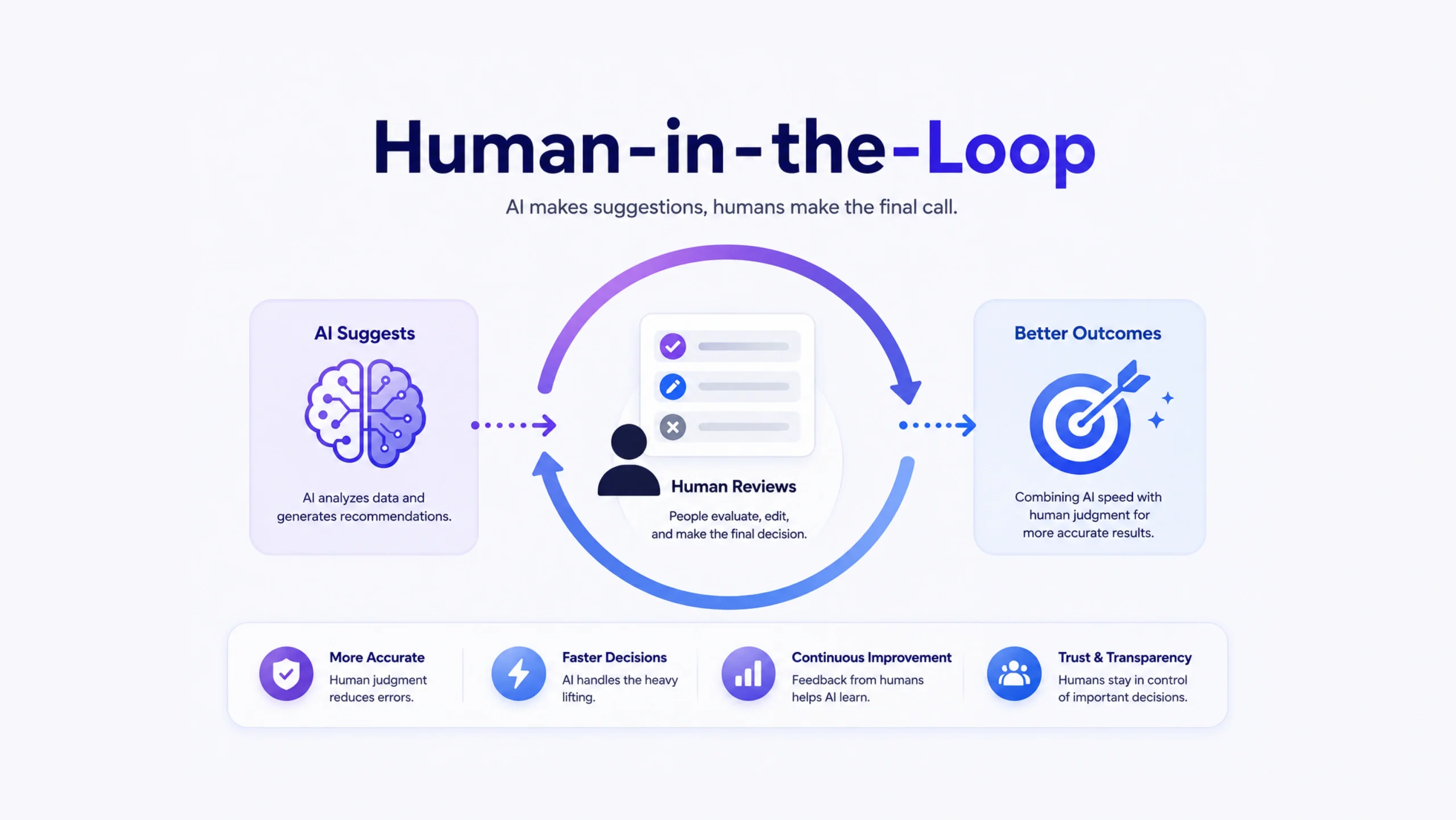
Human-in-the-Loop, often abbreviated as HITL, refers to a system where people actively participate in the operation, training, evaluation, or decision-making process of an automated or AI-powered solution.
Instead of allowing software to make every decision independently, human expertise is introduced at key moments.
The goal is simple: combine the speed of machines with the judgment of people.
Think of it like a modern workplace where software does much of the heavy lifting, but a person reviews the work before it moves forward.
That combination often produces better results than either humans or machines working completely alone.
Why Human Oversight Matters
Artificial intelligence has become remarkably capable.
It can write content.
Analyze images.
Generate code.
Answer questions.
Summarize documents.
Yet AI systems can still make mistakes.
Sometimes those mistakes are small.
Sometimes they can have serious consequences.
A medical recommendation, legal document, financial report, or hiring decision often requires human review.
This is where Human-in-the-Loop becomes valuable.
The human acts as a safeguard, adding context, ethics, experience, and common sense that software may lack.
A Simple Everyday Example
Imagine using GPS navigation.
The system suggests a route.
You follow it most of the time.
Then you notice a road closure, construction zone, or local event causing traffic.
You decide to take a different route.
The GPS provided guidance.
You provided judgment.
That’s essentially a Human-in-the-Loop process.
The technology helps, but the person remains involved.
How Human-in-the-Loop Works
A Human-in-the-Loop workflow can look different depending on the application, though the general process follows a familiar pattern.
Step 1: AI Generates an Output
The system performs a task, prediction, recommendation, or analysis.
Step 2: Human Reviews the Result
A person examines the output and determines whether it is accurate or appropriate.
Step 3: Corrections Are Made
If needed, adjustments are made before the result is finalized.
Step 4: Feedback Improves the System
Many AI systems learn from human corrections and use that feedback to improve future performance.
This creates a cycle where human expertise gradually helps the system become more effective.
Human-in-the-Loop Is Not a Weakness
Some people assume that needing human oversight means the technology isn’t good enough.
Actually, the opposite is often true.
The most reliable systems frequently combine automation with human judgment.
Commercial pilots use autopilot systems.
Doctors use diagnostic software.
Financial analysts use forecasting tools.
Experienced professionals still remain involved.
The software increases efficiency.
The human provides accountability.
Real-World Examples of Human-in-the-Loop
HITL appears in many industries.
Often, people don’t even realize they’re using it.
Content Moderation
Social media platforms use AI to identify harmful content.
Human reviewers handle difficult cases and final decisions.
Healthcare
AI can analyze medical scans and highlight potential concerns.
Doctors review the findings before making diagnoses.
Customer Support
Chatbots answer common questions.
Support agents step in when requests become complex.
Recruitment
AI may screen applications.
Hiring managers make final candidate decisions.
Financial Services
AI can detect suspicious transactions.
Human analysts investigate and verify potential fraud cases.
Human-in-the-Loop in AI Training
One of the most important uses of HITL happens behind the scenes.
AI models learn from human feedback.
During development, people often:
- Label training data
- Review generated outputs
- Correct mistakes
- Rank responses
- Identify harmful content
- Evaluate quality
Without human involvement, many modern AI systems would perform far less effectively.
Human expertise plays a major role in teaching AI how to behave.
Benefits of Human-in-the-Loop Systems
There are several reasons organizations continue to use HITL approaches.
Better Accuracy
Human review helps catch errors that automation may miss.
Improved Trust
People tend to trust systems more when human oversight exists.
Ethical Decision-Making
Humans can evaluate fairness, social impact, and sensitive situations.
Continuous Improvement
Human feedback helps improve future model performance.
Risk Reduction
Critical decisions receive additional review before implementation.
For high-stakes industries, this extra layer of protection can be extremely valuable.
Human-in-the-Loop vs Fully Automated Systems
The difference is straightforward.
Fully Automated Systems
The software makes decisions independently.
Human involvement is minimal or nonexistent.
Examples
- Automated email filters
- Smart thermostats
- Basic recommendation engines
Human-in-the-Loop Systems
Humans participate at important stages.
Examples
- Medical diagnosis tools
- AI-assisted hiring systems
- Legal document review platforms
- Enterprise AI copilots
The choice often depends on the level of risk involved.
A movie recommendation carries little risk.
A medical diagnosis carries much more.
Challenges of Human-in-the-Loop
Although HITL offers many advantages, it also introduces challenges.
Slower Processes
Human review takes time.
A fully automated process is often faster.
Higher Costs
Organizations may need trained experts to review outputs.
Human Bias
People can introduce their own biases into decisions.
Scalability Issues
As workloads increase, maintaining human oversight becomes more difficult.
Finding the right balance between automation and human involvement is often one of the biggest challenges.
Human-in-the-Loop and Generative AI
Generative AI systems have made HITL even more important.
Tools that generate text, images, code, and business recommendations can produce impressive results.
They can also generate inaccurate information.
Many organizations therefore require human review before AI-generated content is published or acted upon.
Writers edit AI-generated articles.
Developers review AI-generated code.
Designers evaluate AI-generated visuals.
Business leaders verify AI-generated insights.
The AI accelerates the process.
Humans maintain quality control.
Why Human Judgment Still Matters
Technology has become remarkably advanced.
Yet there are certain qualities machines still struggle to replicate consistently.
Empathy.
Ethics.
Cultural awareness.
Situational judgment.
Common sense.
These qualities often influence important decisions.
A Human-in-the-Loop framework helps bring those qualities into AI-driven workflows.
The Future of Human-in-the-Loop
As AI becomes more capable, human involvement will likely evolve rather than disappear.
Future systems may:
- Request human input only when confidence is low
- Automatically identify high-risk decisions
- Learn from ongoing feedback
- Personalize oversight requirements
- Combine multiple human reviewers for critical tasks
Rather than replacing humans entirely, many organizations are moving toward collaborative models where people and AI work together.
Final Thoughts
Human-in-the-Loop (HITL) is an approach that combines the speed and efficiency of AI with the judgment, expertise, and oversight of people. By involving humans in key stages of decision-making, organizations can improve accuracy, reduce risk, and build greater trust in automated systems.
From healthcare and finance to customer support and generative AI, HITL remains one of the most effective ways to balance automation with human responsibility. As artificial intelligence continues to advance, the partnership between people and machines will likely become even more important.
Frequently Asked Questions (FAQs)
1. What does Human-in-the-Loop mean?
Human-in-the-Loop refers to a process where humans participate in the training, review, or decision-making stages of an AI or automated system.
2. Why is Human-in-the-Loop important?
It helps improve accuracy, reduce errors, increase trust, and provide human judgment in situations where automation alone may not be sufficient.
3. How does Human-in-the-Loop work?
An AI system generates an output, a human reviews or adjusts it, and the feedback can be used to improve future performance.
4. Where is Human-in-the-Loop commonly used?
It is commonly used in healthcare, finance, recruitment, customer support, content moderation, and AI model training.
5. Can Human-in-the-Loop improve AI systems?
Yes. Human feedback helps AI systems learn, improve accuracy, and produce higher-quality outputs over time.
6. Is Human-in-the-Loop better than full automation?
For high-risk or complex decisions, Human-in-the-Loop often provides better reliability by combining machine efficiency with human judgment.