


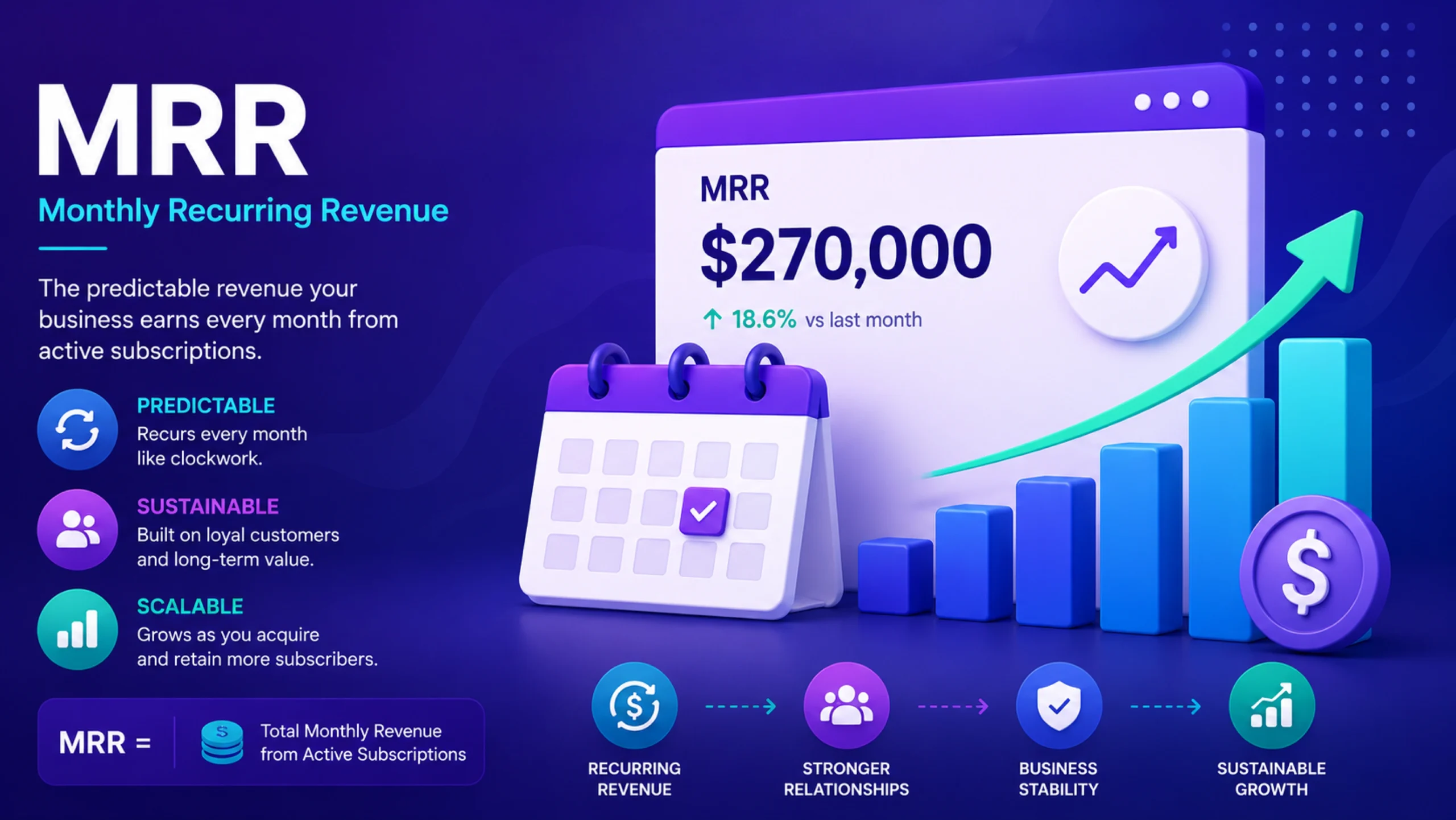
What Is MRR (Monthly Recurring Revenue)?
MRR, or Monthly Recurring Revenue, measures the predictable revenue a business earns each month from recurring subscriptions. It is one of the most closely watched metrics in SaaS, membership platforms, subscription services, and cloud-based businesses.
Think of MRR as the monthly heartbeat of a subscription company. It shows how much recurring income arrives every month before accounting for one-time purchases, setup fees, or consulting revenue.
If 100 customers pay $50 per month for a software subscription, the business generates $5,000 in MRR.
Simple on the surface. Yet behind that number sits a powerful indicator of business growth and stability.
Why MRR Matters
Imagine trying to forecast future revenue without knowing how much money will arrive next month.
That’s where MRR becomes valuable.
Unlike traditional businesses that depend on unpredictable sales cycles, subscription companies can estimate future income with greater confidence. MRR gives founders, investors, and management teams a clear picture of recurring revenue trends.
A rising MRR often signals healthy customer acquisition and retention. A declining MRR may point to customer churn, pricing issues, or product challenges.
How MRR Works
MRR focuses only on recurring revenue generated from active subscriptions.
For example:
- 50 customers paying $20/month = $1,000 MRR
- 100 customers paying $50/month = $5,000 MRR
- 500 customers paying $100/month = $50,000 MRR
As customers join, upgrade, downgrade, or cancel subscriptions, MRR changes accordingly.
This makes MRR a living metric that reflects the current state of the business.
MRR Formula
The standard formula is straightforward:
MRR = Total Monthly Subscription Revenue
For example:
- 200 customers
- $30 monthly subscription
MRR = 200 × $30
MRR = $6,000
Businesses with multiple pricing tiers calculate MRR by adding recurring revenue from all active subscriptions.
The Different Types of MRR
MRR isn’t always viewed as a single number. Many SaaS companies break it into categories to understand growth patterns.
New MRR
Revenue generated from newly acquired customers.
Example:
A customer subscribes to a $100 monthly plan.
New MRR = $100
Expansion MRR
Additional revenue from existing customers who upgrade plans or purchase extra services.
Example:
A customer moves from a $50 plan to a $100 plan.
Expansion MRR = $50
Churned MRR
Revenue lost when customers cancel subscriptions.
Example:
A customer paying $75 per month leaves.
Churned MRR = $75
Contraction MRR
Revenue lost from customers downgrading to lower-priced plans.
Tracking these categories helps businesses identify exactly where growth is coming from.
MRR vs ARR
MRR and ARR are closely connected.
MRR measures recurring revenue on a monthly basis.
ARR measures recurring revenue across an entire year.
A simple relationship exists between the two:
ARR = MRR × 12
For example:
- MRR = $10,000
- ARR = $120,000
Startups often use MRR for short-term tracking and ARR for annual growth reporting.
Why Investors Care About MRR
Investors love predictable revenue.
A company generating recurring monthly income often appears less risky than one dependent on one-time sales.
MRR helps investors evaluate:
- Growth consistency
- Customer retention
- Revenue predictability
- Business momentum
This is why SaaS founders frequently include MRR charts in investor presentations.
Benefits of Tracking MRR
Revenue Visibility
MRR provides a clear view of monthly recurring income.
Better Forecasting
Businesses can estimate future revenue more accurately.
Faster Decision Making
Leadership teams can react quickly to growth opportunities or revenue declines.
Customer Retention Insights
Changes in MRR often reveal customer satisfaction trends.
Growth Measurement
MRR helps track the effectiveness of marketing, sales, and product improvements.
Common MRR Mistakes
MRR is powerful, but it can be misleading if calculated incorrectly.
Including One-Time Revenue
Setup fees, custom development projects, and consulting services generally do not belong in MRR calculations.
Ignoring Churn
New customers matter. Lost customers matter too.
Looking only at growth without tracking churn can create a false sense of success.
Counting Future Contracts Too Early
MRR should reflect active recurring revenue, not projected revenue from unsigned agreements.
Using Inconsistent Definitions
Different teams sometimes calculate MRR differently, leading to confusion and inaccurate reporting.
Consistency is key.
How Businesses Increase MRR
Growing MRR usually involves several strategies working together.
Acquire New Customers
The most obvious path is bringing in additional subscribers.
Improve Retention
Keeping existing customers often costs less than acquiring new ones.
Increase Plan Upgrades
Encouraging customers to move to higher-value plans increases recurring revenue.
Introduce Add-Ons
Additional features and premium services can generate expansion MRR.
Improve Product Experience
Customers are more likely to stay and spend more when they see consistent value.
MRR as a Growth Indicator
Here’s the thing—revenue growth can sometimes look impressive even when it’s temporary.
MRR is different.
Since it focuses on recurring payments, it often provides a clearer picture of long-term business performance.
A company that grows MRR month after month is typically building a stronger and more sustainable revenue engine.
That doesn’t mean MRR tells the whole story. Profitability, customer retention, acquisition costs, and cash flow remain important. Yet MRR often serves as the first metric leaders check when evaluating business momentum.
Final Thoughts
MRR, or Monthly Recurring Revenue, measures the predictable income a business generates from recurring subscriptions each month. It helps companies track growth, forecast future revenue, evaluate customer retention, and make smarter strategic decisions.
For SaaS and subscription businesses, MRR acts as a foundational metric. A steadily growing MRR often reflects strong customer demand, healthy retention, and a business model capable of generating reliable long-term revenue.
Frequently Asked Questions (FAQs)
1. What does MRR stand for?
MRR stands for Monthly Recurring Revenue, which measures recurring subscription revenue earned each month.
2. How do you calculate MRR?
MRR is calculated by adding the monthly recurring revenue generated from all active subscriptions.
3. Why is MRR important?
MRR helps businesses forecast revenue, monitor growth, evaluate retention, and track subscription performance.
4. What is the difference between MRR and ARR?
MRR measures monthly recurring revenue, while ARR measures recurring revenue across an entire year.
5. Does MRR include one-time payments?
No. MRR generally excludes one-time purchases, setup fees, consulting revenue, and other non-recurring income.
6. Which businesses use MRR?
MRR is commonly used by SaaS companies, subscription services, membership platforms, streaming businesses, and cloud software providers.