


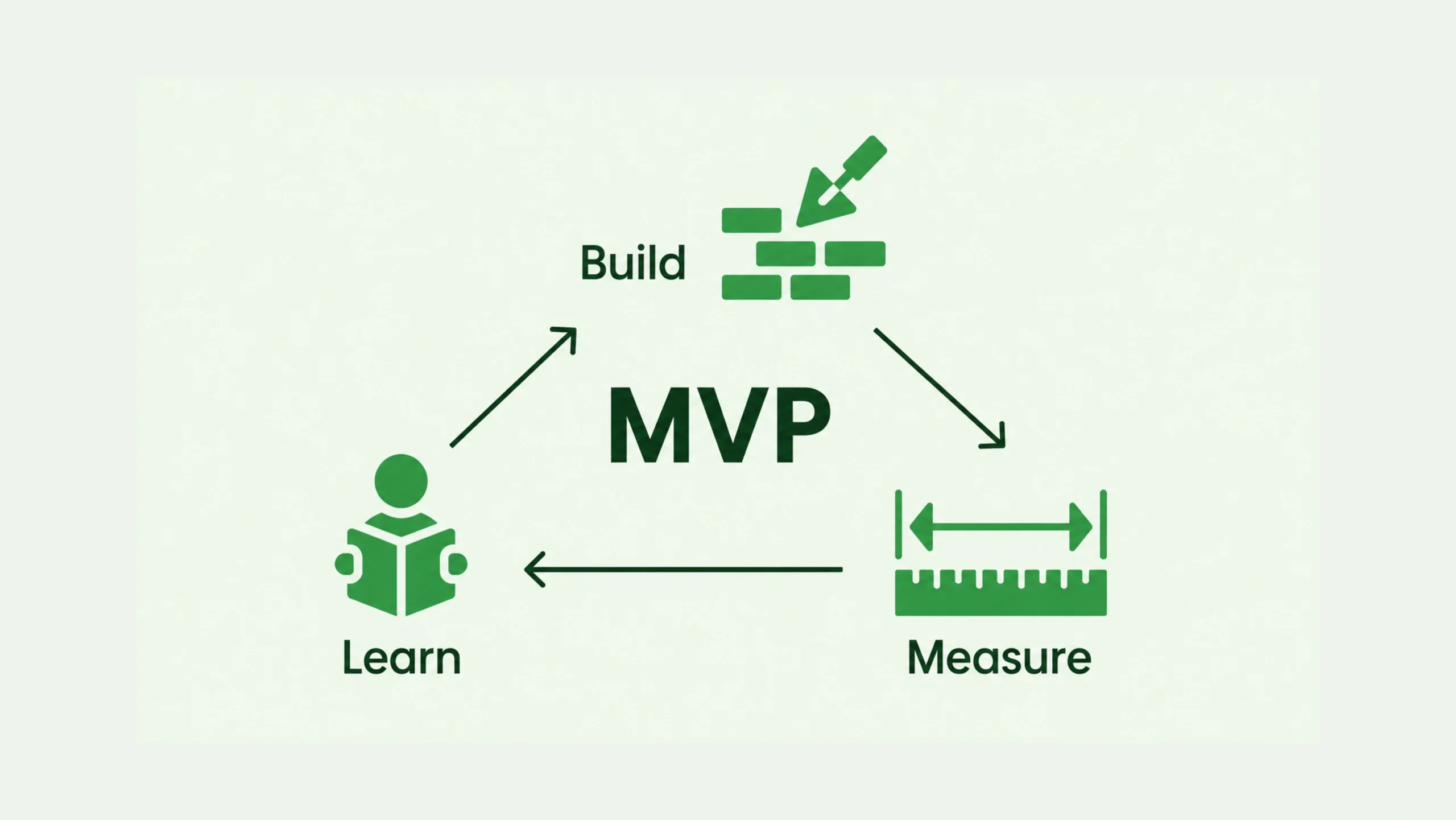
An MVP, or Minimum Viable Product, is the simplest version of a product that contains enough functionality to solve a core problem and gather feedback from real users.
The concept sounds simple.
Build the smallest product possible.
Release it.
Learn from users.
Improve it.
Yet many teams misunderstand what an MVP actually means.
Some believe it means launching an incomplete product.
Others think it means building a low-quality experience.
Neither is true.
An MVP should be minimal, but it should still provide genuine value.
People must be able to accomplish something meaningful with it.
Why Do MVPs Exist?
Building products takes time, money, and effort.
The problem is that no team knows with complete certainty if users will love a product before it exists.
That’s where the MVP approach comes in.
Instead of spending months or years building every feature imaginable, teams release a smaller version and observe how people respond.
Think about opening a restaurant.
You probably wouldn’t launch with a 200-item menu on day one.
You’d start with a smaller selection, see what customers order, and expand based on demand.
An MVP follows a similar philosophy.
Start small.
Learn quickly.
Adjust based on evidence.
The Real Purpose of an MVP
Many people assume an MVP exists to save development costs.
That’s partly true.
The larger purpose is learning.
An MVP helps answer questions such as:
- Do people want this solution?
- Does the problem matter enough?
- Will users pay for it?
- Which features matter most?
- How do people behave when using it?
The goal isn’t simply to launch.
The goal is to learn before making larger investments.
Learning is the product.
The software is merely the vehicle.
Breaking Down the Term
The phrase “Minimum Viable Product” contains three important words.
Minimum
Only the features required to solve the primary problem should be included.
Extra features create complexity and delay learning.
Viable
The product must deliver value.
Users should be able to complete a meaningful task.
A broken experience isn’t viable.
Product
It should function as an actual solution rather than a concept or presentation.
Users need something real enough to evaluate.
When all three elements work together, teams gain valuable insights.
MVP vs Full Product
A common misconception is that an MVP is simply an early version of the final product.
The relationship is a bit more nuanced.
A full product often contains:
- Advanced functionality
- Personalization
- Integrations
- Automation
- Reporting
- Additional workflows
An MVP focuses on the core value proposition.
Imagine a food delivery app.
The full product may include:
- Loyalty programs
- Driver tracking
- Advanced recommendations
- Referral systems
- Multiple payment methods
The MVP might simply allow users to:
- Browse restaurants
- Place an order
- Receive food
That’s enough to test the primary concept.
What Makes a Good MVP?
A successful MVP isn’t defined by how few features it contains.
It’s defined by how effectively it answers important questions.
Strong MVPs typically have several characteristics.
Clear Problem Focus
Every feature should connect directly to the primary user problem.
If a feature doesn’t support that goal, it probably belongs in a later release.
Real Customer Value
Users should gain something useful from the experience.
People rarely provide meaningful feedback on products that don’t help them.
Measurable Outcomes
Teams need ways to evaluate success.
This might include:
- Signups
- Engagement
- Retention
- Purchases
- Task completion
Data helps transform opinions into insights.
Fast Learning Cycles
Good MVPs generate feedback quickly.
The faster teams learn, the faster they can improve.
The MVP Development Process
Although every company works differently, the process usually follows a similar pattern.
Step 1: Identify the Problem
Start with a customer problem.
Not a feature.
Not a technology.
Not a trend.
A genuine problem.
Research often includes:
- User interviews
- Surveys
- Market analysis
- Customer observations
The clearer the problem, the stronger the MVP.
Step 2: Define the Core Value
What is the single most important thing the product should accomplish?
This question forces teams to prioritize.
Everything else becomes secondary.
Step 3: Prioritize Features
Many teams struggle here.
Every feature feels important.
Yet MVP development requires discipline.
Ask:
“If we removed this feature, could users still achieve the primary goal?”
If the answer is yes, it can probably wait.
Step 4: Build the Simplest Solution
The objective isn’t perfection.
The objective is validation.
Build only what’s necessary to test the idea.
Step 5: Release and Observe
Real users provide the most valuable feedback.
Watch what they do.
Listen to what they say.
Pay attention to what they ignore.
Behavior often reveals more than surveys.
Step 6: Learn and Improve
The first release rarely provides all the answers.
Feedback guides future decisions.
Teams may:
- Add features
- Simplify workflows
- Change priorities
- Refine positioning
- Explore new opportunities
Each cycle increases knowledge.
Common Types of MVPs
Not every MVP requires a fully developed application.
Several approaches exist.
Prototype MVP
Interactive prototypes test concepts before development.
Tools such as Figma and Axure are frequently used for this purpose.
Landing Page MVP
A landing page can measure interest before building the product.
Signups help validate demand.
Concierge MVP
Humans perform tasks manually behind the scenes while customers experience the service.
This helps validate ideas without automation.
Wizard of Oz MVP
The product appears automated, but people perform the work manually.
Users see the outcome without knowing the process behind it.
Single-Feature MVP
The product focuses on one valuable capability rather than a large feature set.
Many successful startups began this way.
Benefits of Building an MVP
The advantages extend far beyond cost reduction.
Faster Learning
Teams gain real-world insights earlier.
Lower Risk
Problems become visible before major investments occur.
Better Prioritization
Customer feedback reveals which features deserve attention.
Stronger Product-Market Fit
Products evolve around actual customer needs rather than assumptions.
Improved Stakeholder Confidence
Evidence-based decisions often generate greater support than speculation.
Common MVP Mistakes
Many teams misunderstand the concept and create avoidable problems.
Building Too Much
Ironically, this is the most common mistake.
Teams continue adding features until the “minimum” disappears.
Releasing Poor Quality
Minimal does not mean broken.
Users still expect a functional experience.
Ignoring Customer Feedback
An MVP without learning is simply an unfinished product.
Feedback must influence future decisions.
Measuring the Wrong Things
Vanity metrics can create false confidence.
Focus on behaviors that reflect real value.
Falling in Love With Features
Teams sometimes become attached to ideas before validation occurs.
Evidence should guide decisions.
Not assumptions.
Famous MVP Examples
Many successful companies began with surprisingly simple products.
Airbnb
The founders initially rented space in their own apartment to test the idea.
The concept was validated before significant expansion.
Dropbox
Dropbox famously used a demonstration video to gauge interest before building the complete platform.
The response validated demand.
Early versions focused on a limited audience before expanding globally.
Uber
The original concept centered on requesting rides in a specific market before becoming a worldwide platform.
These examples highlight a common pattern.
Start small.
Learn.
Expand.
MVPs and Modern Product Development
Today’s teams have access to powerful tools that make MVP creation easier than ever.
No-code platforms, AI tools, cloud infrastructure, and rapid prototyping software reduce development time dramatically.
Teams can:
- Build faster
- Test earlier
- Gather feedback sooner
- Validate assumptions more efficiently
Yet technology doesn’t change the core principle.
The purpose remains learning.
Why MVP Thinking Still Matters
The business environment changes constantly.
Customer expectations evolve.
Technology advances.
Competition increases.
Under those conditions, certainty becomes rare.
MVP thinking helps teams manage uncertainty.
Instead of betting everything on a single large release, organizations learn through experimentation.
Some ideas succeed.
Some fail.
Both outcomes provide value.
The real danger isn’t launching a small product.
The real danger is spending years building something nobody wants.
Final Thoughts
A Minimum Viable Product is the simplest version of a product that delivers value and helps teams learn from real users. It allows organizations to test assumptions, validate ideas, and gather evidence before committing significant resources.
The strongest MVPs focus on solving one meaningful problem exceptionally well. They prioritize learning over perfection and progress over complexity.
Many successful products began as remarkably simple solutions.
Their success wasn’t driven by having hundreds of features.
It came from understanding customers, learning quickly, and improving continuously.
That’s the real power of an MVP.
Frequently Asked Questions (FAQs)
1. What does MVP stand for?
MVP stands for Minimum Viable Product, which is the simplest version of a product that delivers value and gathers user feedback.
2. Why is an MVP important?
An MVP helps teams validate ideas, reduce risk, learn from customers, and avoid investing heavily in unproven concepts.
3. What is the difference between an MVP and a prototype?
A prototype is used to test concepts and interactions, while an MVP is a usable product released to real users for feedback and validation.
4. How many features should an MVP include?
Only the features required to solve the primary user problem and test the core product idea should be included.
5. Can an MVP generate revenue?
Yes. Many MVPs are launched as paid products to validate both customer interest and willingness to pay.
6. What happens after an MVP launch?
Teams collect feedback, analyze user behavior, validate assumptions, and continue improving the product based on real-world insights.