


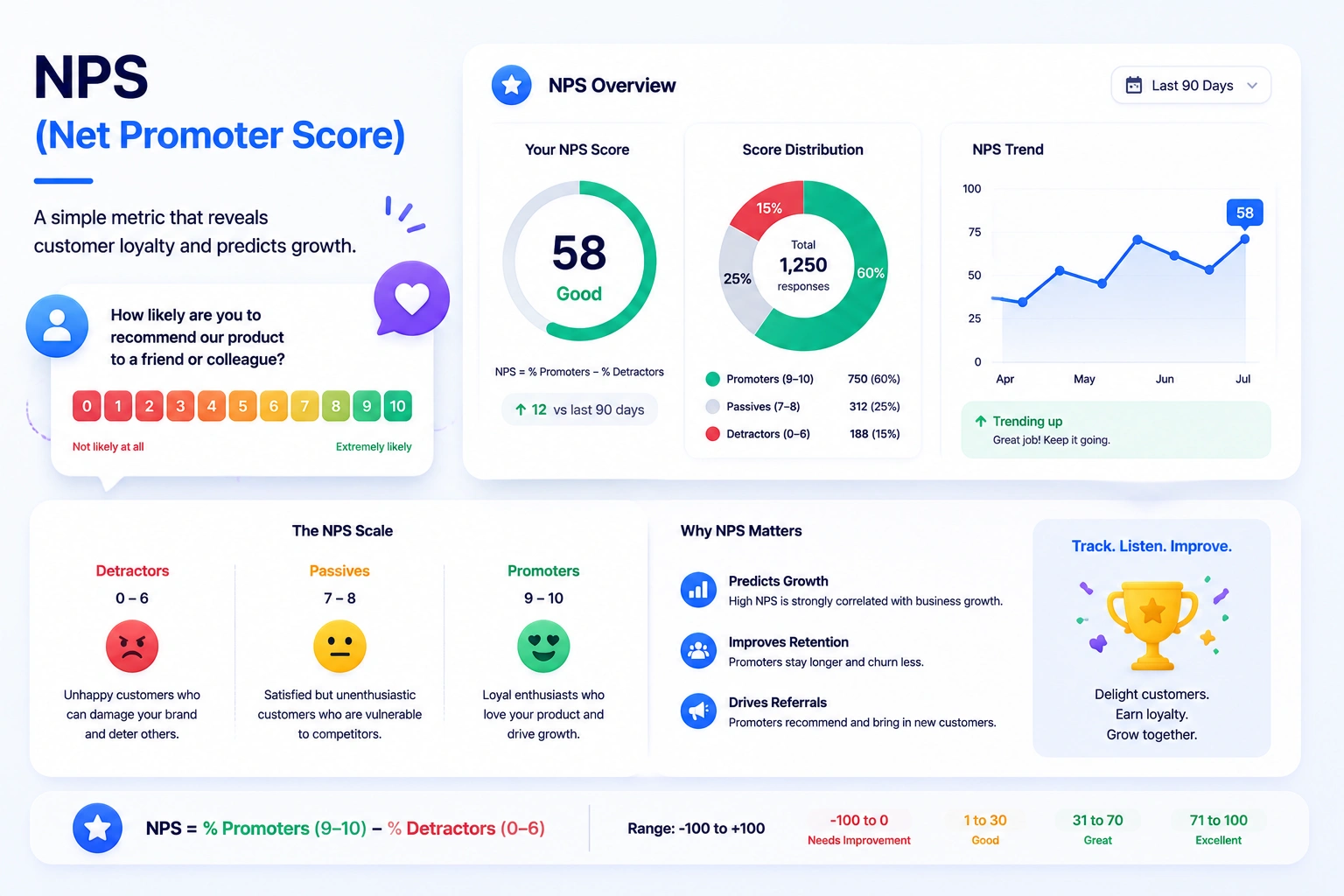
What Is NPS (Net Promoter Score)?
Net Promoter Score, commonly called NPS, is one of the most widely used customer experience metrics.
The concept is surprisingly simple.
Customers answer a single question:
“How likely are you to recommend our product, service, or company to a friend or colleague?”
They respond using a scale from 0 to 10.
That single number can reveal a lot about customer sentiment.
Companies use NPS to measure loyalty, identify risks, and understand how customers feel about their overall experience.
Think of it like word-of-mouth in numerical form. If people willingly recommend a product, chances are they’re receiving genuine value from it.
Why NPS Matters
Businesses spend significant time and money attracting customers.
The real challenge comes afterward.
Do customers enjoy the experience enough to stay? More importantly, will they tell others about it?
NPS helps answer those questions.
A strong score often indicates:
- High customer loyalty
- Positive customer experiences
- Strong product-market fit
- Greater customer retention
- Increased referrals
Many growing SaaS companies closely monitor NPS because loyal customers often become their most effective marketing channel.
Happy users talk.
Unhappy users talk even louder.
How NPS Works
The NPS survey asks customers to rate their recommendation likelihood from 0 to 10.
Based on their responses, customers fall into three categories.
Promoters (Score 9–10)
Promoters are enthusiastic supporters.
They enjoy the product, trust the company, and often recommend it to friends, colleagues, and peers.
These customers frequently generate referrals and repeat purchases.
Passives (Score 7–8)
Passives are reasonably satisfied but not highly enthusiastic.
They don’t actively criticize the product, yet they aren’t strong advocates either.
Competitors can often attract passive customers with better offers or experiences.
Detractors (Score 0–6)
Detractors are unhappy customers.
They may leave negative reviews, share frustrations, or stop using the product altogether.
A growing number of detractors can signal deeper issues that need attention.
The NPS Formula
Calculating NPS is straightforward.
NPS = Percentage of Promoters – Percentage of Detractors
Passives are excluded from the final calculation.
Example
Imagine 100 survey responses:
- 60 Promoters
- 25 Passives
- 15 Detractors
NPS = 60% – 15%
NPS = 45
Scores can range from -100 to +100.
A positive score is generally considered good.
Higher scores typically indicate stronger customer loyalty.
What Is a Good NPS Score?
This is one of the most common questions businesses ask.
The answer varies by industry.
Generally:
- Below 0 = Needs improvement
- 0 to 30 = Acceptable
- 30 to 50 = Strong
- 50 to 70 = Excellent
- Above 70 = Exceptional
Industry context matters.
A score that is outstanding in one market may be average in another.
Comparing scores against industry averages often provides better insights than focusing on a single number.
Why Companies Use NPS
NPS offers a quick snapshot of customer sentiment.
That simplicity is one reason it remains popular.
Businesses use NPS to:
Measure Loyalty
It reveals how customers feel about the brand.
Predict Retention
Customers with high scores often stay longer.
Identify Risks
Detractors highlight areas that need attention.
Track Improvement
Regular surveys show whether customer experiences are improving.
Support Growth Decisions
Leadership teams often use NPS alongside other business metrics.
The score itself is valuable.
The customer feedback behind the score is often even more valuable.
NPS in SaaS Businesses
NPS has become particularly popular among SaaS companies.
Subscription-based businesses depend heavily on customer retention.
If users leave, recurring revenue suffers.
SaaS teams often send NPS surveys at key points:
- After onboarding
- Following product adoption
- During subscription renewals
- After support interactions
- Following major product updates
The goal is simple.
Understand customer sentiment before problems become churn.
The Hidden Value of Follow-Up Questions
The numerical score tells part of the story.
The follow-up question often tells the rest.
Many NPS surveys ask:
“What’s the primary reason for your score?”
This feedback can uncover:
- Product frustrations
- Missing features
- Customer support issues
- Pricing concerns
- Positive experiences
A customer who gives a score of 5 may reveal an issue the company never knew existed.
That’s powerful information.
Common NPS Challenges
NPS is useful, but it isn’t perfect.
Many businesses make the mistake of treating it as the only customer metric that matters.
A strong score can still hide problems.
A low score can sometimes reflect temporary frustrations.
Other challenges include:
Survey Fatigue
Customers may ignore frequent surveys.
Low Response Rates
Small sample sizes can distort results.
Cultural Differences
Scoring behavior varies across countries and regions.
Oversimplification
One score cannot fully explain every customer experience.
NPS works best alongside other customer and product metrics.
How to Improve NPS
Improving NPS usually starts with listening.
Customers often explain exactly what’s bothering them.
Businesses can improve scores by:
Improving Product Quality
Fixing bugs and reducing friction.
Simplifying Onboarding
Helping users achieve value faster.
Delivering Better Support
Quick, helpful responses build trust.
Acting on Feedback
Customers appreciate seeing their suggestions implemented.
Communicating Clearly
Transparency builds stronger relationships.
Interestingly, companies that actively respond to negative feedback often see meaningful NPS improvements over time.
NPS vs Customer Satisfaction (CSAT)
People often confuse NPS and Customer Satisfaction (CSAT).
They serve different purposes.
NPS Measures Loyalty
It asks about future recommendation behavior.
CSAT Measures Satisfaction
It focuses on a specific interaction or experience.
For example:
- NPS asks, “Would you recommend us?”
- CSAT asks, “How satisfied were you with today’s support experience?”
Both metrics provide valuable insights.
Many companies track them together.
Real-World Examples of NPS in Action
Many successful companies use NPS as part of their customer experience strategy.
Slack
Monitors user feedback to improve collaboration experiences.
Canva
Uses customer insights to refine product usability.
HubSpot
Collects loyalty data across multiple customer touchpoints.
Zoom
Tracks user sentiment while continuously improving meeting experiences.
Airbnb
Measures customer loyalty among both hosts and guests.
These businesses understand something important.
Customer feedback isn’t just data. It’s direction.
The Future of NPS
Customer expectations continue to evolve.
NPS is evolving alongside them.
Artificial intelligence can now analyze customer comments, identify patterns, and detect dissatisfaction before it becomes a larger issue.
Predictive analytics can estimate churn risk based on NPS responses and product behavior.
Yet the foundation remains the same.
Ask customers how they feel.
Listen carefully.
Act on what you learn.
That formula continues to work.
Final Thoughts
Net Promoter Score (NPS) is a customer loyalty metric that measures how likely customers are to recommend a business, product, or service to others. Its simplicity makes it easy to understand, while its insights can influence product development, customer success initiatives, support strategies, and long-term growth plans.
The score itself matters, but the feedback behind the score often delivers the greatest value. Companies that listen, learn, and respond to customer concerns often build stronger relationships, improve retention, and create experiences people genuinely want to recommend.
Frequently Asked Questions (FAQs)
1. What does NPS stand for?
NPS stands for Net Promoter Score, a metric used to measure customer loyalty and recommendation likelihood.
2. How is NPS calculated?
NPS is calculated by subtracting the percentage of detractors from the percentage of promoters.
3. What is considered a good NPS score?
A positive score is generally good, while scores above 50 are often viewed as excellent.
4. Why is NPS important?
NPS helps businesses understand customer loyalty, predict retention, and identify areas for improvement.
5. What are promoters, passives, and detractors?
Promoters score 9–10, passives score 7–8, and detractors score 0–6 on the NPS survey scale.
6. Can NPS predict customer churn?
While it cannot predict churn with complete accuracy, low NPS scores often indicate a higher risk of customer dissatisfaction and departure.