


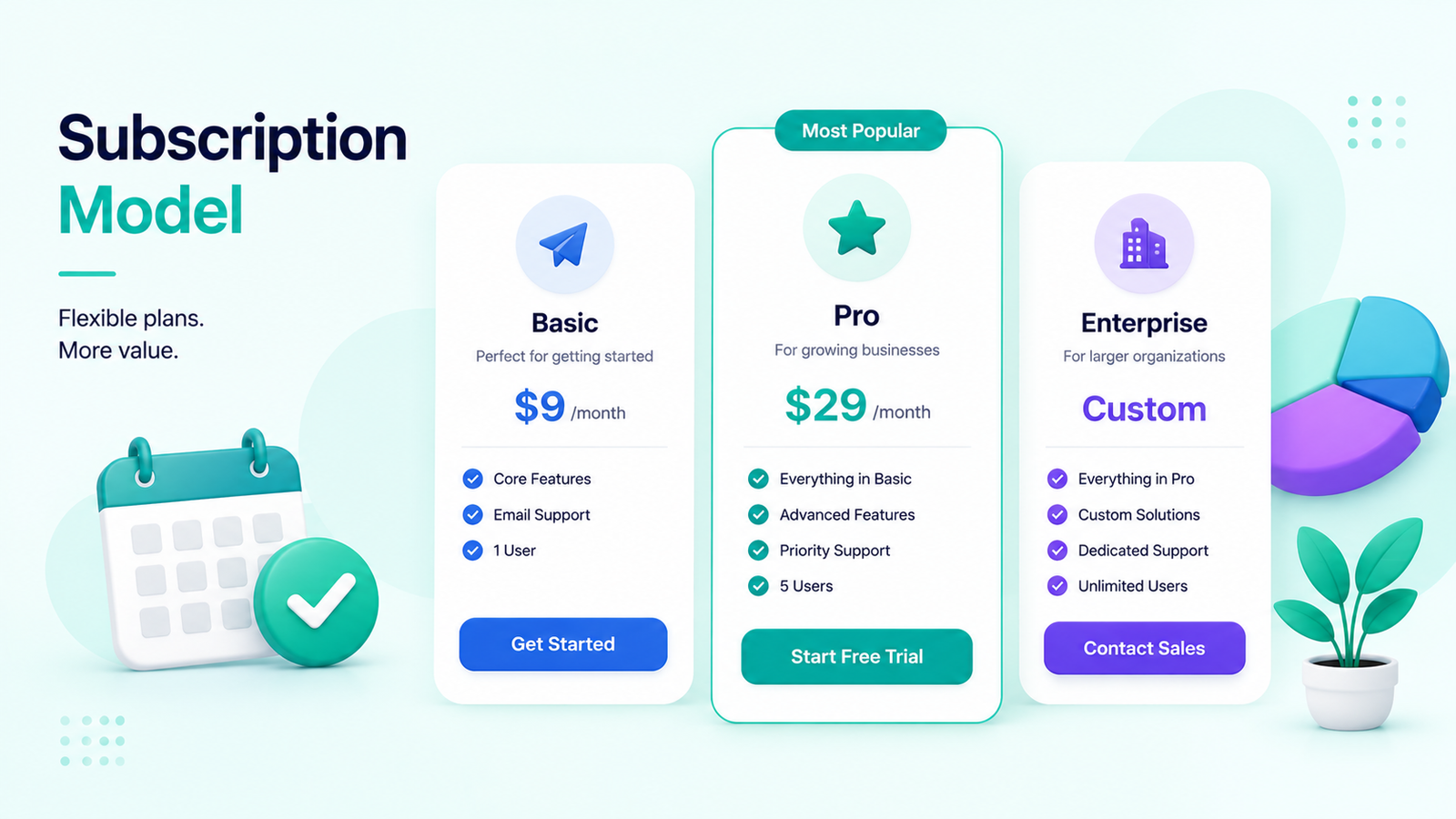
What Is a Subscription Model?
A subscription model is a pricing and revenue approach where customers make recurring payments to continue accessing a product or service.
Instead of paying once and owning something permanently, customers pay regularly—usually monthly, quarterly, or annually.
You’ve probably encountered subscription businesses many times today without thinking about it.
Streaming platforms, music apps, cloud storage services, fitness memberships, meal kits, online learning platforms, and software products often operate this way.
The concept is simple.
Customers receive ongoing value, and businesses receive recurring revenue.
Why Subscription Models Have Become So Popular
Think about how people consume products today.
Many customers prefer flexibility over large upfront purchases.
Paying a smaller monthly amount often feels easier than making a significant one-time investment.
Businesses appreciate subscription models for a different reason.
Recurring revenue creates greater predictability.
Instead of constantly chasing new sales, companies can focus on retaining existing customers and improving their experience.
This shift has changed entire industries.
Software, entertainment, education, healthcare, fitness, and even automotive services increasingly rely on recurring payment structures.
How a Subscription Model Works
At its core, the process is straightforward.
A customer subscribes to a service and agrees to recurring billing.
As long as payments continue, access remains active.
A typical subscription cycle looks like this:
Sign Up
The customer selects a plan and creates an account.
Payment
Billing occurs according to the chosen subscription period.
Access
The customer receives access to products, services, or content.
Renewal
The subscription automatically renews unless canceled.
Retention
The business works to keep customers satisfied and engaged.
This cycle repeats throughout the customer relationship.
Different Types of Subscription Models
Subscription businesses come in many forms.
Fixed Subscription
Customers pay a flat recurring fee.
Examples include streaming platforms and software plans.
Tiered Subscription
Different pricing levels provide varying features or usage limits.
Many SaaS companies use this structure.
Usage-Based Subscription
Customers pay based on consumption.
Cloud hosting providers often use this model.
Freemium Subscription
Basic features remain free while premium capabilities require payment.
Many productivity and collaboration tools follow this approach.
Membership Subscription
Customers receive ongoing access to exclusive content, services, or communities.
Professional organizations and online communities commonly use membership pricing.
Familiar Examples of Subscription Models
Subscription businesses appear everywhere.
Streaming Platforms
Movies, television shows, and music are delivered through recurring plans.
Software Products
Design tools, CRM platforms, accounting software, and project management systems frequently use subscriptions.
Fitness Services
Gyms, workout applications, and coaching platforms often rely on monthly memberships.
Online Learning
Educational platforms provide ongoing access to courses through recurring payments.
Subscription Boxes
Customers receive curated products on a recurring schedule.
The model works across digital and physical products alike.
Why Businesses Love Subscription Models
Here’s the thing.
Predictable revenue makes planning easier.
Businesses can forecast growth more accurately and make longer-term decisions with greater confidence.
Subscription models often provide:
- Recurring revenue streams
- Stronger customer relationships
- Better financial forecasting
- More opportunities for upselling
- Increased customer lifetime value
- Continuous customer feedback
Many companies also benefit from more consistent cash flow compared to one-time purchase models.
Why Customers Like Subscription Models
The appeal isn’t limited to businesses.
Customers often appreciate subscriptions for practical reasons.
Lower Initial Costs
Monthly payments reduce upfront spending.
Ongoing Updates
Software products frequently receive improvements and new features.
Flexibility
Many subscriptions can be upgraded, downgraded, or canceled.
Convenience
Automatic renewals reduce purchasing friction.
Continuous Access
Users always have access to the latest version of a service or product.
For many people, subscriptions fit naturally into modern spending habits.
Challenges of Running a Subscription Business
Subscription businesses aren’t perfect.
Maintaining customer satisfaction becomes an ongoing responsibility.
Unlike one-time purchases, customers continuously evaluate whether the service remains worth paying for.
Common challenges include:
Customer Churn
Subscribers may cancel if value declines.
Competition
Switching services can be relatively easy.
Retention Pressure
Businesses must continually prove value.
Subscription Fatigue
Consumers sometimes feel overwhelmed by multiple recurring payments.
A subscription model succeeds when value consistently exceeds expectations.
Important Subscription Metrics
Subscription businesses rely heavily on performance metrics.
Several measurements help evaluate growth and stability.
MRR (Monthly Recurring Revenue)
Measures recurring monthly income.
ARR (Annual Recurring Revenue)
Measures recurring annual revenue.
Churn Rate
Tracks subscription cancellations.
Customer Acquisition Cost (CAC)
Measures the cost of acquiring new customers.
Lifetime Value (LTV)
Estimates total revenue generated by a customer relationship.
Retention Rate
Measures how many customers continue subscribing over time.
These metrics often guide strategic decisions.
Subscription Models in SaaS
Software companies have become some of the strongest advocates of subscription pricing.
Rather than selling software licenses once, SaaS businesses provide continuous access through recurring plans.
This creates advantages for both sides.
Customers receive ongoing improvements.
Businesses receive recurring income that supports future development.
Many well-known SaaS companies structure pricing around monthly and annual subscriptions because the model encourages long-term customer relationships.
The Future of Subscription Businesses
Subscription models continue evolving.
Companies increasingly personalize pricing, features, and experiences based on customer needs.
Artificial intelligence, automation, and usage-based billing are influencing how subscription businesses operate.
Some organizations are experimenting with hybrid pricing models that combine subscriptions with usage-based charges.
Despite these changes, one principle remains constant.
Customers stay subscribed when they receive consistent value.
Final Thoughts
A subscription model is a business approach where customers pay recurring fees to access products, services, content, or software over time. The model creates predictable revenue for businesses while providing customers with flexibility, convenience, and ongoing value.
From SaaS platforms and streaming services to online education and membership communities, subscription models have become one of the most widely used revenue structures in modern business. Companies that consistently deliver value often build stronger customer relationships and achieve sustainable growth through recurring revenue.
Frequently Asked Questions (FAQs)
1. What is a subscription model?
A subscription model is a pricing structure where customers pay recurring fees, usually monthly or annually, for continued access to a product or service.
2. Why are subscription models popular?
They provide predictable revenue for businesses and flexible payment options for customers.
3. What industries use subscription models?
Common industries include SaaS, streaming media, fitness, education, healthcare, publishing, and e-commerce.
4. What is the difference between a subscription model and a one-time purchase?
A subscription involves recurring payments for ongoing access, while a one-time purchase requires a single payment for ownership or access.
5. What metrics are important for subscription businesses?
Key metrics include MRR, ARR, churn rate, retention rate, CAC, and customer lifetime value.
6. What is subscription churn?
Subscription churn measures the percentage of customers who cancel their subscriptions during a specific period.