


User Interview: Understanding Users Through Meaningful Conversations
Imagine you’re building a food delivery app.
Your team has brainstormed dozens of features. The designs look polished. Stakeholders have strong opinions about what customers want.
Everything seems clear.
Then you sit down with five actual users.
Within twenty minutes, you realize many of your assumptions were wrong.
One user orders food for elderly parents.
Another uses delivery apps only during work travel.
A third struggles with small text and confusing checkout screens.
Suddenly, the picture becomes much clearer.
That’s the power of a user interview.
A user interview is one of the most effective ways to learn directly from the people who use, buy, or interact with a product. It helps researchers move beyond assumptions and discover what users actually think, feel, need, and experience.
The conversation may appear simple on the surface, yet the insights gathered can shape entire products.
What Is a User Interview?
A user interview is a research method where researchers speak directly with users to gather information about their experiences, behaviors, motivations, goals, and challenges.
The format is usually one-on-one.
Researchers ask open-ended questions and encourage participants to share stories, opinions, frustrations, and expectations.
Unlike a survey, where responses are often limited to predefined answers, interviews allow deeper exploration.
One answer often leads to another question.
One story can reveal a problem nobody anticipated.
The goal isn’t to sell, persuade, or validate an existing idea.
The goal is to learn.
Why User Interviews Matter
Many teams think they understand their users.
Sometimes they’re right.
Many times they’re not.
People interact with products in ways that designers, developers, and business stakeholders never expect.
A user interview provides a direct window into that reality.
Instead of guessing what people want, teams hear it firsthand.
Instead of assuming why users behave a certain way, researchers can ask.
And sometimes the most valuable insight comes from something completely unexpected.
A casual comment can uncover a major usability issue.
A simple complaint can reveal a larger business opportunity.
That’s why user interviews remain one of the most trusted research methods in UX.
More Than Questions and Answers
At first glance, a user interview may seem like a structured conversation.
And it is.
Yet there’s another layer.
Researchers aren’t only listening to words.
They’re paying attention to:
- Emotions
- Frustrations
- Confidence levels
- Hesitations
- Workarounds
- Behavioral patterns
Sometimes what a participant pauses before saying can be as revealing as the answer itself.
Human behavior is fascinating that way.
The Purpose of User Interviews
User interviews help researchers understand people on a deeper level.
Common objectives include:
- Learning about user needs
- Discovering pain points
- Understanding goals
- Exploring decision-making processes
- Validating assumptions
- Identifying unmet needs
- Improving existing experiences
The purpose isn’t always finding problems.
Sometimes interviews uncover positive experiences worth strengthening.
Good research looks for both opportunities and obstacles.
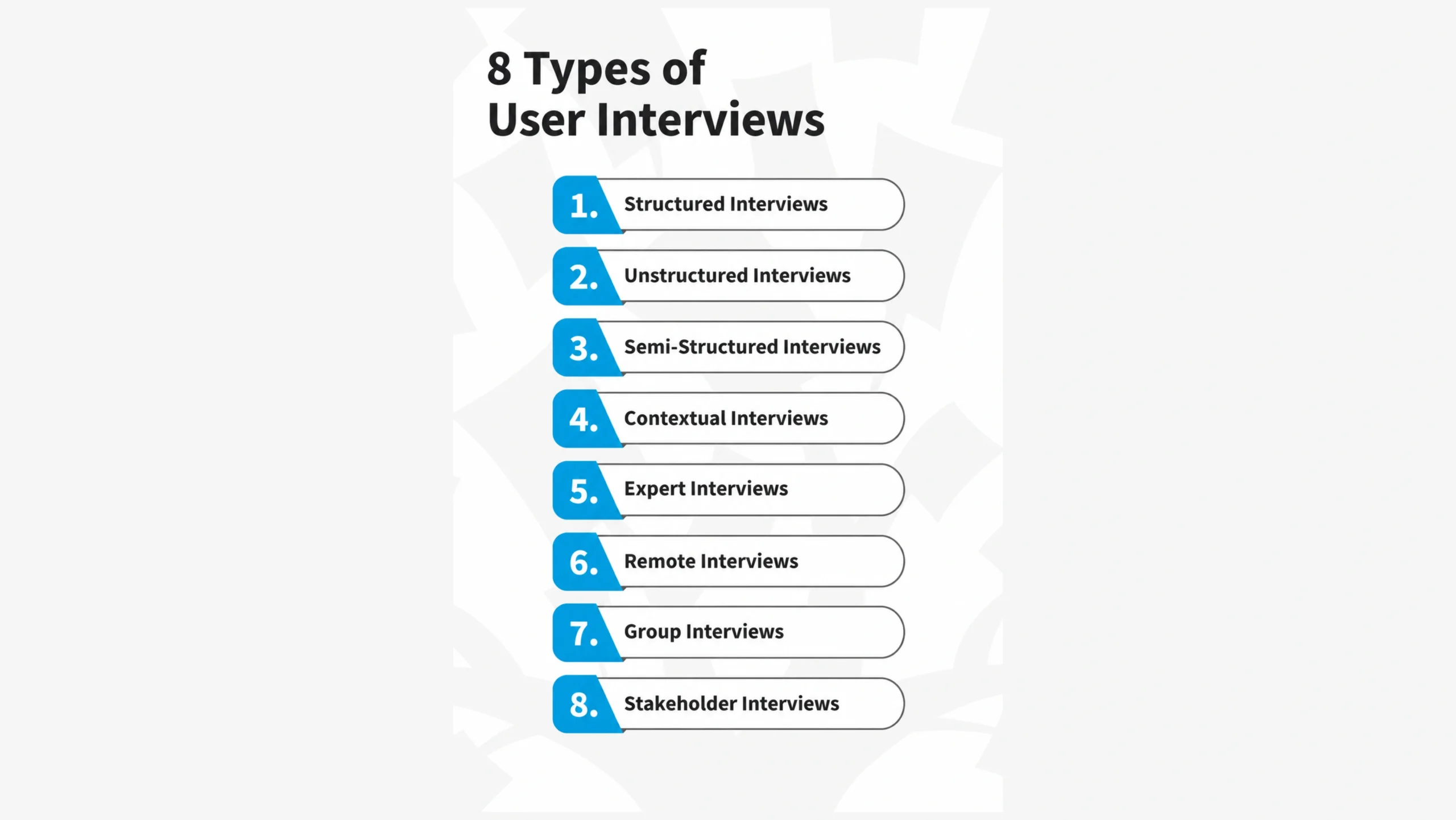
Types of User Interviews
Not every interview serves the same purpose.
Different projects require different approaches.
Exploratory Interviews
Exploratory interviews happen early in a project.
Researchers use them to learn about users, behaviors, and problems.
At this stage, the goal is discovery rather than evaluation.
Questions remain broad and open-ended.
Contextual Interviews
These interviews take place within the user’s environment.
Researchers observe people while they perform tasks.
For example:
- Watching a nurse use medical software
- Observing a restaurant manager schedule employees
- Studying how customers shop online
Context often reveals details users forget to mention.
Evaluative Interviews
Evaluative interviews focus on testing ideas, concepts, prototypes, or products.
Researchers gather feedback on existing designs and features.
The goal is learning what works and what doesn’t.
Structured Interviews
Structured interviews follow a predefined set of questions.
Each participant receives the same questions in the same order.
This approach helps researchers compare responses consistently.
Semi-Structured Interviews
This is the most common format in UX research.
Researchers prepare guiding questions but allow conversations to flow naturally.
Interesting topics can be explored further through follow-up questions.
The balance between structure and flexibility makes this approach particularly effective.
Unstructured Interviews
Unstructured interviews resemble open conversations.
Researchers begin with a topic and allow participants to guide much of the discussion.
This method can reveal unexpected insights but requires strong interviewing skills.
When Should User Interviews Be Conducted?
User interviews can happen throughout the product lifecycle.
Many people associate interviews with early discovery research.
They are valuable there.
They’re valuable later too.
Teams conduct interviews:
- Before designing a product
- During concept development
- While testing prototypes
- After product launch
- During feature improvements
- During redesign projects
Research isn’t a one-time activity.
User needs evolve.
Markets change.
Technology shifts.
Continuous learning keeps teams connected to real users.
The User Interview Process
Effective interviews follow a thoughtful process.
Let’s walk through the major stages.
Step 1: Define Research Goals
Everything begins with clear objectives.
Researchers determine what they want to learn.
Questions might include:
- Why do customers abandon checkout?
- How do users manage daily tasks?
- What influences purchasing decisions?
Focused goals lead to focused interviews.
Step 2: Recruit Participants
The right participants matter enormously.
Researchers seek people who closely match the target audience.
Talking to the wrong people often produces misleading insights.
Quality recruitment frequently determines research quality.
Step 3: Create an Interview Guide
An interview guide serves as a roadmap.
It includes:
- Introduction questions
- Core discussion topics
- Follow-up prompts
- Closing questions
The guide keeps conversations organized without making them feel rigid.
Step 4: Conduct Interviews
Researchers create a comfortable environment and encourage honest discussion.
The best interviews feel natural.
Participants should feel like they’re sharing experiences, not taking an exam.
Good interviewers spend more time listening than talking.
Step 5: Analyze Findings
After interviews are completed, researchers organize and review the data.
Patterns begin to emerge.
Repeated frustrations often signal larger issues.
Recurring needs often reveal opportunities.
Individual comments matter.
Patterns matter even more.
Step 6: Share Insights
Research findings must reach stakeholders, designers, product managers, and developers.
Insights can be shared through:
- Research reports
- Presentations
- Journey maps
- Personas
- Workshops
Research becomes valuable when it influences decisions.
Asking Better Questions
Here’s where things get interesting.
The quality of insights often depends on the quality of questions.
Poor questions create poor data.
Strong questions create meaningful conversations.
Open-Ended Questions Work Best
Instead of asking:
“Do you like this feature?”
Ask:
“Can you tell me about your experience using this feature?”
The second question invites discussion.
The first encourages a simple yes-or-no answer.
Focus on Past Behavior
People predict future behavior poorly.
Past behavior is usually more reliable.
Instead of asking:
“Would you use this feature?”
Ask:
“How did you solve this problem the last time it happened?”
Real experiences often reveal more than hypothetical situations.
Avoid Leading Questions
Leading questions influence responses.
For example:
“How helpful was our easy checkout process?”
The question already assumes the checkout process is easy.
Neutral questions create more trustworthy results.
What Makes a Good User Interview?
Successful interviews share several characteristics.
Active Listening
Great interviewers listen carefully.
They don’t rush to the next question.
They follow interesting clues.
Sometimes the most valuable insight emerges from an unexpected direction.
Curiosity
Researchers approach interviews with curiosity.
They seek understanding rather than confirmation.
This mindset often uncovers surprising discoveries.
Empathy
Participants are sharing experiences, frustrations, and sometimes personal stories.
Empathy helps create trust.
Trust encourages honesty.
Honesty creates better research.
Flexibility
Interview guides are helpful.
Rigid scripts are not.
Researchers should adapt when participants reveal interesting information.
Some of the strongest insights emerge outside the planned discussion.
Common Mistakes During User Interviews
Even experienced researchers make mistakes occasionally.
Several challenges appear frequently.
Talking Too Much
Researchers sometimes explain ideas excessively.
That limits participant responses.
The participant should do most of the talking.
Asking Biased Questions
Biased wording influences answers and reduces research quality.
Neutral language remains critical.
Interrupting Participants
People often reveal valuable insights if given time to think.
Interruptions can cut off important stories and details.
Patience matters.
Looking for Validation
Research isn’t about proving ideas are correct.
It’s about discovering the truth.
Sometimes findings support assumptions.
Sometimes they challenge them.
Both outcomes are valuable.
Ignoring Non-Verbal Signals
Participants communicate through body language, facial expressions, and tone.
A hesitant response may reveal uncertainty.
A frustrated tone may indicate a deeper issue.
Listening goes beyond words.
User Interviews vs Surveys
Both methods gather user feedback.
They serve different purposes.
User interviews provide depth.
Surveys provide breadth.
Interviews help answer:
- Why?
- How?
- What happened?
Surveys help answer:
- How many?
- How often?
- What percentage?
Many research teams combine both methods for a richer understanding.
Think of interviews as a microscope and surveys as a wide-angle lens.
Each reveals something different.
Benefits of User Interviews
Organizations continue using interviews because they generate valuable insights.
Some key benefits include:
Rich Qualitative Insights
Participants explain motivations, feelings, and experiences in their own words.
Discovery of Hidden Problems
Users often reveal challenges teams never anticipated.
Better Product Decisions
Real user feedback reduces guesswork.
Stronger Empathy
Teams gain a deeper appreciation for user needs and frustrations.
Reduced Product Risk
Research helps identify issues before expensive development work occurs.
Improved Customer Experiences
Products become easier, more useful, and more enjoyable to use.
Popular Tools for User Interviews
Modern teams use various tools to conduct and analyze interviews.
Common options include:
- Zoom
- Google Meet
- Microsoft Teams
- Lookback
- User Interviews
- Dovetail
- Notion
- Miro
- Otter
- Figma
Technology helps manage the process.
The human conversation remains the centerpiece.
AI and the Future of User Interviews
Artificial intelligence is beginning to support research workflows.
Researchers now use AI for:
- Transcription
- Note summarization
- Theme identification
- Insight clustering
These capabilities save time.
Still, interpretation remains deeply human.
People understand emotion, nuance, humor, context, and cultural signals in ways software still struggles to match.
The strongest research teams combine technology with human judgment.
A Simple Conversation Can Change Everything
You know what?
One of the most fascinating aspects of user interviews is how simple they appear.
It’s just a conversation.
No complicated dashboard.
No advanced analytics platform.
No sophisticated algorithm.
Just two people talking.
Yet those conversations often uncover insights that shape products, services, businesses, and customer experiences.
A single interview can challenge months of assumptions.
A handful of interviews can redirect an entire product strategy.
That’s remarkable.
Final Thoughts
A user interview is a qualitative research method that helps teams understand users through direct conversations. By exploring experiences, goals, motivations, and challenges, researchers gain insights that numbers alone cannot provide.
These interviews help organizations create products grounded in real human needs rather than assumptions.
The method may seem straightforward, yet it remains one of the most powerful tools in UX research.
Products change.
Technology evolves.
Customer expectations shift.
One thing remains constant: meaningful conversations with real users continue to reveal some of the most valuable insights a team can discover.
Frequently Asked Questions (FAQs)
What is a user interview?
A user interview is a research method where researchers speak directly with users to understand their experiences, needs, motivations, behaviors, and challenges.
Why are user interviews important in UX research?
User interviews provide deep qualitative insights that help teams understand users beyond analytics and surveys. They reveal motivations, pain points, and unmet needs.
How long should a user interview last?
Most UX user interviews last between 30 and 60 minutes, depending on research goals and discussion topics.
What is the difference between a user interview and a survey?
User interviews provide detailed conversations and deeper insights, while surveys collect structured feedback from larger groups and generate measurable data.
How many user interviews are needed?
The number varies by project. Many UX studies begin uncovering recurring patterns after interviewing five to ten participants from the target audience.
What are the most common user interview mistakes?
Common mistakes include asking leading questions, interrupting participants, talking too much, recruiting the wrong users, and seeking validation instead of learning.