


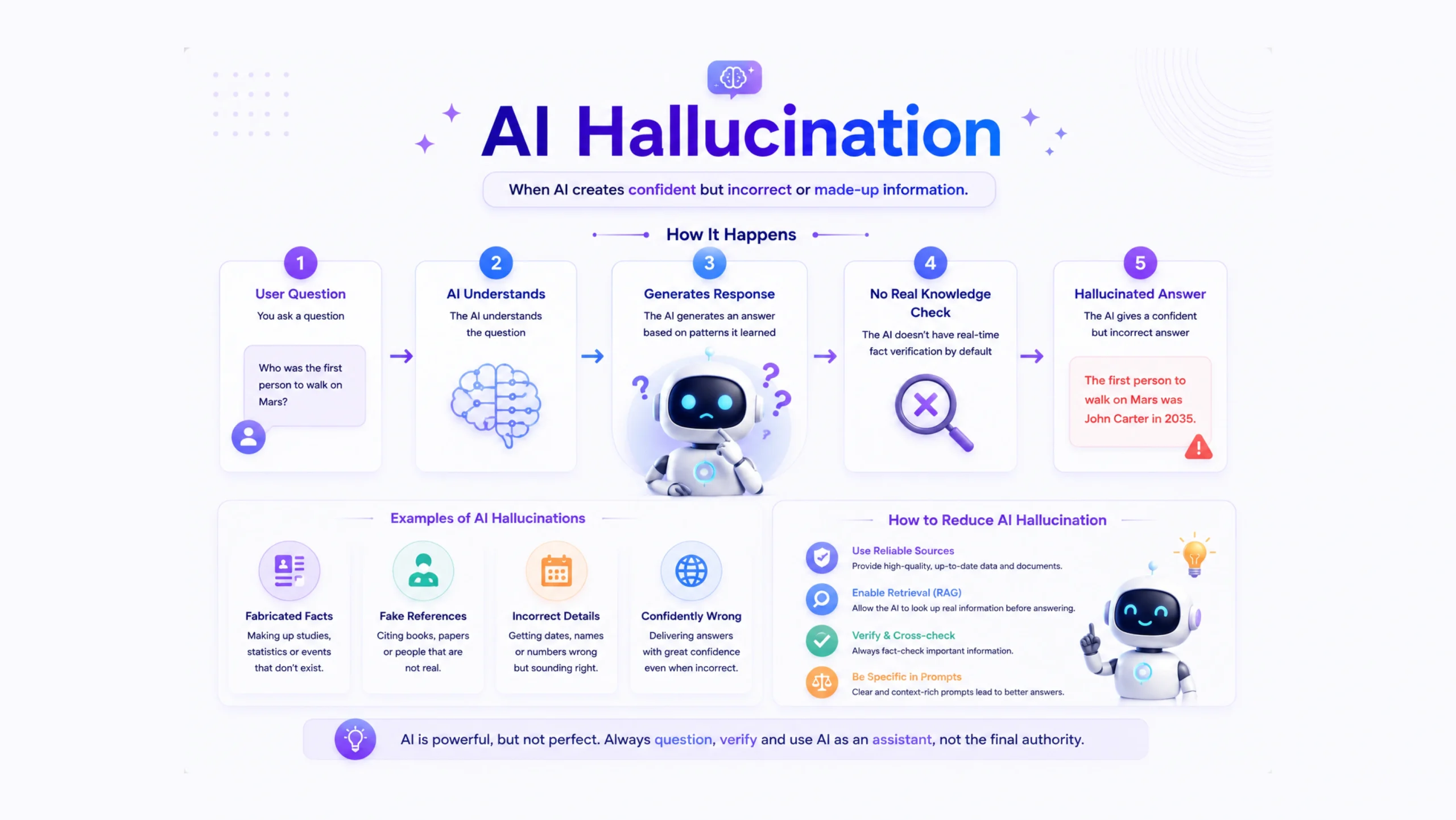
What Is AI Hallucination?
AI hallucination is a phenomenon where an artificial intelligence system produces information that sounds believable but is actually inaccurate, misleading, or entirely made up.
The term might sound dramatic. After all, machines don’t literally hallucinate the way humans do. Yet the phrase has stuck because it describes a surprisingly similar outcome: the AI confidently presents something that doesn’t exist in reality.
You ask an AI tool for a statistic, a quote, a source, or a historical fact. It responds instantly. The answer looks polished. The grammar is perfect. The confidence is convincing.
Then you check the information and realize the source never existed, the quote was invented, or the statistic was fabricated.
That’s an AI hallucination.
As artificial intelligence becomes part of daily work, education, healthcare, customer service, and software development, understanding hallucinations has become increasingly important.
Why Do AI Hallucinations Happen?
Here’s the thing: large language models aren’t databases.
Many people assume AI works like a search engine that looks up facts and retrieves correct answers. In reality, most language models generate text by predicting what words are likely to come next based on patterns learned from massive amounts of data.
Think of it like a person who has read millions of books and articles but doesn’t always remember where information came from.
The AI recognizes patterns such as:
- Common sentence structures
- Frequently associated concepts
- Writing styles
- Relationships between words and ideas
Sometimes those patterns lead to accurate responses.
Sometimes they create information that sounds right but isn’t.
The model fills gaps with probability rather than certainty.
The Confidence Problem
One reason hallucinations are dangerous is confidence.
Humans usually signal uncertainty.
We say things like:
- “I think…”
- “I’m not sure…”
- “Maybe…”
- “I need to check that.”
AI systems often don’t.
An AI can present a completely incorrect answer with the same confidence it uses for a correct one.
That makes hallucinations harder to detect, especially for users who are unfamiliar with the topic.
A student researching a paper, a business analyst preparing a report, or a developer writing code may assume the response is trustworthy simply because it sounds authoritative.
Different Types of AI Hallucinations
AI hallucinations aren’t all the same. They appear in several forms.
Fabricated Facts
The AI invents information.
Examples include:
- Fake statistics
- Nonexistent research papers
- Imaginary historical events
- Invented product specifications
This is one of the most common forms.
Fake Citations and Sources
Researchers encounter this frequently.
An AI may generate:
- Academic papers that don’t exist
- Journal articles with incorrect authors
- Broken references
- Fabricated publication details
The citation format often looks perfectly legitimate.
The source simply isn’t real.
Incorrect Reasoning
Sometimes the facts are correct, but the conclusion isn’t.
The AI may connect ideas incorrectly and produce flawed reasoning.
This can happen in business analysis, legal discussions, scientific topics, and financial reports.
Hallucinated Code
Developers see this regularly.
An AI might:
- Invent software libraries
- Create nonexistent functions
- Suggest invalid API calls
- Generate code that appears correct but fails during execution
The syntax may look clean even when the logic is flawed.
Visual Hallucinations
Image-generation systems experience hallucinations too.
Examples include:
- Extra fingers on hands
- Distorted faces
- Incorrect text in images
- Objects appearing where they shouldn’t
You may have seen AI-generated images where a person mysteriously has six fingers. That’s a visual hallucination.
Why Hallucinations Matter
A small mistake in a casual conversation isn’t usually a big issue.
The risks grow when AI is used in high-stakes situations.
Consider a few examples:
Healthcare
A hallucinated medical recommendation could influence treatment decisions.
Legal Research
An attorney relying on fabricated legal cases could submit incorrect information to a court.
Education
Students may unknowingly cite nonexistent sources.
Finance
Investors could make decisions based on incorrect market information.
Business
Leaders might create strategies using inaccurate reports or forecasts.
The more people trust AI outputs without verification, the greater the potential impact.
Are All AI Models Affected?
Yes.
Hallucinations affect nearly all generative AI systems to some degree.
This includes:
- Chatbots
- Writing assistants
- Coding assistants
- Image generators
- Voice assistants
- AI agents
Some models perform better than others, particularly those connected to current data sources or retrieval systems.
Yet no model is completely immune.
Even advanced systems occasionally generate inaccurate information.
How RAG Helps Reduce Hallucinations
One major advancement involves a technique called Retrieval-Augmented Generation (RAG).
Instead of relying solely on information learned during training, a RAG system retrieves relevant documents from trusted sources before generating a response.
Think of it as giving the AI access to a reference library before answering a question.
Without retrieval:
AI guesses based on learned patterns.
With retrieval:
AI grounds its answer using actual documents.
This doesn’t eliminate hallucinations entirely, though it often reduces them significantly.
That’s one reason many enterprise AI systems now combine language models with knowledge bases, documentation repositories, and search systems.
Signs You Might Be Seeing a Hallucination
You don’t always need to be an expert to spot one.
Some warning signs include:
- Highly specific statistics without sources
- Citations you can’t verify
- Overly confident answers to obscure questions
- Contradictory statements
- References to products, books, or studies that seem difficult to find
- Technical explanations that sound impressive but feel vague
A good rule is simple:
The more important the information, the more important verification becomes.
How to Reduce AI Hallucinations
AI users can take several practical steps.
Ask for Sources
Request supporting references whenever possible.
Then verify them independently.
Use Trusted Data
Connect AI systems to company documents, databases, or approved knowledge repositories.
Break Complex Questions Into Parts
Smaller questions often produce more reliable responses than broad requests.
Verify Critical Information
Always confirm:
- Medical advice
- Legal information
- Financial recommendations
- Research citations
- Technical specifications
Use Human Review
AI works best as a collaborator, not a final authority.
Human judgment still matters.
Quite a lot, actually.
AI Hallucination vs Human Error
People sometimes compare hallucinations to human mistakes.
There is some truth in that comparison.
Humans misremember facts.
Humans make assumptions.
Humans occasionally fill knowledge gaps with guesses.
The difference lies in perception.
When people make mistakes, uncertainty is often visible.
AI can produce mistakes wrapped in confidence, making them harder to catch.
That’s why responsible AI use combines machine speed with human oversight.
The Future of AI Hallucinations
Researchers are actively working on reducing hallucinations through:
- Better training methods
- Retrieval systems
- Fact-checking mechanisms
- Agent-based verification workflows
- Improved reasoning models
- Domain-specific knowledge systems
The quality of AI outputs has improved dramatically over the past few years.
Yet hallucinations remain one of the biggest challenges in artificial intelligence.
The goal isn’t perfection. That’s unrealistic.
The goal is making AI systems more reliable, transparent, and easier to trust.
Final Thoughts
AI hallucination refers to instances where an AI system generates information that is incorrect, misleading, or completely fabricated while presenting it as accurate. These errors occur because language models predict likely responses rather than verifying facts in the way humans often assume.
As AI becomes woven into workplaces, classrooms, software products, and daily life, recognizing hallucinations becomes a valuable skill. The most effective approach combines AI’s speed and creativity with human verification and critical thinking.
AI can be remarkably helpful. It can save time, spark ideas, and simplify complex tasks. Still, a healthy dose of verification goes a long way—especially when accuracy matters.
Frequently Asked Questions (FAQs)
1. What is AI hallucination?
AI hallucination occurs when an AI system generates false, misleading, or fabricated information and presents it as factual.
2. Why do AI models hallucinate?
AI models predict likely responses based on patterns in data rather than verifying facts, which can lead to incorrect outputs.
3. Are AI hallucinations common?
Yes. All generative AI systems can experience hallucinations, though the frequency varies by model, task, and available data sources.
4. Can AI hallucinations be completely eliminated?
No. Current AI systems cannot completely eliminate hallucinations, though techniques such as retrieval systems and fact-checking can reduce them.
5. How can users detect AI hallucinations?
Users can verify sources, cross-check facts, look for inconsistencies, and be cautious of highly confident answers without evidence.
6. What is the difference between AI hallucination and misinformation?
AI hallucination is typically an unintentional generation error by an AI model, while misinformation may be created or shared intentionally or unintentionally by people or organizations.