DNA Automation Consulting takes on one of the less glamorous—but increasingly important—parts of modern business: making complex processes work better.
From process discovery and modelling to automation, integration, and BPM consulting, the company helps organizations bring more structure and efficiency to the way they operate. What makes its digital presence especially interesting is how it turns this technical subject into a clear and approachable visual story.
With a distinctive blue interface, generous spacing, process diagrams, subtle UI details, and a strong DNA-inspired concept, the website feels less like a traditional enterprise consultancy site and more like a modern digital product experience.
DNA Automation Consulting: Turning Process Chaos Into Intelligent Organizational DNA
In large organizations, the problem is rarely a lack of technology. More often, it is the way different processes, systems, teams, and tools work—or fail to work—together.
That is the space DNA Automation Consulting operates in.
Based in Split, Croatia, DNA is an EU-nearshored business process management consultancy focused on process discovery, modelling, automation, integration, and BPM technology.
Its work spans platforms including ARIS, Camunda, ServiceNow, SAP Signavio, and Microsoft Power Platform, while its own product, Concordia BPM, brings an AI-powered and open approach to business process management.
But what makes their website particularly interesting from a design perspective is how it communicates a fairly complex enterprise subject without making the experience feel overly corporate or technical.
From Process Chaos to Intelligent, Resilient Organizational DNA
The homepage opens with a strong statement:
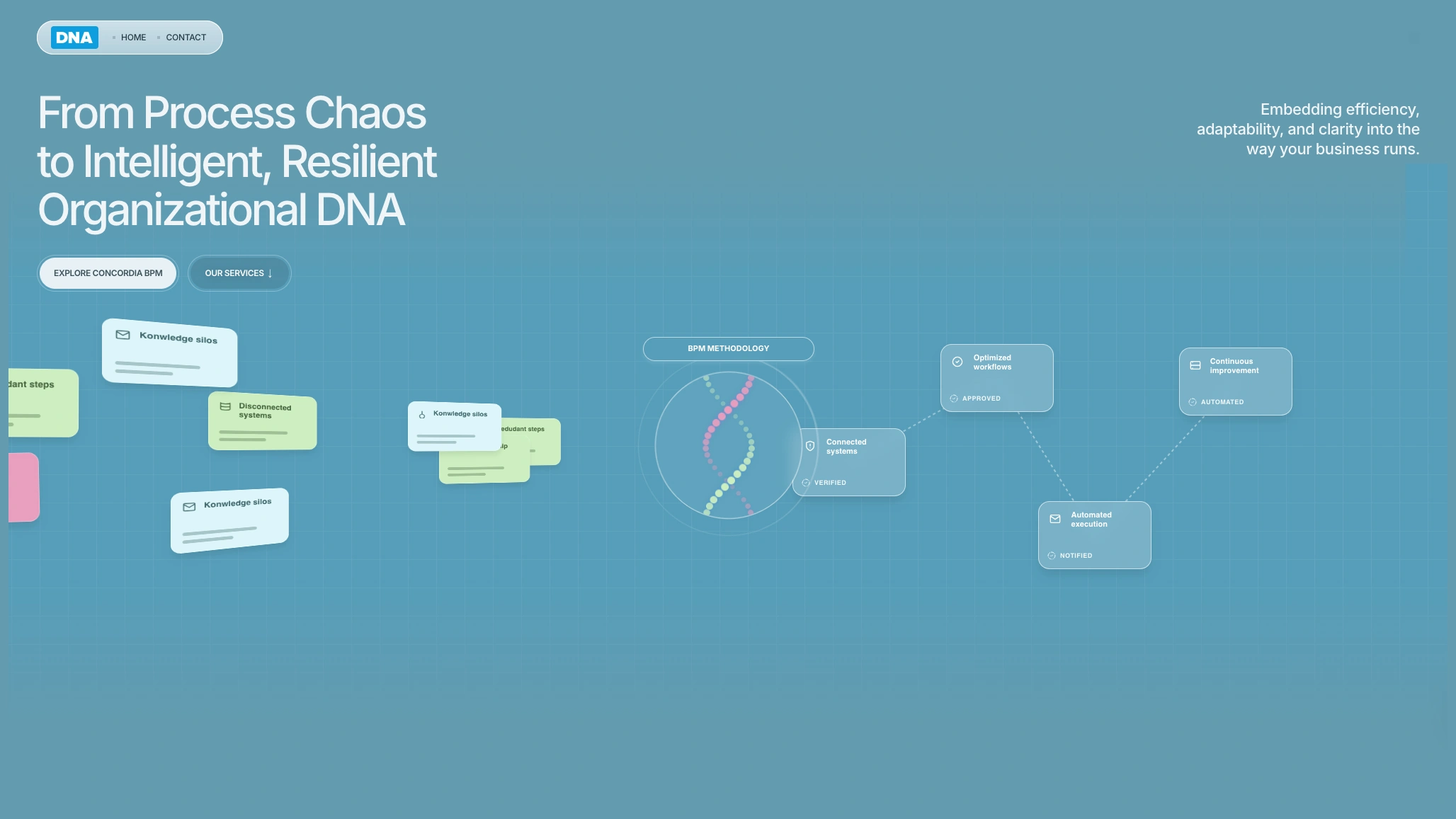
“From Process Chaos to Intelligent, Resilient Organizational DNA.”
It’s a clever way of framing what DNA actually does. Rather than leading with a long list of consulting services, the site immediately presents a transformation—from messy, inefficient processes to something more intelligent, structured, and resilient.
The supporting message is equally straightforward: the goal is to embed efficiency, adaptability, and clarity into the way a business operates.
That positioning carries through the entire website.
Instead of making visitors dig through technical terminology to understand the offering, the homepage gradually introduces the problem, the methodology, the expertise, the technology, and finally the product.
It’s essentially a story about how an organization can move from complexity to clarity.
A Homepage With a Distinctive Visual Personality
The first thing that stands out in the homepage screenshot is the blue-toned visual system.
Rather than relying on the typical enterprise-tech combination of dark navy, gradients, stock photography, and glowing dashboards, DNA uses a softer blue background throughout much of the page.
That creates a calm and consistent visual environment.
White typography sits comfortably against the blue, while small pastel cards, diagrams, icons, and interface elements introduce contrast without overwhelming the page.
The result feels technical, but not intimidating.
That’s important for a consultancy working with enterprise processes, where the subject matter can easily become dense.
Turning Processes Into Visual Stories
One of the more interesting design decisions is how the website uses visual process diagrams and floating cards instead of relying heavily on traditional photography.
The hero area includes small process-related cards and a central DNA-inspired graphic. It’s a subtle reference to the company’s name and its positioning around the “organizational DNA” of a business.
Further down the page, the “What we do?” section breaks the service offering into three clear stages:
- Process Discovery & Analysis
- Process Design & Modelling
- Process Automation & Integration
That structure mirrors the actual methodology DNA describes on the site: understand the current process, design the future state, and then implement automation and integration. (DNA Consulting)
It’s a good example of content and interface design working together. Instead of simply listing services, the website turns them into a progression.
A Strong Use of Typography and White Space
The typography is another important part of the visual identity.
Large headlines create hierarchy without needing oversized illustrations or photography. Supporting text is kept relatively small, allowing the main statements to breathe.
The page also makes generous use of space.
This is particularly noticeable in sections such as “Why us?” and the transition into the platform expertise section. Rather than filling every available area with content, the design gives individual messages room to stand on their own.
That restraint helps balance the amount of information being presented.
And there is quite a lot of information.
DNA talks about enterprise process management, automation, integrations, platforms, consulting experience, proprietary extensions, and its own BPM product. A conventional corporate website could easily become a wall of text.
Here, the visual pacing helps break that information into smaller moments.
The “Why Us?” Section Feels More Like Evidence Than Marketing
The next section focuses on why a business might work with DNA.
Instead of only using generic statements such as “experienced team” or “innovative solutions,” the website highlights specific capabilities:
- EU-nearshored delivery
- Vendor-neutral expertise
- Integration capabilities
- Proprietary extensions
- Long-term client relationships
- Product innovation
The vendor-neutral positioning is particularly interesting because DNA says its experience covers ARIS, Camunda, Signavio, ServiceNow, and Power Platform, and that recommendations are based on what fits the client rather than simply what is licensed.
That makes the section feel more grounded in the company’s actual work.
The DNA Concept Comes Back Throughout the Experience
One of the strongest branding moments on the page is the transition into:
“Redefining the Genetic Code of Digital Organizations.”
This is where the company’s name and its business proposition come together.
The “DNA” metaphor could easily have been used only in the hero headline and forgotten. Instead, it becomes part of the visual and verbal language of the site.
That gives the brand a stronger sense of continuity.
It’s a small detail, but these recurring ideas are often what make a website feel like a brand experience rather than a collection of sections.
Platform Expertise Without Making It Feel Like a Product Catalogue
DNA works across a fairly technical ecosystem, including ARIS, Camunda, ServiceNow, SAP Signavio, and Power Automate. The homepage dedicates a significant section to this expertise.
What’s interesting is how the design handles it.
Instead of throwing a huge list of technologies at visitors, each platform gets its own space and supporting explanation.
For example, the ARIS section talks about methodology setup, scripting, automation, portal customization, governance, and process mining. The Camunda section moves into BPMN/DMN modelling, Java/Spring Boot development, Angular, REST API integrations, and custom modules.
For the right audience, that level of specificity is useful. It tells technically minded visitors that this isn’t simply a strategy consultancy—it can also get into implementation.
Concordia BPM Gets Its Own Spotlight
The homepage eventually shifts from consultancy into product territory with Concordia BPM, DNA’s own open, AI-powered BPM platform.
This is arguably the most product-focused part of the experience.
The messaging centres around three problems many BPM platforms struggle with: usability, transparency, and end-user adoption. DNA describes Concordia as combining AI-guided process design, workflow automation, process monitoring, and an open technology stack.
The visual treatment changes here too.
Product screenshots, interface previews, and the large product name create a sense that visitors have moved from consulting services into an actual software product.
That separation is useful because it gives Concordia its own identity while still connecting it to DNA’s years of consulting experience.
The Design Keeps Returning to Real Outcomes
Another nice touch is the transition from technology back to relationships.
The website states that more than 75% of its engagements last five years, positioning long-term partnerships as an important part of the business.
Client logos then reinforce that message.
This creates a sensible progression:
Expertise → Technology → Product → Client relationships
It feels more convincing than simply placing a “Trusted by” logo strip near the top of the homepage.
A CTA That Brings Everything Back to the Core Idea
The homepage ends with:
“Let’s redefine your organization’s process DNA.”
It’s a natural callback to the opening headline.
The CTA invites visitors to modernize their BPM approach, automate operations, or explore Concordia BPM.
That gives the homepage a sense of closure. The same idea introduced at the beginning—organizational DNA—comes back at the end as an invitation to take action.
Final Take
DNA Automation Consulting’s website is a good example of how a technically complex B2B service can be presented without falling into the usual enterprise website patterns.
The soft blue visual language, generous spacing, oversized typography, process diagrams, floating UI cards, subtle motion-oriented composition, and product interface visuals give the website a distinctive character.
More importantly, the design supports the story.
It takes visitors through process discovery → process design → automation → platform expertise → Concordia BPM → long-term partnership rather than presenting everything as a disconnected list of services.
For designers working on B2B SaaS, enterprise software, consulting websites, or process-heavy products, there is a useful lesson here: complex information doesn’t necessarily need a complex interface.
Sometimes, the better approach is to give the content a clear narrative, establish a strong visual system, and let the design create enough space for the complexity to breathe.
DNA Automation Consulting is a thoughtful example of that approach—where enterprise process management meets a more modern, editorial-style digital experience.