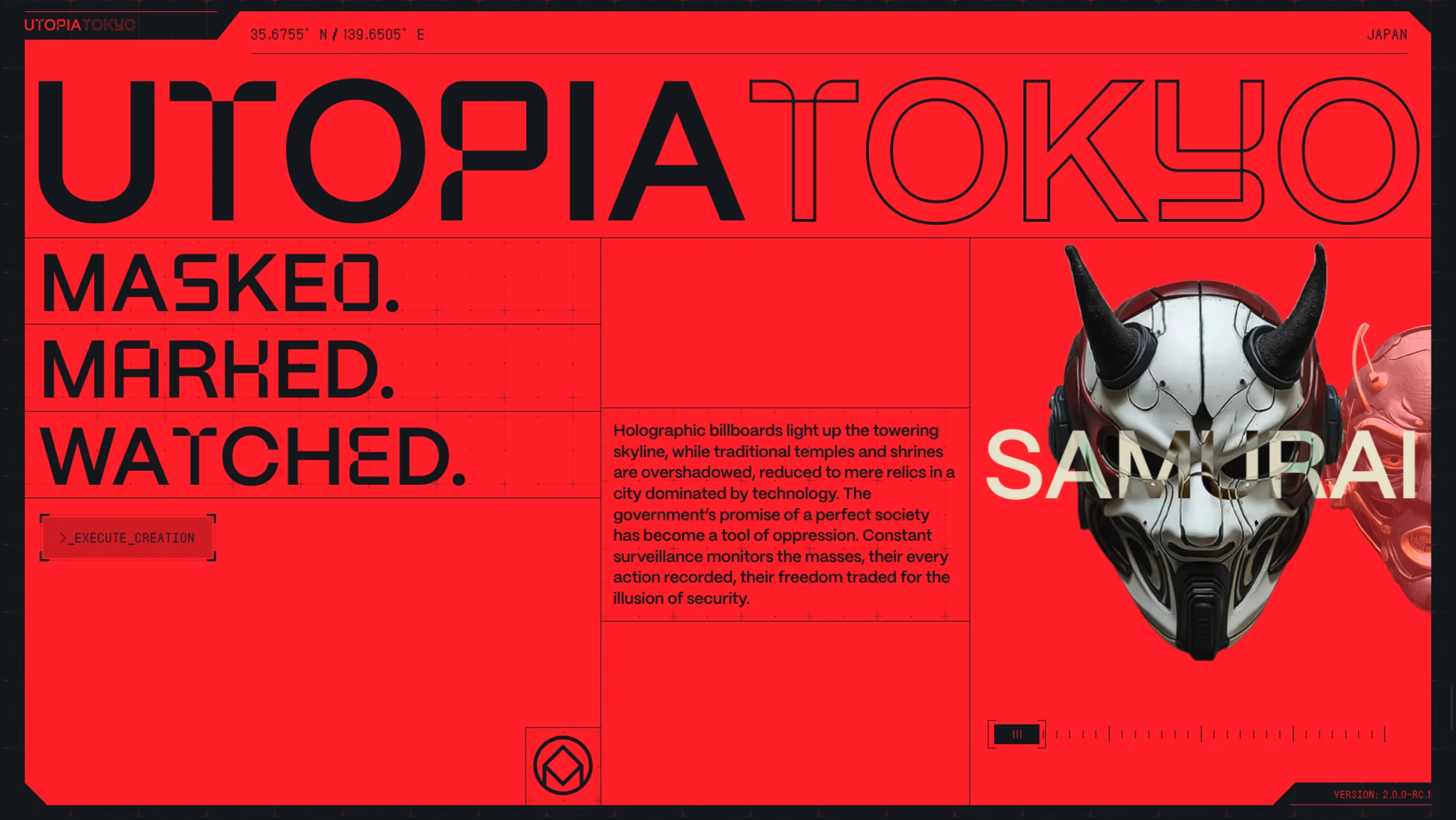
Utopia Tokyo is a boundary-pushing, immersive digital experience that explores a reimagined, cyberpunk future for Japan’s capital. The site functions as a speculative narrative playground where “past and future collide,” blending traditional Japanese folklore—specifically the symbolism of masks—with a dystopian, high-tech aesthetic.
Designers Simon Smeraldi and Andrew Measham created it, influenced by Niccolo Miranda’s creative masterclasses. The site is a premier example of “Experiential Web Design,” moving away from standard utility to focus on world-building and sensory engagement.
Design Philosophy & Immersive UX
The website is a masterclass in Experimental Narrative Design, utilizing several advanced web techniques to tell its story:
- High-Octane Visuals: The site begins with an “Experience Warning,” signaling its use of high-contrast effects, rapid transitions, and glitch aesthetics. It offers a “Safe Mode” for accessibility, demonstrating a responsible approach to experimental design.
- Cyberpunk Futurism: The UI mimics a high-tech terminal or a data-overlaid visor. It uses coordinates (35.6762°N / 139.6503°E), holographic effects, and monospaced typography to create a sense of constant surveillance and “Data Intelligence.”
- Gamified Interaction: Utopia Tokyo isn’t just for reading; it’s for playing. Users can allocate “Skill Points” across categories like Strength, Intellect, Agility, and Spirit to “Discover Their Inner Mask.” Integrating RPG (Role-Playing Game) mechanics directly into the browser creates strong user retention.
- Cultural Fusion: The site beautifully contrasts traditional Japanese elements (masks like Hannya, Oni, and Tengu) with ultra-modern WebGL and GSAP animations, creating a unique “Cyber-Folk” visual language.
Core Features & Tech Stack
From a technical and UI perspective, Utopia Tokyo is a showcase of:
- Advanced Motion Design: Using GSAP and WebGL for fluid, physics-based transitions that feel like a high-budget video game.
- Dynamic Content Loading: The use of “Glitch Effect” loaders and custom progress bars turns technical wait times into part of the narrative.
- Interactive Storytelling: A “Minigame” and “Skill Tree” system that allows users to interact with the content on a personal level.
- Bilingual UI: Integrating Japanese characters and English text seamlessly, reinforcing the “Neo-Tokyo” theme.