


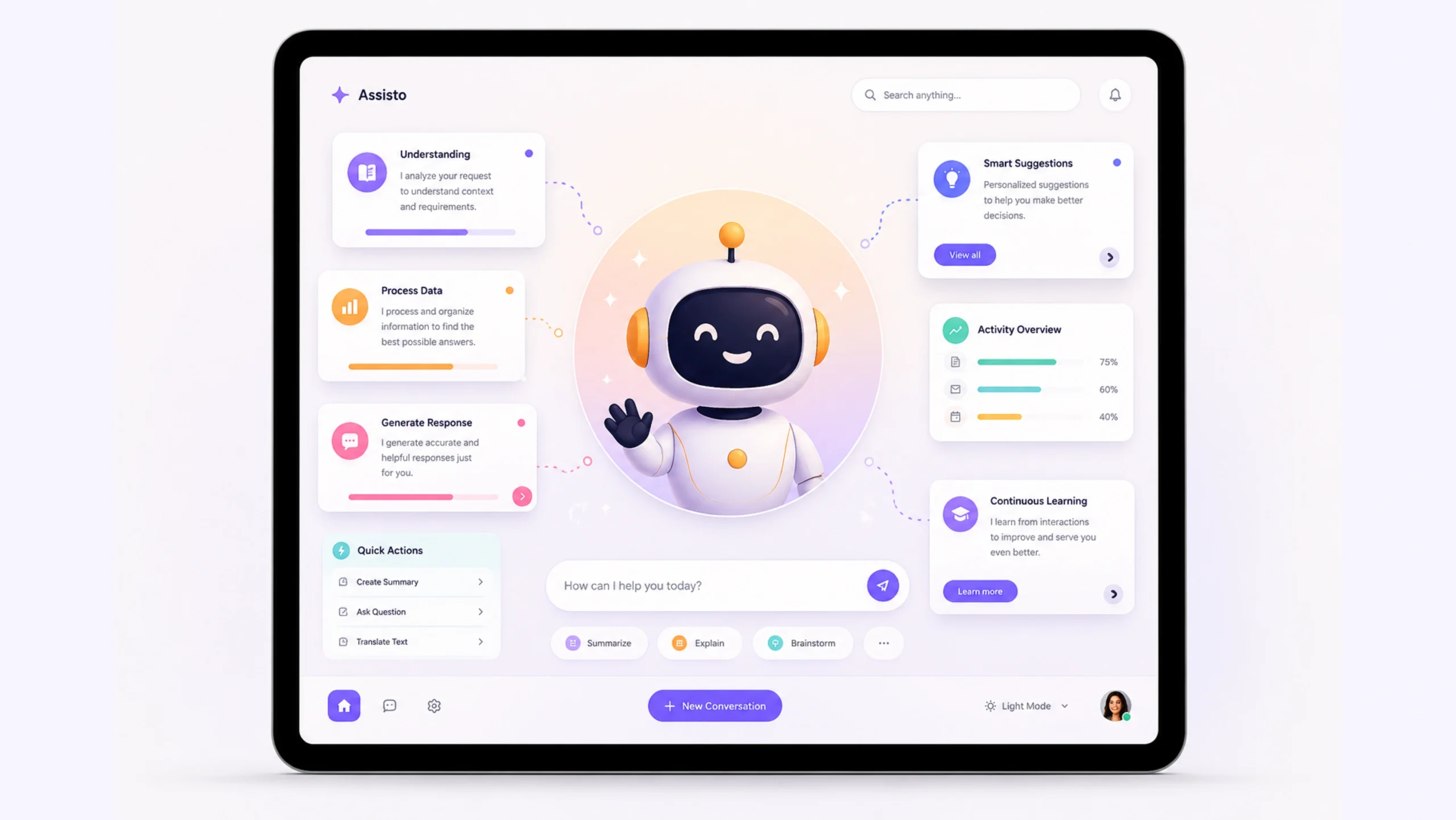
What Is an AI Assistant?
An AI Assistant is a software system that uses artificial intelligence to understand user requests, answer questions, complete tasks, generate content, and provide support through natural conversation.
Think of it as a digital helper that can listen, understand, respond, and sometimes even take action.
Years ago, software required users to learn commands and menus.
AI assistants flipped that relationship.
Now users can simply type or speak what they want.
The system interprets the request and responds in a way that feels surprisingly human.
Whether you’re asking for a recipe, drafting an email, analyzing data, scheduling a meeting, or brainstorming ideas, an AI assistant acts as a bridge between human intent and digital execution.
A Simple Idea With Big Impact
Imagine walking into an office and having a highly knowledgeable assistant sitting nearby.
Need research?
They help.
Need writing support?
They’re ready.
Need a quick summary of a long document?
Done.
That’s the promise of an AI assistant.
Of course, AI isn’t human.
It doesn’t possess personal experiences, emotions, or independent judgment.
Yet modern AI systems can process vast amounts of information and respond with remarkable speed.
That’s why adoption has grown so quickly across industries.
How AI Assistants Work
Behind every AI assistant is a combination of technologies working together.
These commonly include:
- Natural Language Processing (NLP)
- Machine Learning
- Large Language Models (LLMs)
- Speech Recognition
- Knowledge Retrieval Systems
- Automation Workflows
When a user submits a request, the assistant analyzes the language, identifies intent, processes context, and generates a response.
The process happens within seconds.
To users, it often feels like a conversation.
Behind the scenes, it’s an enormous amount of computation.
From Simple Commands to Conversations
Early digital assistants were fairly limited.
They could perform simple tasks such as:
- Setting alarms
- Checking weather forecasts
- Making phone calls
- Playing music
Today’s assistants are capable of far more.
Modern systems can:
- Write articles
- Generate code
- Analyze documents
- Create marketing campaigns
- Summarize meetings
- Translate languages
- Assist with research
- Support customer service
The shift from command-based interactions to conversational intelligence changed expectations for software.
People increasingly expect products to understand them rather than forcing them to learn complicated interfaces.
Different Types of AI Assistants
AI assistants come in many forms.
Personal AI Assistants
These help individuals manage everyday tasks.
Examples include:
- ChatGPT
- Google Assistant
- Amazon Alexa
- Apple Siri
They assist with information, reminders, productivity, and entertainment.
Business AI Assistants
Organizations use AI assistants to support employees and customers.
Common use cases include:
- Customer support
- Internal knowledge search
- Sales assistance
- Employee onboarding
- Report generation
These assistants help teams work faster and handle repetitive tasks.
Industry-Specific AI Assistants
Many organizations build assistants for specialized fields such as:
- Healthcare
- Finance
- Legal services
- Education
- Human resources
These systems focus on industry-specific tasks and terminology.
What Can an AI Assistant Do?
Capabilities continue expanding every year.
Today, many AI assistants can:
- Answer questions
- Write content
- Summarize information
- Generate ideas
- Analyze data
- Translate languages
- Create reports
- Assist with coding
- Support research
- Automate workflows
Some assistants can even connect with external tools and perform actions across multiple systems.
The line between software and assistant is becoming increasingly blurred.
Why People Use AI Assistants
Here’s the thing.
Most people don’t adopt technology because it’s exciting.
They adopt it because it saves effort.
AI assistants help reduce time spent on repetitive tasks.
Instead of manually searching through documents, users can ask questions.
Instead of starting from a blank page, writers can generate first drafts.
Instead of reviewing hundreds of data points, analysts can receive summaries.
The value comes from speed, convenience, and accessibility.
AI Assistants in Product Design
AI assistants are becoming a major part of digital products.
Many companies now integrate AI directly into their applications.
For example:
- Design tools suggest layouts and content.
- CRM platforms recommend next actions.
- Writing tools improve content quality.
- Analytics platforms explain trends.
- Productivity tools automate routine work.
The assistant is no longer a separate application.
It’s becoming part of the product experience itself.
AI Assistant vs Chatbot
People often use these terms interchangeably.
They’re related, but they’re not identical.
Traditional chatbots typically follow predefined rules and scripted responses.
AI assistants are generally more flexible.
They can interpret intent, manage context, generate original responses, and handle a wider range of tasks.
A chatbot might answer frequently asked questions.
An AI assistant might answer questions, write content, analyze data, and automate workflows within the same conversation.
The Human Side of AI
One interesting aspect of AI assistants is how quickly people assign human qualities to them.
Users often say things like:
“Can you help me?”
“What do you think?”
“Thank you.”
The interaction feels personal even though it involves software.
Good AI design acknowledges this behavior.
Successful assistants communicate clearly, explain limitations, and build trust through consistency.
People don’t expect perfection.
They expect helpfulness.
Challenges and Limitations
AI assistants are powerful.
They are not perfect.
Challenges still exist.
These include:
- Incorrect information
- Limited context
- Privacy concerns
- Bias in outputs
- Overreliance on automation
- Difficulty with highly specialized tasks
Human review remains important, particularly in areas involving legal, medical, financial, or high-risk decisions.
AI should support human judgment rather than replace it entirely.
The Future of AI Assistants
AI assistants are moving beyond simple conversations.
Future systems will likely become:
- More personalized
- More context-aware
- More proactive
- Better integrated with business tools
- More capable of completing multi-step tasks
Many experts believe AI assistants will become a standard interface for interacting with software.
Instead of learning dozens of applications, users may simply describe what they want and let the assistant coordinate the work.
It’s a significant shift in how people interact with technology.
AI Assistants and Everyday Work
For students, AI assistants can help explain concepts and organize study materials.
For marketers, they can generate campaigns and analyze customer feedback.
For developers, they can assist with coding and debugging.
For designers, they can support research, content creation, and ideation.
For business leaders, they can summarize reports and surface insights.
The common theme is simple:
Less time spent on repetitive work.
More time available for decision-making, creativity, and problem-solving.
Final Thoughts
An AI assistant is an intelligent software system that helps users complete tasks, answer questions, generate content, and interact with technology through natural language. By combining machine learning, language processing, and automation, AI assistants simplify complex tasks and make digital experiences more accessible.
As artificial intelligence continues advancing, AI assistants are becoming a central part of how people work, learn, communicate, and create. Their role is shifting from simple support tools to collaborative digital partners that help individuals and organizations accomplish more with less effort.
Frequently Asked Questions (FAQs)
1. What is an AI assistant?
An AI assistant is software that uses artificial intelligence to understand user requests and help complete tasks through conversation.
2. How does an AI assistant work?
AI assistants use technologies such as natural language processing, machine learning, and large language models to interpret requests and generate responses.
3. What can AI assistants do?
They can answer questions, generate content, summarize information, analyze data, automate tasks, and support decision-making.
4. What is the difference between an AI assistant and a chatbot?
Chatbots often follow predefined rules, while AI assistants can understand context, generate responses, and perform a broader range of tasks.
5. Are AI assistants used in businesses?
Yes. Many businesses use AI assistants for customer support, employee productivity, sales assistance, knowledge management, and workflow automation.
6. Can AI assistants replace human workers?
AI assistants can automate certain tasks, but human judgment, creativity, empathy, and strategic thinking remain important in many roles.