


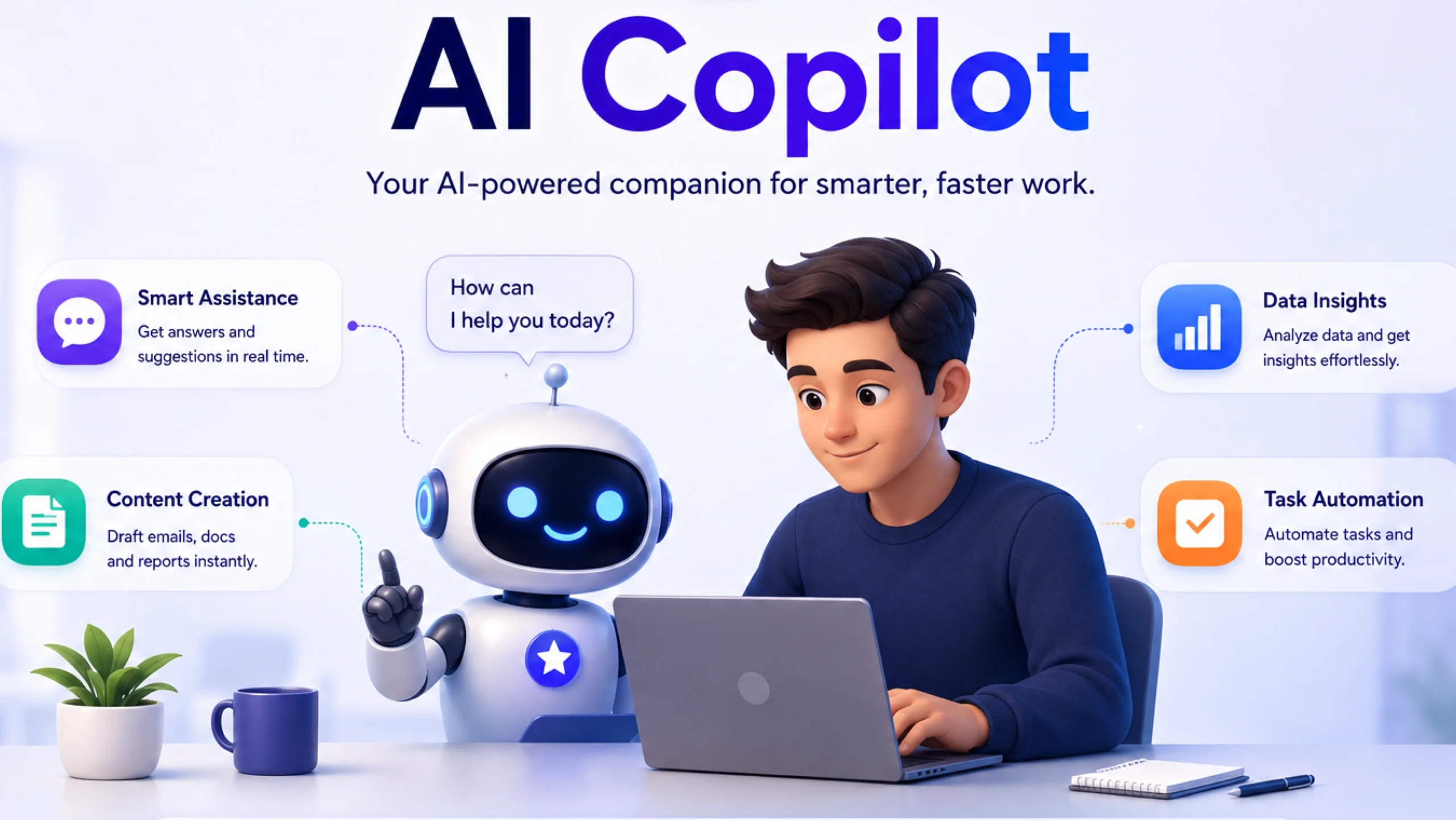
What Is an AI Copilot?
An AI Copilot is an intelligent software assistant that works alongside a user to help complete tasks more efficiently. Instead of replacing people, it acts like a helpful teammate that provides suggestions, automates repetitive work, answers questions, and offers guidance during a task.
The term “copilot” comes from aviation. A copilot supports the pilot, monitors information, and helps make decisions. In much the same way, an AI Copilot assists users while they remain in control.
You can think of it as having a knowledgeable colleague available whenever you need help.
Why AI Copilots Are Becoming Popular
People spend a surprising amount of time on repetitive work.
Writing emails.
Summarizing meetings.
Searching for information.
Creating reports.
Reviewing documents.
These tasks may not be difficult, but they consume valuable hours.
AI copilots help reduce that workload by handling routine activities and providing useful suggestions at the right moment.
As organizations look for ways to improve productivity, AI copilots have quickly become one of the most talked-about applications of artificial intelligence.
A Simple Example
Imagine you’re writing a project proposal.
Instead of staring at a blank page, an AI Copilot can:
- Suggest an outline
- Generate draft content
- Correct grammar
- Summarize research
- Recommend improvements
You still make the final decisions.
The AI simply helps you get there faster.
How Does an AI Copilot Work?
An AI Copilot typically combines several AI technologies, including:
- Large language models (LLMs)
- Natural language processing
- Machine learning
- Knowledge retrieval systems
- Workflow automation tools
When a user asks a question or starts a task, the copilot analyzes the request, gathers relevant information, and generates a response or recommendation.
Many modern copilots can also access documents, databases, emails, calendars, and company knowledge bases to provide context-aware assistance.
The Core Idea: Assistance, Not Replacement
Here’s something people often misunderstand.
An AI Copilot isn’t usually meant to replace human workers.
It’s built to support them.
A graphic designer may use a copilot for brainstorming.
A developer may use one for writing code.
A marketer may use one for campaign ideas.
A project manager may use one for summaries and reporting.
The human remains responsible for decisions and final output.
The AI helps reduce effort and speed up execution.
Key Features of AI Copilots
Most AI copilots include several common capabilities.
Content Generation
They can draft emails, articles, reports, presentations, and other written content.
Task Automation
Routine tasks can often be completed automatically.
Information Retrieval
Users can ask questions and receive answers based on connected documents or databases.
Recommendations
AI copilots frequently suggest actions, improvements, or next steps.
Summarization
Long documents, meetings, and conversations can be condensed into shorter summaries.
Conversational Interaction
Most copilots use natural language, allowing users to interact through simple conversation.
Real-World Examples of AI Copilots
AI copilots are appearing across many industries.
Software Development
Developers use coding copilots that suggest code, identify errors, and generate functions.
Business Productivity
Teams use copilots to draft documents, summarize meetings, and analyze business data.
Customer Support
Support agents receive suggested responses and relevant information during customer conversations.
Sales
Sales professionals use copilots to prepare proposals, analyze customer interactions, and draft follow-up messages.
Healthcare
Medical professionals can use AI-powered tools to summarize notes and assist with documentation.
Why People Like AI Copilots
The appeal is fairly easy to understand.
Nobody enjoys spending hours on repetitive tasks.
AI copilots help reduce manual work and free up time for activities that require creativity, judgment, and human insight.
Some common benefits include:
- Faster task completion
- Increased productivity
- Reduced administrative workload
- Improved consistency
- Better access to information
- Quicker decision-making
For many users, the biggest advantage is simply saving time.
AI Copilot vs AI Assistant
The terms are often used interchangeably, though there is a subtle difference.
AI Assistant
An AI assistant typically responds to requests and answers questions.
Examples include chatbots and virtual assistants.
AI Copilot
An AI copilot actively participates within a workflow.
It provides guidance, suggestions, and contextual help while a task is being performed.
A simple way to think about it:
An assistant waits for instructions.
A copilot works alongside you during the task.
Industries Adopting AI Copilots
AI copilots are becoming common across many sectors.
Technology
Coding, testing, debugging, and documentation support.
Marketing
Content creation, campaign planning, and audience analysis.
Finance
Reporting, forecasting, and data analysis.
Education
Lesson planning, tutoring support, and content generation.
Human Resources
Recruitment assistance, policy drafting, and employee support.
Legal Services
Document review, research assistance, and contract analysis.
Challenges and Limitations
AI copilots offer many advantages, though they aren’t perfect.
Incorrect Information
The AI may occasionally provide inaccurate or outdated responses.
Over-Reliance
Users may trust AI recommendations without proper verification.
Privacy Concerns
Organizations must carefully manage sensitive information shared with AI systems.
Context Limitations
Some copilots may misunderstand complex business requirements or industry-specific nuances.
Human review remains an important part of the process.
The Relationship Between AI Copilots and Productivity
Interestingly, productivity isn’t always about working harder.
Sometimes it’s about removing friction.
Think about how GPS systems changed driving.
Drivers still control the vehicle.
The GPS simply helps them find the best route.
AI copilots play a similar role.
They reduce the mental effort required to locate information, organize tasks, and create content.
The user remains behind the wheel.
The Future of AI Copilots
AI copilots are becoming more capable every year.
Future systems may:
- Understand voice, images, and documents together
- Manage complex workflows automatically
- Collaborate with multiple applications
- Personalize recommendations based on work habits
- Assist entire teams instead of individual users
Many experts believe copilots will become a standard feature across business software, productivity tools, and professional workflows.
Final Thoughts
An AI Copilot is an AI-powered assistant that helps users perform tasks, access information, generate content, and make better decisions while remaining under human control. Rather than replacing people, it works alongside them, reducing repetitive work and improving productivity.
From software development and marketing to customer support and education, AI copilots are becoming valuable workplace companions. As artificial intelligence continues to advance, these tools are likely to become a regular part of how people work, create, and solve problems.
Frequently Asked Questions (FAQs)
1. What is an AI Copilot?
An AI Copilot is an intelligent assistant that helps users complete tasks, generate content, access information, and improve productivity during their workflow.
2. How does an AI Copilot work?
It uses technologies such as large language models, machine learning, and natural language processing to understand requests and provide assistance.
3. What is the difference between an AI Copilot and an AI Assistant?
An AI assistant mainly responds to requests, while an AI copilot actively supports users throughout a task or workflow.
4. Can AI copilots replace human workers?
No. AI copilots are intended to assist users, while humans remain responsible for decisions, oversight, and final outcomes.
5. What are some examples of AI copilots?
Examples include coding assistants, document-writing copilots, meeting summarization tools, and business productivity assistants.
6. What are the benefits of using an AI Copilot?
Common benefits include time savings, increased productivity, faster content creation, improved access to information, and reduced repetitive work.