


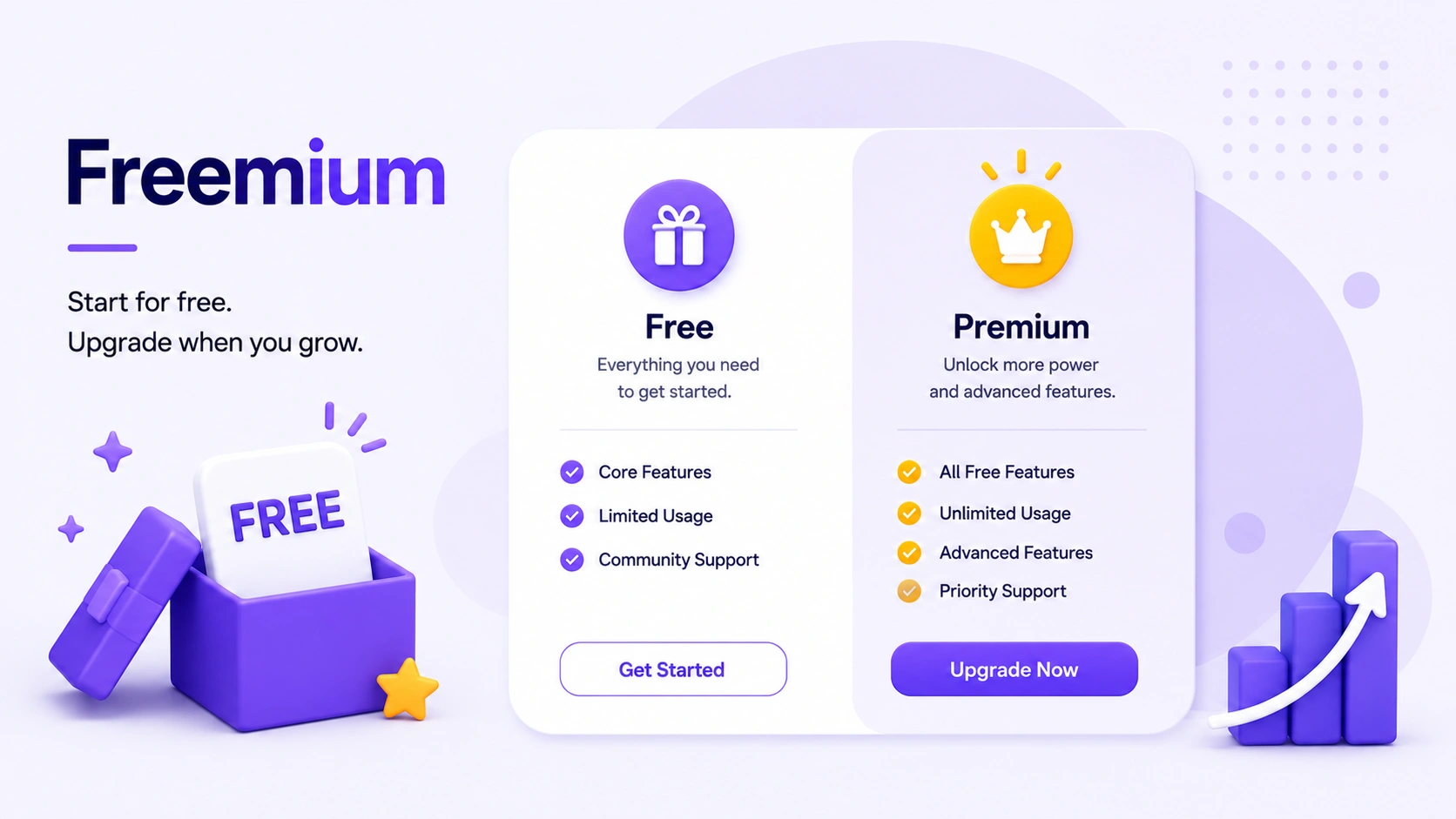
What Is Freemium?
Freemium is a pricing strategy that combines the words “free” and “premium.”
The idea is simple.
Users can access a product without paying anything upfront. They can explore features, solve problems, and experience value before spending money. If they need additional functionality, more storage, advanced tools, or fewer restrictions, they can upgrade to a paid plan.
Many of the apps and software products people use every day follow this approach.
Think about cloud storage platforms, project management tools, design software, note-taking apps, or communication platforms. Most offer a free version alongside one or more paid plans.
It’s a model built on trust. Instead of convincing people through sales pitches alone, the product gets a chance to prove itself.
Why Freemium Became So Popular
People enjoy trying things before making a purchase.
It’s the same reason supermarkets offer food samples and car dealerships offer test drives.
Software companies realized something interesting years ago. If users could experience value first, many would become paying customers later.
The internet made this strategy even more attractive.
A user can sign up within seconds, explore the product immediately, and decide at their own pace if an upgrade makes sense.
That creates less friction and fewer barriers to entry.
For businesses, it often means reaching a much larger audience.
How the Freemium Model Works
At a high level, the process looks straightforward.
Step 1: Free Access
Users sign up and receive access to core features.
Step 2: Product Experience
The user interacts with the platform and discovers its value.
Step 3: Growing Needs
As usage increases, limitations become more noticeable.
Step 4: Upgrade Decision
The user upgrades to gain access to premium features, higher limits, or additional benefits.
The free version acts as both a product and a marketing channel.
Rather than relying entirely on advertisements, the software itself becomes the sales representative.
What Usually Stays Free?
A freemium product typically provides enough functionality to be useful.
Examples include:
- Limited storage space
- Basic collaboration features
- Restricted usage volume
- Fewer customization options
- Smaller project limits
- Standard support
The goal isn’t to frustrate users.
The free version should provide genuine value while naturally encouraging upgrades when needs grow.
What Usually Requires Payment?
Premium plans often include:
- Advanced features
- Increased usage limits
- More storage capacity
- Team collaboration tools
- Analytics and reporting
- Priority customer support
- Security and compliance features
The paid offering must solve bigger problems or save more time.
That’s what motivates users to upgrade.
Familiar Freemium Examples
Many successful companies have built large businesses using freemium pricing.
Dropbox
Users receive free storage and can purchase additional capacity.
Canva
Basic design tools are available for free, while premium templates, assets, and features require a subscription.
Slack
Teams can communicate without paying, though advanced collaboration features and longer message history come with paid plans.
Zoom
Free meetings work well for many users, but larger organizations often upgrade for expanded functionality.
Spotify
Listeners can stream music for free with ads or subscribe for an ad-free experience and additional benefits.
These examples demonstrate how free access can attract millions of users.
Why Businesses Love the Freemium Model
Freemium can create powerful growth opportunities.
Faster User Acquisition
People are far more likely to try something when no payment is required.
Lower Sales Resistance
The product demonstrates value before asking for money.
Strong Word-of-Mouth Growth
Free users often recommend products to friends and colleagues.
Product-Led Growth
The software itself helps generate conversions.
Larger Market Reach
Companies can attract users who may never have signed up for a paid-only service.
When executed properly, freemium can become a major growth engine.
Why Users Like Freemium
The benefits extend beyond businesses.
Users appreciate freemium products because they can:
- Try software without financial risk
- Learn features before committing
- Compare alternatives easily
- Upgrade only when necessary
- Access useful tools at no cost
Honestly, people prefer making informed decisions. Freemium supports that behavior naturally.
The Hidden Challenges of Freemium
Freemium sounds perfect.
Yet it comes with complications.
A large percentage of users may never become paying customers.
Supporting free users still costs money. Servers, storage, customer support, and development expenses don’t disappear simply because someone isn’t paying.
Businesses must carefully balance:
- Free user satisfaction
- Upgrade motivation
- Operating costs
- Revenue growth
Finding that balance often determines success or failure.
Freemium vs Free Trial
People sometimes confuse freemium with free trials.
They are different.
Freemium
The free plan remains available indefinitely.
Users can continue using it without paying.
Free Trial
Users receive temporary access to premium features.
After the trial ends, payment becomes necessary to continue.
A free trial creates urgency.
Freemium creates long-term exposure.
Both strategies can work well depending on business goals.
Freemium in SaaS Businesses
Freemium has become closely associated with SaaS companies.
Software products can distribute free accounts at scale, making customer acquisition relatively efficient.
Many SaaS businesses build growth strategies around three stages:
- Acquire users through free plans.
- Deliver value quickly.
- Convert engaged users into paying customers.
This process is often called product-led growth because the product plays a central role in driving conversions.
Metrics That Matter
Businesses using freemium pricing closely track several metrics.
Conversion Rate
The percentage of free users who become paying customers.
Customer Acquisition Cost (CAC)
The cost required to attract new users.
Lifetime Value (LTV)
The total revenue expected from a customer relationship.
Retention Rate
The percentage of users who continue using the product over time.
Churn Rate
The percentage of customers who cancel subscriptions.
These metrics help companies understand whether their freemium strategy is sustainable.
The Future of Freemium
Freemium pricing continues evolving.
Artificial intelligence, personalized onboarding, behavioral analytics, and in-app recommendations are helping businesses guide users toward paid plans more effectively.
Companies are becoming smarter about showing the right upgrade prompts at the right moment.
The core idea remains unchanged, though.
Give users value first. Let the product earn trust. Then offer premium capabilities for people who need more.
That simple formula still works remarkably well.
Final Thoughts
Freemium is a pricing model that gives users free access to a product while reserving advanced features or expanded capabilities for paying customers. It has become one of the most common growth strategies in SaaS, mobile apps, productivity tools, and digital services.
When the free experience delivers genuine value and the premium offering solves bigger problems, freemium can create a win-win situation. Users gain access without financial risk, and businesses build a pipeline of potential customers who already understand the product’s value.
Frequently Asked Questions (FAQs)
1. What does freemium mean?
Freemium is a pricing model where users receive free access to a product, while advanced features or higher usage limits require payment.
2. How is freemium different from a free trial?
A freemium plan remains available indefinitely, while a free trial expires after a limited period.
3. Why do companies use freemium pricing?
It helps attract more users, increase product adoption, and create opportunities to convert free users into paying customers.
4. What are examples of freemium products?
Popular examples include Canva, Dropbox, Slack, Zoom, and Spotify.
5. Is freemium common in SaaS?
Yes. Many SaaS companies use freemium pricing to grow their user base and support product-led growth strategies.
6. What is a freemium conversion rate?
It measures the percentage of free users who upgrade to a paid subscription plan.