


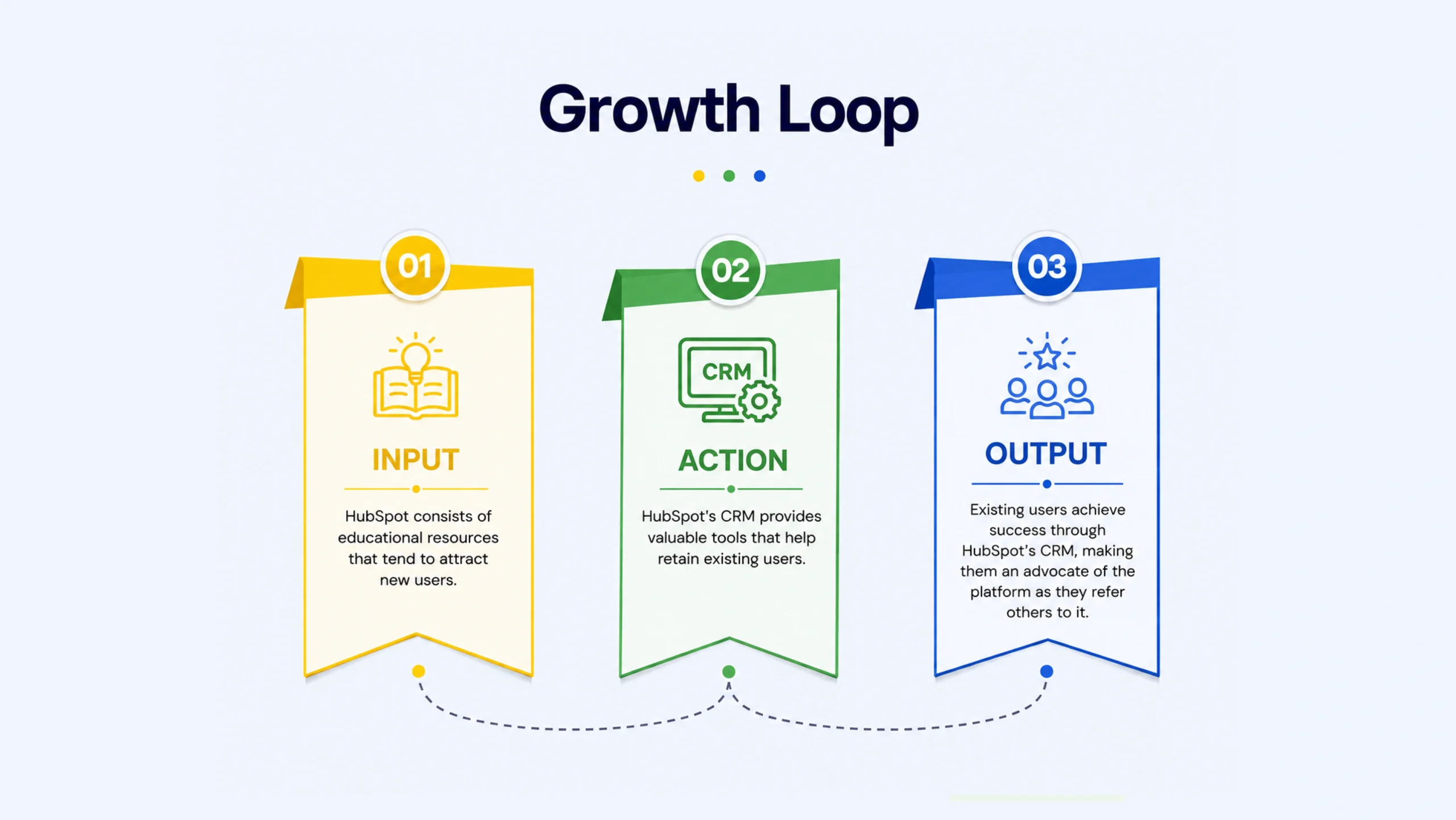
What Is a Growth Loop?
A growth loop is a self-reinforcing system where user actions generate outcomes that attract, engage, or activate more users, creating continuous product growth.
Unlike traditional marketing campaigns that require constant investment, a growth loop creates momentum through the product itself. Each action taken by a user contributes to future growth, forming a cycle that can repeat again and again.
Think of it like a snowball rolling downhill. It starts small, gathers more snow, grows larger, and gains momentum as it moves forward. A well-designed growth loop works in a similar way.
Why Growth Loops Matter
For years, many businesses relied heavily on growth funnels.
A funnel focuses on moving users through stages such as awareness, acquisition, activation, and conversion.
Funnels are useful.
Yet they often have one weakness: the process usually ends after conversion.
Growth loops take a different approach.
Instead of ending with a purchase or sign-up, they create a cycle where one customer’s activity helps generate the next customer.
This creates compounding growth rather than linear growth.
And that’s where things get interesting.
The Basic Idea Behind a Growth Loop
Here’s the thing.
Growth doesn’t happen magically.
Something has to create new opportunities for people to discover and use a product.
A growth loop creates those opportunities through existing user behavior.
The cycle often looks like this:
- Users receive value from the product.
- Their actions create content, referrals, data, or visibility.
- New users discover the product.
- New users receive value.
- The cycle repeats.
The output from one stage becomes the input for the next stage.
That’s why it’s called a loop.
Understanding the Core Components
Most growth loops contain three key parts.
Input
The loop begins with a user action.
Examples include:
- Creating content
- Inviting friends
- Posting reviews
- Sharing links
- Completing transactions
Value Creation
The action creates value for users, customers, or the platform.
Without value, the loop breaks.
People won’t continue participating if they gain nothing in return.
Output
The action produces something that attracts or activates additional users.
This output feeds back into the system and starts another cycle.
Growth Loop vs Growth Funnel
Many people confuse these concepts.
They work differently.
A growth funnel often follows a straight path.
Awareness → Sign-Up → Conversion
Once users reach the final stage, the process ends.
A growth loop keeps moving.
User Activity → Value Creation → New Users → More Activity
Funnels focus on progression.
Loops focus on repetition.
Modern products often use both together.
Funnels help convert users.
Loops help sustain growth.
Common Types of Growth Loops
Different businesses use different loop structures.
Let’s look at a few popular examples.
Viral Loops
Users bring new users into the system.
Referral programs often use this model.
A customer invites friends.
Friends join.
Those friends invite more people.
The cycle continues.
Content Loops
Users create content that attracts additional users.
Social platforms are built around this idea.
Every post, video, comment, or review creates opportunities for discovery.
More content attracts more visitors.
More visitors create more content.
Marketplace Loops
Marketplaces often grow through supply and demand interactions.
More sellers attract buyers.
More buyers attract sellers.
Each side strengthens the other.
Data Loops
Some products improve as users generate more data.
Search engines and recommendation systems frequently use this model.
More usage generates more data.
More data improves the experience.
A better experience attracts more users.
Real-World Examples of Growth Loops
Many successful digital products rely on growth loops.
Social Media Platforms
When users create posts, photos, and videos, that content attracts viewers.
Some viewers become active users.
Those users create more content.
The cycle repeats continuously.
Collaboration Tools
Workplace collaboration platforms often grow through invitations.
One team member invites coworkers.
The coworkers begin using the platform.
They invite additional teammates.
Adoption spreads naturally.
Online Marketplaces
A marketplace with more sellers offers greater selection.
Greater selection attracts buyers.
More buyers attract additional sellers.
Growth occurs on both sides of the platform.
Why Product Teams Love Growth Loops
Growth loops create a direct connection between product value and business growth.
Instead of relying entirely on advertising, teams can build growth into the product experience itself.
This creates several advantages.
- Lower acquisition costs
- Better user retention
- Sustainable growth
- Increased network effects
- Stronger customer engagement
A good growth loop can continue producing results long after launch.
Building a Growth Loop
Creating a growth loop requires careful planning.
Teams usually start by identifying actions users already enjoy taking.
Then they ask:
“Can this action help attract more users?”
For example:
- Can users share their work?
- Can they invite others?
- Can their activity create public visibility?
- Can their success encourage participation?
The strongest loops feel natural.
Users participate because they gain value, not because they’re forced into marketing activities.
Growth Loops and User Experience
UX design plays a significant role in growth loops.
A complicated experience can weaken the loop quickly.
Imagine a referral system hidden behind multiple screens.
Few people will find it.
Few invitations will be sent.
Growth slows down.
Now imagine the same process taking one click.
Participation increases dramatically.
Small design improvements often have a surprisingly large impact on loop performance.
Common Mistakes
Growth loops sound simple.
Building effective ones can be challenging.
Several mistakes appear repeatedly.
Focusing Only on Virality
Not every product needs viral sharing.
Content creation, collaboration, and data generation can create equally powerful loops.
Ignoring User Value
A loop survives only when users benefit from participating.
Without value, growth eventually stalls.
Adding Friction
Too many steps can interrupt the cycle.
Simple experiences tend to produce stronger results.
Measuring the Wrong Metrics
Teams sometimes track sign-ups while ignoring activation and retention.
A healthy loop requires users who continue receiving value.
Measuring Growth Loop Performance
Several metrics help evaluate loop effectiveness.
These include:
- User acquisition rate
- Referral rate
- Activation rate
- Retention rate
- Content creation frequency
- Engagement metrics
The goal isn’t simply acquiring users.
The goal is keeping the loop active and healthy over time.
The Future of Growth Loops
As customer acquisition costs continue rising, growth loops are becoming increasingly important.
Companies want products that contribute directly to growth rather than relying solely on paid marketing channels.
Artificial intelligence, creator economies, social commerce, and community-driven platforms are creating new opportunities for loop-based growth strategies.
Products that successfully connect value creation with user acquisition will likely maintain a competitive advantage for years to come.
Final Thoughts
A growth loop is a self-sustaining cycle where user actions create value that attracts, engages, or activates more users. Unlike traditional funnels that end after conversion, growth loops continue generating momentum through repeated cycles.
When designed thoughtfully, growth loops help products grow naturally, reduce dependency on paid acquisition, and create long-term business value. They connect product experience, user behavior, and growth into a system that keeps feeding itself.
The strongest growth loops don’t feel like marketing. They feel like part of the product itself.
Frequently Asked Questions (FAQs)
1. What is a growth loop?
A growth loop is a self-reinforcing cycle where user actions generate outcomes that help attract and activate additional users.
2. How is a growth loop different from a growth funnel?
A growth funnel follows a linear path, while a growth loop continuously feeds new users back into the system through repeated cycles.
3. Why are growth loops important?
They help products achieve sustainable growth by connecting user value with customer acquisition and engagement.
4. What are common types of growth loops?
Popular examples include viral loops, content loops, marketplace loops, and data loops.
5. Can every product have a growth loop?
Most products can build some type of growth loop, though the structure varies depending on the product and audience.
6. What role does UX play in growth loops?
Good UX reduces friction, encourages participation, and helps users complete actions that keep the growth loop running.