


What Is Growth Marketing?
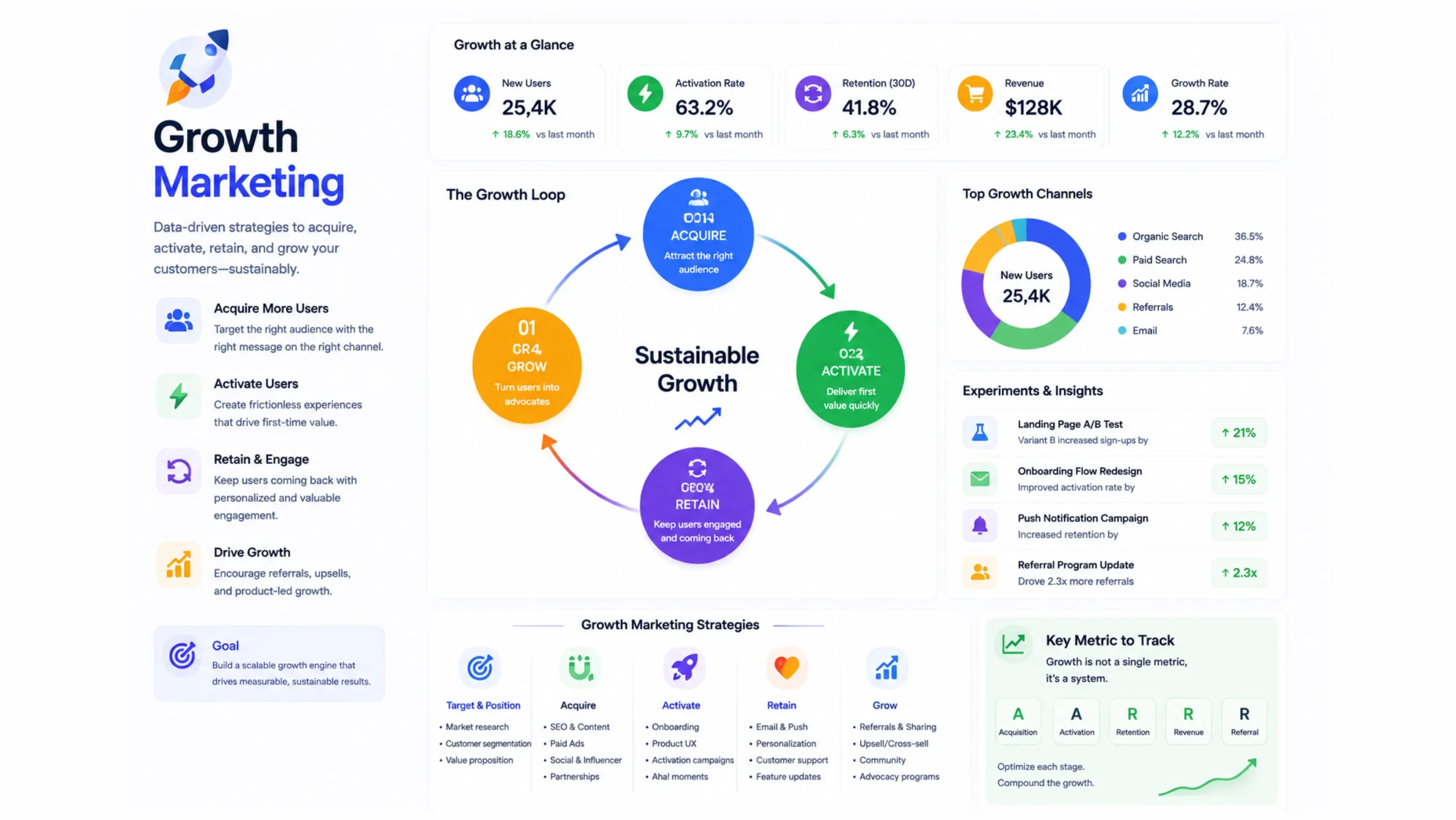
Growth Marketing is a marketing approach centered on sustainable business growth through experimentation, data analysis, customer insights, and continuous improvement. Unlike traditional marketing, which often focuses on generating awareness and leads, growth marketing looks at the entire customer lifecycle—from the first website visit to long-term customer retention.
Think of it like tending a garden. Traditional marketing may focus on planting seeds and attracting attention. Growth marketing focuses on planting, watering, monitoring, pruning, and helping every plant thrive over time.
The goal isn’t simply getting more visitors. The goal is turning visitors into customers, customers into repeat buyers, and repeat buyers into loyal advocates.
As digital competition increases across industries, growth marketing has become a popular strategy for startups, SaaS companies, e-commerce brands, mobile apps, and even large enterprises.
So, What Makes It Different?
Here’s the thing: growth marketers don’t stop after launching a campaign.
They constantly ask questions:
- Why are visitors leaving this page?
- Which email subject line gets more opens?
- What makes users complete a purchase?
- Why do customers cancel subscriptions?
- Which acquisition channel generates the highest revenue?
Every answer becomes an opportunity for improvement.
Growth marketing operates through testing, learning, refining, and repeating.
Traditional Marketing vs Growth Marketing
At first glance, both approaches seem similar. Both aim to attract customers. The difference appears once you look deeper.
Traditional marketing often focuses on top-of-funnel activities such as advertising, brand awareness, and lead generation.
Growth marketing expands its attention across the entire customer journey.
| Traditional Marketing | Growth Marketing |
|---|---|
| Focuses on awareness | Focuses on the entire customer lifecycle |
| Campaign-driven | Experiment-driven |
| Measures reach and impressions | Measures business outcomes |
| Often fixed strategies | Continuous testing and improvement |
| Short-term campaigns | Long-term growth focus |
Neither approach is wrong. Many successful companies combine both.
Why Businesses Love Growth Marketing
Customer acquisition is becoming more expensive every year.
Running ads alone no longer guarantees success. Businesses need smarter ways to increase revenue without endlessly increasing budgets.
Growth marketing helps companies:
- Improve conversion rates
- Reduce customer acquisition costs
- Increase customer retention
- Boost lifetime value
- Discover new growth opportunities
- Make decisions backed by data
A small improvement in several areas can create remarkable results.
For example:
- 10% better conversion rates
- 10% higher retention
- 10% more referrals
Individually, those gains seem modest. Together, they can dramatically affect revenue.
The Growth Marketing Funnel
Many marketers use a framework known as AARRR, sometimes called Pirate Metrics.
The stages include:
Acquisition
This stage focuses on attracting visitors through channels such as:
- SEO
- Social media
- Paid advertising
- Content marketing
- Partnerships
The question here is simple:
“How are people finding us?”
Activation
Acquisition gets visitors through the door.
Activation creates a positive first experience.
Examples include:
- Completing onboarding
- Creating an account
- Watching a product demo
- Starting a free trial
This is often where first impressions are formed.
Retention
Many businesses focus heavily on getting customers and very little on keeping them.
Growth marketers pay close attention to retention.
Strategies may include:
- Email campaigns
- Loyalty programs
- Product improvements
- Personalized experiences
- Customer support initiatives
Revenue
This stage focuses on converting engagement into business value.
Examples include:
- Product purchases
- Subscription upgrades
- Renewals
- Upsells
Revenue metrics often reveal where growth efforts create the biggest impact.
Referral
Happy customers can become powerful marketing channels.
Referral programs encourage users to recommend products to friends, colleagues, and family members.
Think about companies like Dropbox or Airbnb. Referrals played a major role in their early growth.
Popular Growth Marketing Channels
Growth marketing doesn’t rely on a single channel.
Successful teams often combine several.
Search Engine Optimization (SEO)
SEO helps businesses attract organic traffic from search engines.
Strong content, technical improvements, and keyword research often contribute to long-term growth.
Email Marketing
Email remains one of the highest-performing channels for many businesses.
Personalized emails can nurture leads, recover abandoned carts, and encourage repeat purchases.
Content Marketing
Blogs, videos, guides, webinars, and case studies help educate audiences while attracting qualified traffic.
Good content keeps working long after publication.
Social Media Marketing
Platforms like Instagram, LinkedIn, TikTok, X, and YouTube help businesses connect directly with audiences.
Growth marketers analyze engagement patterns and audience behavior to improve results.
Paid Advertising
Paid campaigns provide immediate visibility and measurable performance data.
Growth teams frequently test:
- Headlines
- Creatives
- Audience segments
- Landing pages
- Calls to action
Referral Marketing
Word-of-mouth remains incredibly powerful.
People trust recommendations from friends more than advertisements.
Common Growth Marketing Strategies
Growth marketing thrives on experimentation.
A few popular approaches include:
A/B Testing
Two versions of a page, email, or advertisement are compared.
The better-performing version becomes the winner.
Sometimes changing a single headline produces surprising results.
Personalization
Customers expect experiences that feel relevant.
Personalization can include:
- Product recommendations
- Dynamic content
- Customized emails
- Behavior-based messaging
Conversion Rate Optimization (CRO)
Growth marketers constantly improve landing pages, forms, checkout experiences, and calls to action.
Small adjustments often lead to measurable gains.
Product-Led Growth
Some companies allow products to become the primary acquisition tool.
Free trials, freemium plans, and self-service onboarding are common examples.
Customer Retention Campaigns
Retaining existing customers often costs less than acquiring new ones.
That’s why growth marketers invest heavily in customer satisfaction and long-term engagement.
Metrics That Matter
Growth marketing relies heavily on measurement.
Common metrics include:
- Customer Acquisition Cost (CAC)
- Lifetime Value (LTV)
- Conversion Rate
- Retention Rate
- Churn Rate
- Monthly Recurring Revenue (MRR)
- Return on Ad Spend (ROAS)
- Customer Engagement
Data helps remove guesswork.
Without measurement, growth marketing becomes little more than assumptions.
Tools Growth Marketers Use
Growth teams often rely on specialized tools.
Popular examples include:
- Google Analytics
- Hotjar
- Mixpanel
- Amplitude
- HubSpot
- Mailchimp
- Ahrefs
- Semrush
- Optimizely
- Google Ads
The specific tool matters less than the insights it provides.
The Benefits of Growth Marketing
Businesses adopt growth marketing for many reasons.
Faster Learning
Experiments reveal what works and what doesn’t.
Better Customer Experiences
Data highlights pain points that might otherwise go unnoticed.
Higher Marketing Efficiency
Budgets can be directed toward activities producing real results.
Improved Retention
Keeping customers engaged often leads to stronger revenue over time.
Sustainable Growth
Growth marketing focuses on building repeatable systems rather than relying on one-off campaigns.
Challenges Worth Knowing
Growth marketing sounds exciting—and it is—but it isn’t magic.
A few common challenges include:
Too Much Data
Modern businesses collect enormous amounts of information.
Knowing which metrics matter can be difficult.
Experiment Fatigue
Constant testing without clear priorities can create confusion.
Resource Constraints
Smaller teams may struggle to run multiple experiments simultaneously.
Long-Term Patience
Some improvements take months before meaningful patterns emerge.
Growth rarely happens overnight.
Smart Growth Marketing Practices
Organizations that succeed with growth marketing often share a few habits:
- Focus on customer behavior
- Test one variable at a time
- Track meaningful metrics
- Learn from failed experiments
- Prioritize retention alongside acquisition
- Make decisions based on evidence rather than assumptions
Growth often comes from hundreds of small improvements rather than one dramatic breakthrough.
Final Thoughts
Growth marketing has changed how businesses think about marketing success.
Instead of focusing solely on traffic or impressions, it examines the complete customer experience. Every click, signup, purchase, renewal, and referral becomes part of a larger growth system.
The most successful growth marketers remain curious. They test ideas, study customer behavior, analyze results, and continue improving.
That’s really the heart of growth marketing—continuous learning backed by real data and a deep understanding of what customers need.
Frequently Asked Questions (FAQs)
1. What is Growth Marketing in simple terms?
Growth Marketing is a data-driven approach that focuses on attracting, converting, retaining, and growing customers through continuous testing and optimization.
2. How is Growth Marketing different from traditional marketing?
Traditional marketing mainly focuses on awareness and lead generation, while growth marketing focuses on the entire customer lifecycle, including retention and revenue growth.
3. Why is Growth Marketing important?
It helps businesses improve conversions, reduce acquisition costs, increase customer retention, and generate sustainable long-term growth.
4. What skills are needed for Growth Marketing?
Common skills include analytics, experimentation, SEO, content marketing, email marketing, customer research, and conversion optimization.
5. Which industries use Growth Marketing?
Growth marketing is widely used by SaaS companies, e-commerce brands, startups, mobile apps, healthcare businesses, fintech companies, and subscription-based services.
6. What are the most important Growth Marketing metrics?
Key metrics include Customer Acquisition Cost (CAC), Lifetime Value (LTV), Conversion Rate, Retention Rate, Churn Rate, and Return on Ad Spend (ROAS).