


A/B Testing – What It Is, How It Works, and Why Smart Teams Rely on It.
Definition
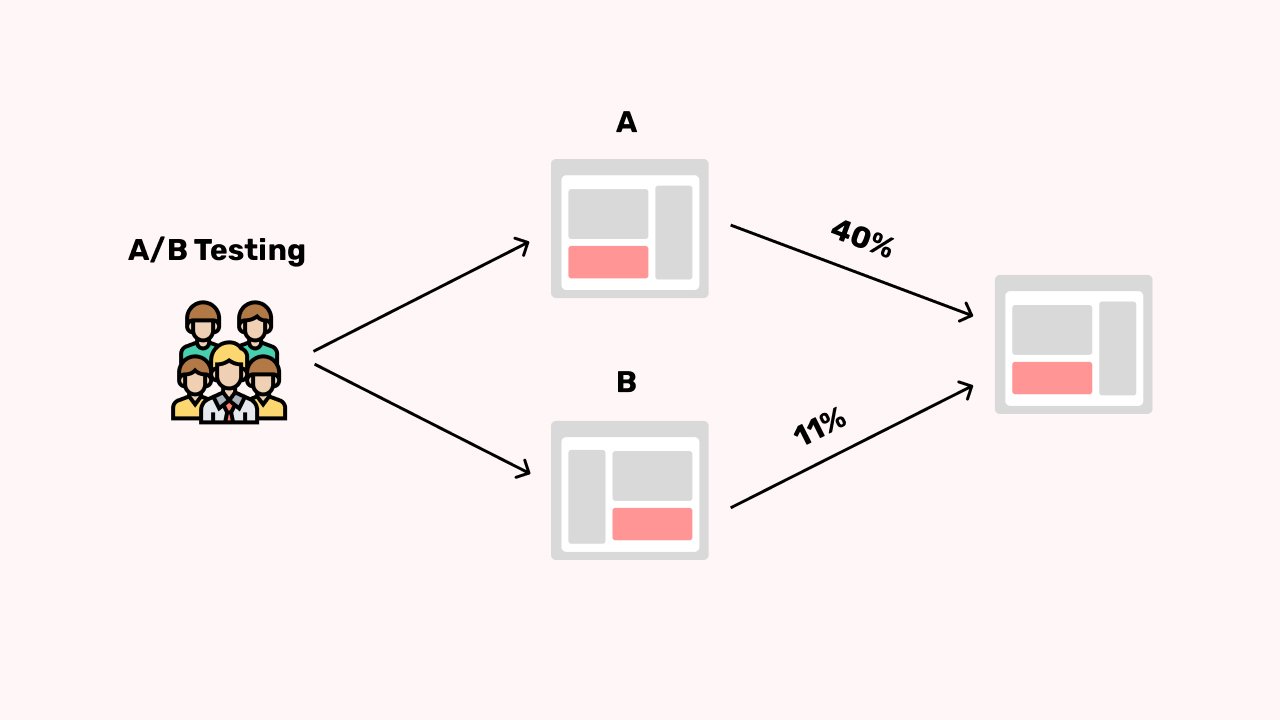
A/B Testing is a method of comparing two versions of a webpage, app screen, email, advertisement, or digital experience to determine which version performs better.
One group of users sees Version A.
Another group sees Version B.
The performance of both versions is then measured against a specific goal, such as:
- Click-through rate
- Sign-ups
- Purchases
- Form completions
- Downloads
- User engagement
The version that produces better results becomes the winner.
Simple idea. Powerful impact.
Instead of making decisions based on assumptions, opinions, or office debates, A/B testing allows teams to use real user behavior as their guide.
Why Is It Called A/B Testing?
The name comes from the two versions being tested.
- Version A is usually the original version, often called the Control.
- Version B is the modified version, often called the Variant.
Users are randomly split between the two experiences.
Imagine running a coffee shop.
One day, you place your “Order Now” sign near the entrance.
The next day, you move it closer to the counter.
Rather than guessing which placement works better, you track actual orders.
Digital products follow the same principle, except the results can be measured much more precisely.
A Quick Example
Let’s say an online store has a “Buy Now” button.
The original button is blue.
Someone on the team believes a green button might attract more clicks.
Instead of redesigning the entire website, they test both options.
Version A
Blue button
Version B
Green button
After several thousand visitors:
- Blue button conversion rate: 3.8%
- Green button conversion rate: 5.1%
The green button wins.
A small design change leads to a measurable increase in sales.
And that’s exactly why A/B testing has become such a common practice in product design, marketing, ecommerce, and SaaS businesses.
Why A/B Testing Matters
People often have strong opinions about design.
A CEO likes one version.
A designer prefers another.
A marketer has a completely different perspective.
The funny thing is that everyone can sound convincing.
Yet users frequently behave in unexpected ways.
A/B testing helps remove guesswork.
Instead of asking:
“What do we think users want?”
Teams can ask:
“What did users actually do?”
That shift changes everything.
The Goal of A/B Testing
The primary goal is to improve performance through evidence rather than assumptions.
Different teams use A/B testing for different reasons.
Product Teams
- Improve onboarding
- Increase feature adoption
- Reduce user drop-off
- Improve retention
Marketing Teams
- Increase click-through rates
- Generate more leads
- Improve email engagement
Ecommerce Teams
- Increase purchases
- Reduce cart abandonment
- Improve checkout completion
UX Teams
- Validate design decisions
- Improve usability
- Reduce friction
The underlying idea remains the same.
Test. Measure. Learn.
Then test again.
How A/B Testing Works
The process sounds technical, yet the logic is surprisingly straightforward.
Step 1: Identify a Problem
Something isn’t performing as expected.
Maybe:
- Few users complete a form
- Too many visitors leave a landing page
- Checkout completion rates are low
A problem creates an opportunity for improvement.
Step 2: Create a Hypothesis
A hypothesis is an educated prediction.
For example:
“Changing the CTA button text from ‘Submit’ to ‘Get My Free Trial’ will increase sign-ups.”
Good tests begin with a clear hypothesis.
Step 3: Create a Variant
Design a modified version.
This could involve:
- Different copy
- New images
- Updated layout
- Different colors
- Alternative button styles
The key is keeping the change focused.
Testing ten things at once makes it difficult to identify what caused the result.
Step 4: Split Traffic
Users are randomly assigned to either version.
Half may see Version A.
Half may see Version B.
Random distribution helps create fair results.
Step 5: Measure Results
Teams track predefined metrics.
Examples include:
- Conversion rate
- Click-through rate
- Revenue
- Engagement
- Time spent on the page
The numbers reveal which variation performs better.
Step 6: Analyze and Implement
Once enough data has been collected, the winning version can be adopted.
Then the cycle starts again.
Many successful products run experiments continuously.
What Can Be A/B Tested?
Almost anything users interact with can be tested.
And sometimes the smallest details produce surprisingly large results.
Headlines
A different headline can change how users perceive a product.
Call-to-Action Buttons
Examples:
- Start Free Trial
- Get Started
- Try It Free
- Create Account
A few words can dramatically influence behavior.
Images
Product photos.
Hero images.
Illustrations.
Background visuals.
Visuals often affect trust and engagement.
Landing Page Layouts
Changing content order can alter user behavior.
Sometimes moving a testimonial section higher on a page produces better conversions.
Forms
Teams frequently test:
- Number of fields
- Field labels
- Form placement
- Multi-step forms
- Single-page forms
Pricing Pages
Pricing is one of the most tested areas in SaaS products.
Small changes can influence revenue significantly.
Email Campaigns
Common email experiments include:
- Subject lines
- Send times
- Email copy
- Button placement
- Personalization
A/B Testing in UX Design
Many people associate A/B testing with marketing.
Yet UX designers use it regularly.
Imagine a product onboarding experience.
Version A uses four onboarding screens.
Version B uses two onboarding screens.
The team wants to know which approach helps more users complete the setup.
Rather than arguing about design preferences, they run a test.
The results reveal which experience users actually prefer through their behavior.
That’s valuable information.
Very valuable.
Common Metrics Used in A/B Testing
Success depends on choosing the right metric.
Some common examples include:
Conversion Rate
Percentage of users completing a desired action.
Click-Through Rate (CTR)
Percentage of users who click a link or button.
Bounce Rate
Percentage of visitors who leave without interacting further.
Revenue Per Visitor
Average revenue generated by each visitor.
Engagement Rate
Measures interactions within the product.
Retention Rate
Tracks how many users return over time.
A/B Testing vs Multivariate Testing
These terms are often confused.
They are related but different.
A/B Testing
Tests one variation against another.
Example:
- Blue button
- Green button
Simple and focused.
Multivariate Testing
Tests multiple combinations simultaneously.
Example:
- Three headlines
- Two button colors
- Two hero images
This creates many combinations.
Multivariate testing can provide deeper insights, though it requires much larger traffic volumes.
Common A/B Testing Mistakes
A/B testing sounds simple.
Executing it correctly is another story.
Here are some mistakes that regularly cause problems.
Ending Tests Too Early
Many teams stop a test the moment one variation takes the lead.
That’s risky.
Early results can be misleading.
Testing Too Many Changes
Changing headlines, layouts, colors, images, and forms simultaneously creates confusion.
Keep experiments focused.
Ignoring Statistical Significance
Random chance can produce surprising results.
A test should collect enough data before decisions are made.
Measuring the Wrong Metric
More clicks don’t always mean more sales.
Always connect metrics to actual business goals.
Following Trends Blindly
A trend that works for Spotify or Airbnb may fail completely for another product.
Context matters.
A lot.
Popular A/B Testing Tools
Many organizations use specialized software to run experiments.
Popular options include:
- Optimizely
- VWO
- Adobe Target
- Convert
- AB Tasty
- Statsig
- LaunchDarkly
- Google Analytics (for measurement and analysis)
Many modern SaaS products also include built-in experimentation features.
Benefits of A/B Testing
The advantages extend far beyond conversion optimization.
A/B testing can help teams:
- Make data-backed decisions
- Reduce risk
- Improve user experiences
- Increase revenue
- Validate design ideas
- Learn about customer behavior
- Improve onboarding flows
- Increase engagement
Most importantly, it encourages a culture of learning.
Instead of assuming.
Instead of guessing.
Instead of debating endlessly.
Teams learn directly from user behavior.
Is A/B Testing Always Necessary?
Interestingly, no.
Some decisions don’t require an experiment.
For example:
- Fixing a broken button
- Correcting accessibility issues
- Resolving obvious usability problems
A/B testing works best when multiple reasonable solutions exist, and the team wants evidence before committing to one.
Sometimes, research is enough.
Sometimes analytics are enough.
Sometimes a test is the right move.
Good product teams know the difference.
The Future of A/B Testing
AI is changing experimentation.
Modern tools can generate test ideas, identify opportunities automatically, and analyze results faster than ever.
Some platforms can even personalize experiences dynamically based on user behavior.
Still, one thing remains unchanged.
Human behavior continues to surprise us.
And that’s exactly why experimentation remains valuable.
No matter how experienced a designer, marketer, founder, or product manager becomes, assumptions can still be wrong.
A/B testing acts as a reality check.
A very useful one.
Final Thoughts
A/B testing is one of the simplest ways to learn what users actually prefer.
It replaces opinions with evidence.
It turns assumptions into measurable outcomes.
And it helps teams make smarter product, marketing, and design decisions.
The beauty of A/B testing isn’t found in complicated statistics or fancy dashboards.
It’s found in a simple question:
“What happens if we try something different?”
Then letting users answer that question through their actions.