


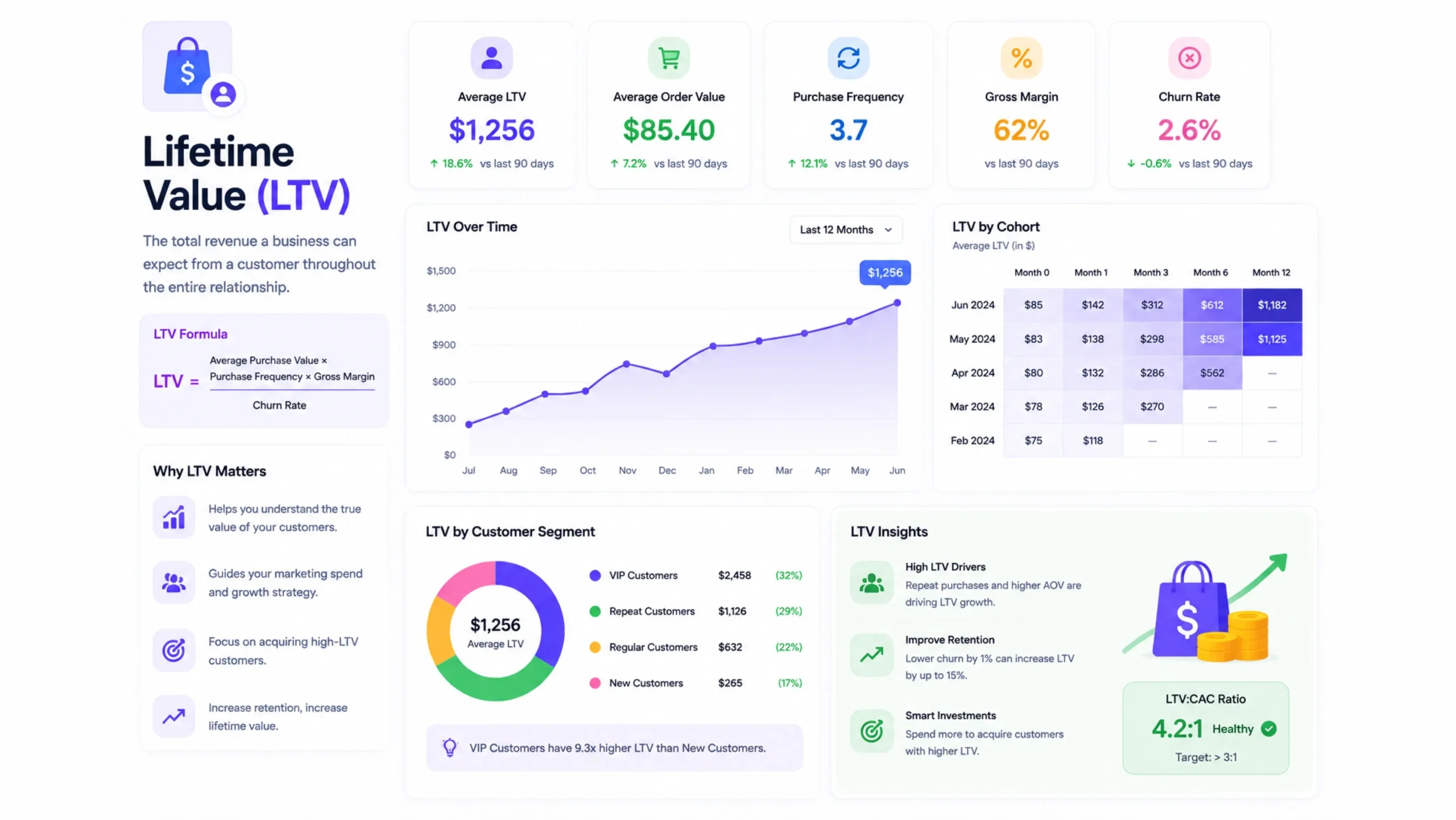
What Is Lifetime Value (LTV)?
Lifetime Value, often called Customer Lifetime Value (CLV) or simply LTV, measures the total amount of revenue a customer generates during their relationship with a business.
Think about your favorite coffee shop. You may spend only a few dollars on a single visit. Yet if you return every week for several years, your total value becomes much larger than that first purchase.
The same idea applies to digital products, SaaS platforms, online stores, subscription services, and almost every business that serves repeat customers.
Many companies focus heavily on acquiring new customers. That’s important. Yet the customers who stay, buy again, upgrade plans, and recommend the business often create the greatest financial impact.
That’s where LTV becomes valuable.
Why LTV Matters
A customer’s first purchase rarely tells the whole story.
Some customers buy once and disappear.
Others stay for months or years, generating recurring revenue and becoming loyal supporters of a brand.
LTV helps businesses answer important questions:
- How valuable is each customer?
- How much can we spend to acquire new customers?
- Which customer segments generate the highest revenue?
- Are retention efforts paying off?
- Is long-term growth sustainable?
Without LTV, companies often judge customers based only on their first transaction.
That can lead to costly decisions.
How LTV Works
Lifetime Value estimates the revenue a customer contributes from the moment they become a customer until they stop buying.
The calculation often includes:
- Average purchase value
- Purchase frequency
- Customer retention period
The longer customers stay and the more they spend, the higher their lifetime value becomes.
Simple idea. Powerful business insight.
The LTV Formula
One common formula looks like this:
Businesses sometimes use more advanced formulas, particularly in SaaS and subscription models, though the core principle remains the same.
The goal is to estimate how much revenue a customer contributes over time.
A Simple Example
Imagine an online fitness platform.
A customer:
- Pays $25 per month
- Stays subscribed for 24 months
Lifetime Value:
$25 × 24 = $600
That customer generates $600 in revenue during their relationship with the company.
Now imagine another customer who stays for only three months.
Their value would be:
$25 × 3 = $75
Same product. Very different customer value.
This difference explains why retention matters so much.
What Influences Lifetime Value?
Several factors affect LTV.
Customer Retention
Customers who stay longer create greater value.
Purchase Frequency
More frequent purchases increase total revenue.
Average Order Value
Larger transactions generally raise LTV.
Upselling and Cross-Selling
Additional products and services often increase customer spending.
Customer Experience
Positive experiences encourage customers to remain loyal.
Brand Trust
Customers who trust a brand typically purchase more often.
LTV and Customer Acquisition Cost: A Powerful Pair
Businesses rarely look at LTV alone.
They often compare it with Customer Acquisition Cost (CAC).
CAC measures how much it costs to acquire a customer.
LTV measures how much revenue that customer generates.
Imagine this scenario:
- CAC = $100
- LTV = $600
The company spends $100 to gain a customer worth $600.
That’s usually a healthy situation.
Many growth-focused businesses aim for an LTV-to-CAC ratio of at least 3:1.
The higher the ratio, the more room there is for profitable growth.
Why Businesses Track LTV
LTV affects decisions across an organization.
Marketing teams use it to determine advertising budgets.
Sales teams use it to prioritize customer segments.
Product teams use it to improve retention.
Leadership teams use it to forecast growth.
Here’s the thing: revenue from existing customers is often less expensive than finding new ones.
A strong LTV helps companies grow with greater efficiency.
How to Increase Lifetime Value
Improving LTV doesn’t always require attracting new customers.
Often, the biggest gains come from serving existing customers better.
Improve Customer Onboarding
A smooth start helps customers see value quickly.
Deliver Excellent Support
Helpful support builds trust and loyalty.
Create Loyalty Programs
Rewards can encourage repeat purchases.
Upsell Relevant Products
Additional offerings can increase customer spending naturally.
Improve Product Quality
Customers stay longer when products consistently solve problems.
Personalize Experiences
Relevant recommendations often lead to stronger engagement.
Small improvements made consistently can produce significant long-term results.
Common Lifetime Value Mistakes
Many businesses struggle with LTV calculations.
Some common mistakes include:
Ignoring Retention
Customer lifespan has a major impact on LTV.
Focusing Only on Revenue
Profitability matters too.
A high-revenue customer isn’t always a profitable customer.
Using Short Data Periods
Limited data can create misleading projections.
Treating All Customers the Same
Different customer groups often have dramatically different lifetime values.
Forgetting Changing Customer Behavior
Customer needs and purchasing patterns evolve over time.
Regular updates keep LTV calculations meaningful.
LTV in SaaS and Subscription Businesses
Lifetime Value plays a particularly important role in SaaS.
Subscription companies often invest heavily upfront to acquire customers.
Revenue arrives gradually over months or years.
Investors, founders, and growth teams closely monitor:
- LTV
- CAC
- Churn Rate
- Retention Rate
- Monthly Recurring Revenue (MRR)
A subscription business with high retention often enjoys significantly higher LTV, creating a stronger foundation for growth.
Tools Used to Measure LTV
Several analytics and customer intelligence tools help businesses calculate and monitor LTV.
Popular options include:
- Google Analytics
- HubSpot
- Salesforce
- Mixpanel
- Amplitude
- Tableau
- Looker Studio
- Stripe Analytics
- Shopify Analytics
These platforms connect customer activity, revenue, and retention data to provide a clearer picture of long-term customer value.
Why LTV Matters More Than Many People Realize
Many companies celebrate acquiring new customers.
That’s understandable.
Growth feels exciting.
Yet a business built entirely on constant customer acquisition can become expensive to operate.
LTV shifts attention from short-term wins to long-term relationships.
A customer who stays for years often creates far more value than several one-time buyers combined.
That’s why successful businesses pay close attention to retention, satisfaction, and loyalty.
The numbers usually tell the story.
Final Thoughts
Lifetime Value (LTV) measures the total revenue a customer generates throughout their relationship with a business. It helps companies understand customer profitability, guide marketing investments, improve retention strategies, and build sustainable growth plans.
When combined with Customer Acquisition Cost, LTV becomes one of the most useful metrics for evaluating business performance. Companies that understand customer value over time are often better positioned to make smarter decisions and grow profitably.
Frequently Asked Questions (FAQs)
1. What does Lifetime Value (LTV) mean?
Lifetime Value measures the total revenue a customer generates during their relationship with a business.
2. Why is LTV important?
LTV helps businesses understand customer profitability and determine how much they can spend on customer acquisition.
3. How is Lifetime Value calculated?
A common calculation multiplies average purchase value, purchase frequency, and customer lifespan.
4. What is the difference between LTV and CAC?
LTV measures customer revenue over time, while CAC measures the cost of acquiring that customer.
5. How can a business increase LTV?
Businesses can increase LTV through better customer experiences, retention strategies, loyalty programs, and upselling opportunities.
6. What is a good LTV-to-CAC ratio?
Many businesses target a ratio of 3:1 or higher, meaning a customer generates three times more revenue than it costs to acquire them.