


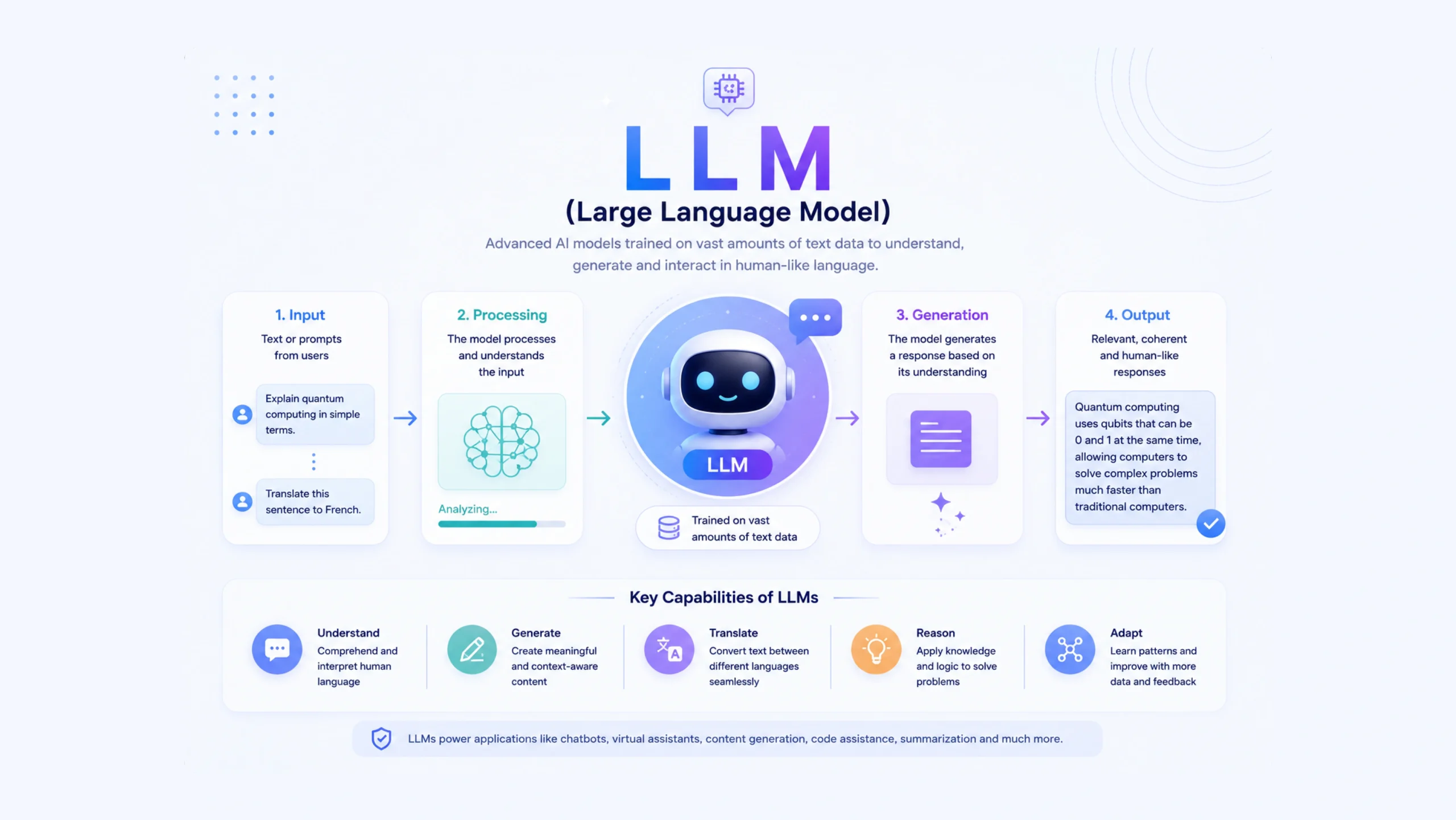
What Is a Large Language Model (LLM)?
A Large Language Model, commonly called an LLM, is a type of artificial intelligence trained on enormous amounts of text data to understand, generate, summarize, translate, and interact using human language.
If you’ve used ChatGPT, Claude, Gemini, or other conversational AI tools, you’ve already interacted with an LLM.
Think of an LLM as a highly sophisticated prediction engine. It reads the words you’ve written and predicts the most likely next words based on patterns learned from billions or even trillions of examples.
That sounds simple. In reality, it’s one of the most significant developments in modern computing.
Why Are LLMs Such a Big Deal?
For decades, computers followed strict rules.
If a user entered a specific command, the software returned a predefined response.
Language doesn’t work that way.
People use slang, abbreviations, incomplete sentences, jokes, and cultural references. We change our writing style depending on who we’re talking to.
Traditional software struggled with that flexibility.
LLMs changed the situation dramatically.
Instead of relying entirely on fixed rules, they learn language patterns from vast collections of books, articles, websites, conversations, research papers, and other text sources.
The result feels surprisingly natural. Sometimes almost unsettlingly natural.
A Quick Example
Imagine asking a search engine:
“How do I prepare for my first UX design interview?”
A traditional search engine gives you links.
An LLM can provide:
- Interview preparation tips
- Common UX questions
- Portfolio suggestions
- Research methods
- Follow-up recommendations
All within a conversational response.
That’s why LLMs have become popular across industries.
How Does an LLM Work?
Let’s make the concept easier to understand.
At its core, an LLM predicts what comes next in a sequence of words.
For example:
“Product designers conduct user…”
Most people would guess words like:
- Research
- Interviews
- Testing
An LLM performs a similar task, but at a much larger scale.
After analyzing enormous amounts of text, it learns relationships between words, phrases, concepts, and context.
When a user enters a prompt, the model generates a response one token at a time.
A token may represent:
- A word
- Part of a word
- A punctuation mark
- A symbol
Each generated token influences the next one.
The process happens extremely quickly, creating responses that feel fluid and conversational.
The Technology Behind the Magic
People often imagine AI as a digital brain.
The reality is different.
LLMs are built using deep neural networks that process language mathematically.
The breakthrough that accelerated modern AI came from a machine learning architecture called the Transformer.
Introduced in 2017, Transformers dramatically improved how machines process language and context.
Almost every major language model today relies on Transformer-based architecture.
Without it, modern conversational AI likely wouldn’t exist in its current form.
The Main Components of an LLM
Several pieces work together behind the scenes.
Training Data
An LLM learns from enormous collections of text.
This data may include:
- Books
- Research papers
- Websites
- Documentation
- Public conversations
- Educational content
The quality and variety of training data influence how capable the model becomes.
Parameters
Parameters are internal numerical values learned during training.
You can think of them as learned relationships between language patterns.
Modern LLMs may contain billions or even hundreds of billions of parameters.
This is one reason they’re called “large” language models.
Neural Networks
Neural networks process information through interconnected layers.
These layers identify patterns and relationships across massive datasets.
The deeper and larger the network, the more sophisticated its language capabilities can become.
Context Window
The context window determines how much information an LLM can consider at one time.
A larger context window allows the model to remember more of a conversation or document during processing.
This becomes particularly useful for long reports, coding projects, and research tasks.
Training an LLM: A Massive Undertaking
Training a modern language model requires enormous computing power.
The process typically involves several stages.
Pre-Training
During pre-training, the model learns language patterns from vast text datasets.
It predicts missing words, understands relationships between concepts, and develops general language knowledge.
This phase often requires thousands of powerful GPUs running for weeks or months.
Fine-Tuning
After pre-training, developers often refine the model for specific purposes.
Examples include:
- Customer support
- Healthcare assistance
- Legal research
- Software development
- Educational applications
Fine-tuning helps improve performance in specialized areas.
Human Feedback
Many modern LLMs also learn from human evaluations.
Reviewers rate outputs and help guide the model toward more useful responses.
This process improves quality, safety, and relevance.
Popular Examples of LLMs
The AI industry currently includes several well-known language models.
Examples include:
- ChatGPT
- Claude
- Gemini
- Llama
- Mistral
- Grok
Each model has strengths, limitations, and design priorities.
Some focus on reasoning.
Some focus on coding.
Others emphasize speed, context length, or enterprise use cases.
Real-World Applications of LLMs
One reason LLMs have spread so rapidly is their versatility.
The same technology can support many different tasks.
Content Creation
Writers use LLMs to brainstorm ideas, draft articles, summarize research, and edit content.
This doesn’t replace creativity.
It often accelerates the writing process.
Customer Support
Businesses deploy AI assistants to answer customer questions around the clock.
Support teams can handle larger volumes without expanding headcount dramatically.
Software Development
Developers use LLMs to:
- Generate code
- Explain programming concepts
- Debug applications
- Review software architecture
Coding assistants have become common across development teams.
Education
Students and educators use LLMs for tutoring, explanations, summaries, and study assistance.
A concept that once required multiple searches can often be explained conversationally.
Research and Knowledge Work
Researchers use LLMs to summarize lengthy documents, organize information, and identify patterns across large datasets.
Hours of reading can sometimes be condensed into minutes.
What Makes LLMs So Powerful?
Several factors contribute to their capabilities.
They Understand Context
Modern models can interpret meaning rather than simply matching keywords.
This allows more natural conversations.
They Work Across Domains
The same model can discuss marketing, programming, medicine, history, and design.
The breadth is remarkable.
They Generate Human-Like Language
Responses often feel conversational and coherent.
This makes AI systems more accessible to non-technical users.
They Learn Patterns at Massive Scale
Humans read thousands of books during a lifetime.
Large language models learn from datasets that may contain billions of pages of text.
The scale is difficult to comprehend.
Challenges and Limitations
Despite impressive capabilities, LLMs are far from perfect.
Hallucinations
An LLM can generate information that sounds accurate but is incorrect.
This remains one of the most discussed challenges in AI.
Outdated Knowledge
A model’s knowledge may stop at a specific training date.
Without access to current information, responses may become outdated.
This is one reason retrieval systems are becoming popular.
Bias
Training data reflects human content, which may contain biases and inaccuracies.
Developers continuously work to reduce these issues.
High Computing Costs
Training and operating large models requires substantial computational resources.
This remains expensive, even for major technology companies.
LLMs and the Rise of AI Products
Many recent AI products rely heavily on language models.
Examples include:
- AI chatbots
- AI search assistants
- Writing tools
- Coding assistants
- Research assistants
- Knowledge management platforms
You may notice something interesting.
Many products that appear different on the surface often share similar LLM technology underneath.
The experience changes. The underlying language model remains a key component.
The Future of Large Language Models
The next generation of LLMs will likely become:
- More accurate
- Better at reasoning
- More multimodal
- Faster
- More personalized
- More capable of working with real-time information
We’re already seeing systems that combine language, images, video, documents, voice, and external knowledge sources.
The language model is gradually becoming the central interface between humans and software.
Instead of learning software commands, people increasingly communicate through natural language.
That’s a significant shift.
Final Thoughts
Large Language Models represent one of the most influential developments in artificial intelligence. By learning patterns from massive amounts of text, these models can generate human-like responses, assist with research, write content, support customer service, help developers code, and power conversational AI experiences.
As the technology continues to mature, LLMs are becoming a foundational layer for many modern digital products. Their capabilities are impressive, yet understanding their strengths and limitations remains just as important as appreciating their potential.
Frequently Asked Questions (FAQs)
1. What does LLM stand for?
LLM stands for Large Language Model, an AI system trained on massive amounts of text to understand and generate human language.
2. How do Large Language Models learn?
LLMs learn by analyzing enormous datasets and identifying patterns between words, phrases, and concepts during training.
3. Is ChatGPT an LLM?
ChatGPT is an AI application powered by a Large Language Model developed by OpenAI.
4. What are LLMs used for?
LLMs are used for content creation, customer support, coding assistance, research, education, translation, summarization, and conversational AI.
5. Can LLMs make mistakes?
Yes. LLMs can generate incorrect information, misunderstand context, or produce inaccurate responses despite sounding confident.
6. What’s the difference between AI and an LLM?
Artificial Intelligence is a broad field. A Large Language Model is a specific type of AI focused on understanding and generating language.