


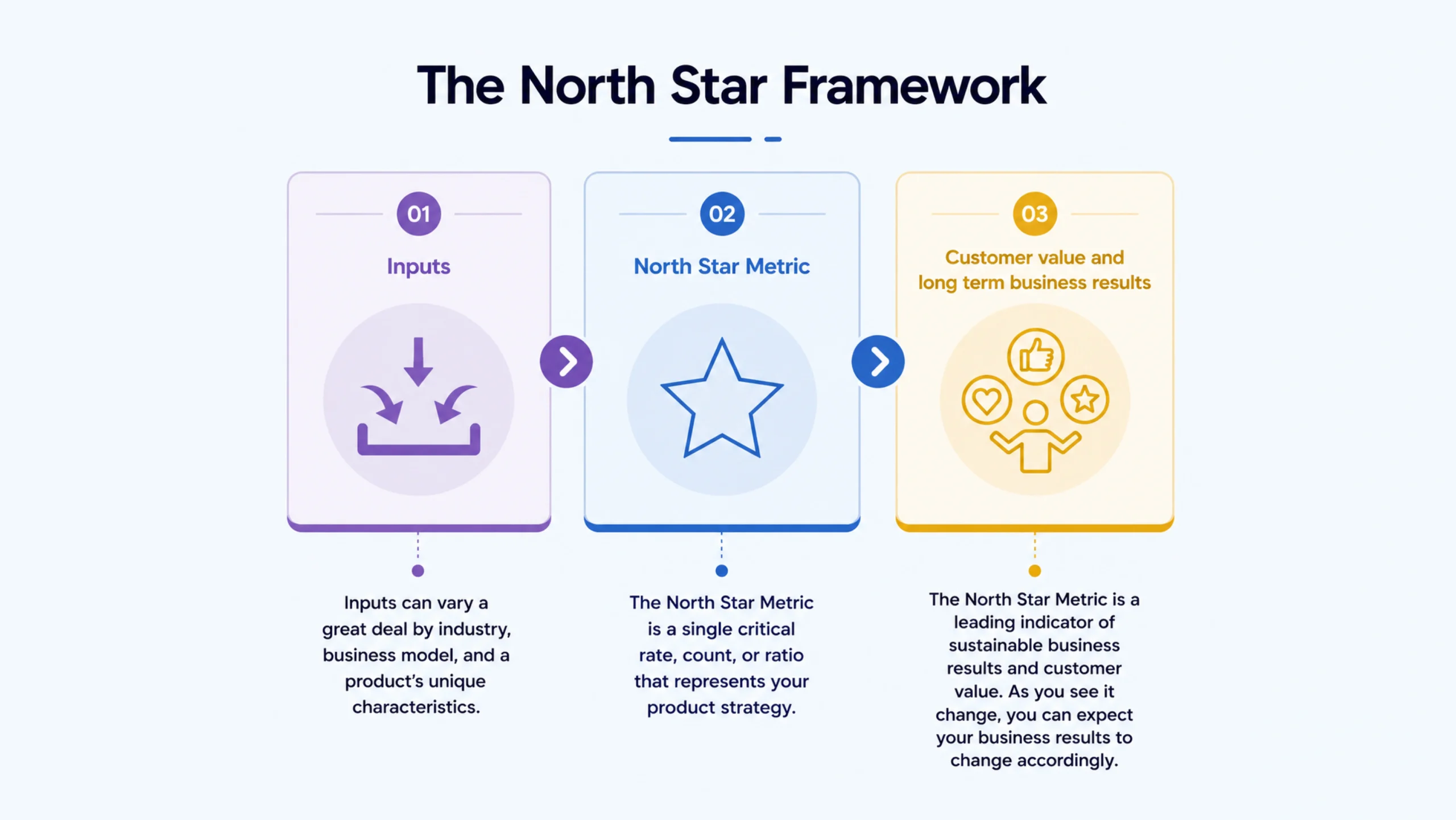
What Is a North Star Metric?
A North Star Metric (NSM) is a single measurement that reflects the core value a product delivers to its users.
It acts as a guiding indicator that helps teams focus on creating meaningful customer value while supporting business growth.
The term comes from the North Star, which travelers historically used for direction. In product development, the North Star Metric serves a similar purpose. It gives teams a clear destination and helps them make better decisions.
Instead of tracking hundreds of disconnected numbers, companies use a North Star Metric to align product, design, engineering, marketing, and leadership around one shared goal.
Why Do Companies Need a North Star Metric?
Modern businesses generate massive amounts of data.
Teams can track clicks, page views, downloads, sign-ups, purchases, session duration, retention, referrals, and dozens of other metrics.
The challenge isn’t collecting data.
The challenge is knowing which data matters most.
Without a clear focus, teams may chase numbers that look impressive but contribute little to long-term success.
A North Star Metric creates clarity.
It helps answer a simple question:
“Are we creating real value for our users?”
More Than Just a Number
At first glance, a North Star Metric may seem like another KPI.
It isn’t.
A KPI measures performance in a specific area.
A North Star Metric represents the overall value users receive from a product.
For example, a streaming platform may track:
- New subscriptions
- Watch time
- Revenue
- App downloads
These metrics matter.
Yet the company might choose “hours of content watched” as its North Star Metric because it reflects user engagement and value creation more directly.
The focus shifts from vanity numbers to meaningful outcomes.
The Core Idea Behind a North Star Metric
Here’s the thing.
Successful products grow when users receive value consistently.
If people enjoy using a product, they return.
If they return, engagement increases.
If engagement increases, revenue often follows.
The North Star Metric captures this relationship.
Rather than concentrating solely on business outcomes, it focuses on customer outcomes that naturally support business growth.
It’s a subtle difference, but a powerful one.
What Makes a Good North Star Metric?
Not every metric qualifies as a North Star Metric.
A strong NSM typically has several characteristics.
It Reflects Customer Value
The metric should represent something users genuinely benefit from.
If the metric increases, customer value should increase as well.
It Supports Business Growth
Customer success and business success should move in the same direction.
The ideal metric benefits both users and the company.
It Is Easy to Understand
Every team member should understand what the metric measures and why it matters.
Complex metrics often create confusion.
It Encourages Long-Term Thinking
Short-term gains can sometimes hurt long-term growth.
A good North Star Metric promotes sustainable improvement rather than temporary spikes.
Examples of North Star Metrics
Different businesses have different goals.
That means North Star Metrics vary across industries.
Streaming Platforms
A streaming service may focus on:
Hours watched
The more content users consume, the more value they receive.
Social Media Platforms
A social platform might track:
Daily active users engaging with content
This reflects user participation and platform health.
E-Commerce Platforms
An online marketplace may measure:
Successful purchases
Purchases indicate value for customers and revenue for the business.
Project Management Software
A collaboration platform may focus on:
Projects completed
The metric reflects successful product usage.
Food Delivery Apps
A delivery service may track:
Completed orders
Each completed order represents value delivered to customers.
North Star Metric vs KPI
People often use these terms interchangeably.
They’re related but different.
A company typically has one North Star Metric and many KPIs.
Think of it like this:
The North Star Metric answers:
“Are we delivering meaningful value?”
KPIs answer:
“How are individual areas performing?”
For example, a product team may track:
- Conversion rate
- Customer retention
- Churn rate
- Revenue growth
- Feature adoption
These are KPIs.
The North Star Metric sits above them and acts as the primary guiding measure.
How Teams Choose a North Star Metric
Choosing a North Star Metric requires research and discussion.
Teams usually start by identifying the value their product creates.
Questions often include:
- Why do customers use the product?
- What problem does it solve?
- What action demonstrates successful product use?
- What behavior predicts long-term retention?
The answers often reveal the most meaningful metric.
The process sounds simple.
In practice, it can spark intense debate.
Different departments may prefer different measurements.
That’s normal.
The goal is finding the metric that reflects customer success most accurately.
Why Product Designers Care About North Star Metrics
Designers aren’t responsible only for visuals.
They’re responsible for helping users achieve goals.
A North Star Metric provides a shared target.
For example, if a product’s North Star Metric focuses on completed tasks, designers may improve:
- User flows
- Information architecture
- Navigation
- Onboarding experiences
- Error prevention
Each improvement supports the larger objective.
This connection helps design decisions become more strategic and measurable.
The Relationship Between UX and North Star Metrics
Good user experiences often influence the North Star Metric directly.
Imagine an onboarding flow that confuses users.
Fewer people complete setup.
Engagement drops.
The North Star Metric suffers.
Now imagine the onboarding process becomes simpler and easier to understand.
More users reach value faster.
Engagement increases.
The metric improves.
Small UX changes can create meaningful movement in product performance.
Common Mistakes When Choosing a North Star Metric
Many organizations struggle with selecting the right metric.
A few mistakes appear frequently.
Focusing Only on Revenue
Revenue matters.
Yet revenue is often a result rather than the value itself.
The best North Star Metrics usually reflect customer success before revenue appears.
Choosing a Vanity Metric
Large numbers can be misleading.
Page views, downloads, or impressions may look impressive without reflecting meaningful engagement.
Picking Too Many Metrics
A North Star Metric should create focus.
Having five or six “North Stars” defeats the purpose.
Ignoring User Behavior
Internal assumptions can lead teams in the wrong direction.
Customer research and product analytics should guide the decision.
Benefits of Using a North Star Metric
Organizations that successfully adopt a North Star Metric often experience several advantages.
Better Alignment
Teams share a common objective.
Product, design, marketing, and engineering move in the same direction.
Stronger Decision-Making
When priorities compete, the North Star Metric helps determine what deserves attention.
Greater Customer Focus
The metric encourages teams to think about customer value rather than isolated business goals.
Clearer Product Strategy
Roadmaps, feature decisions, and investments become easier to evaluate.
Teams can ask:
“Will this improve our North Star Metric?”
If the answer is no, the initiative may deserve less attention.
North Star Metrics Change Sometimes
Many people assume a North Star Metric should remain permanent.
That’s not always true.
Products evolve.
Markets shift.
Customer expectations change.
A startup may use one metric during its early growth phase and another as it matures.
The destination remains customer value.
The measurement can evolve as the business grows.
Final Thoughts
A North Star Metric is a single measurement that reflects the value a product delivers to its users. It helps teams focus on what matters most, align decisions across departments, and connect customer success with business growth.
The strongest North Star Metrics don’t chase vanity numbers. They measure meaningful outcomes that indicate users are receiving real value from the product.
When chosen carefully, a North Star Metric becomes a guiding compass for product strategy, design decisions, feature planning, and long-term growth.
Frequently Asked Questions (FAQs)
1. What is a North Star Metric?
A North Star Metric is a key measurement that reflects the primary value a product delivers to its users.
2. Why is a North Star Metric important?
It helps teams align around a shared goal and focus on activities that create meaningful customer value.
3. Is a North Star Metric the same as a KPI?
No. A North Star Metric represents overall product value, while KPIs measure performance in specific areas.
4. Can a company have more than one North Star Metric?
Most organizations focus on a single North Star Metric to maintain clarity and alignment.
5. How do companies choose a North Star Metric?
They identify the user behavior or outcome that best represents successful product usage and customer value.
6. Can a North Star Metric change over time?
Yes. As products, customers, and business goals evolve, companies may revise their North Star Metric.