


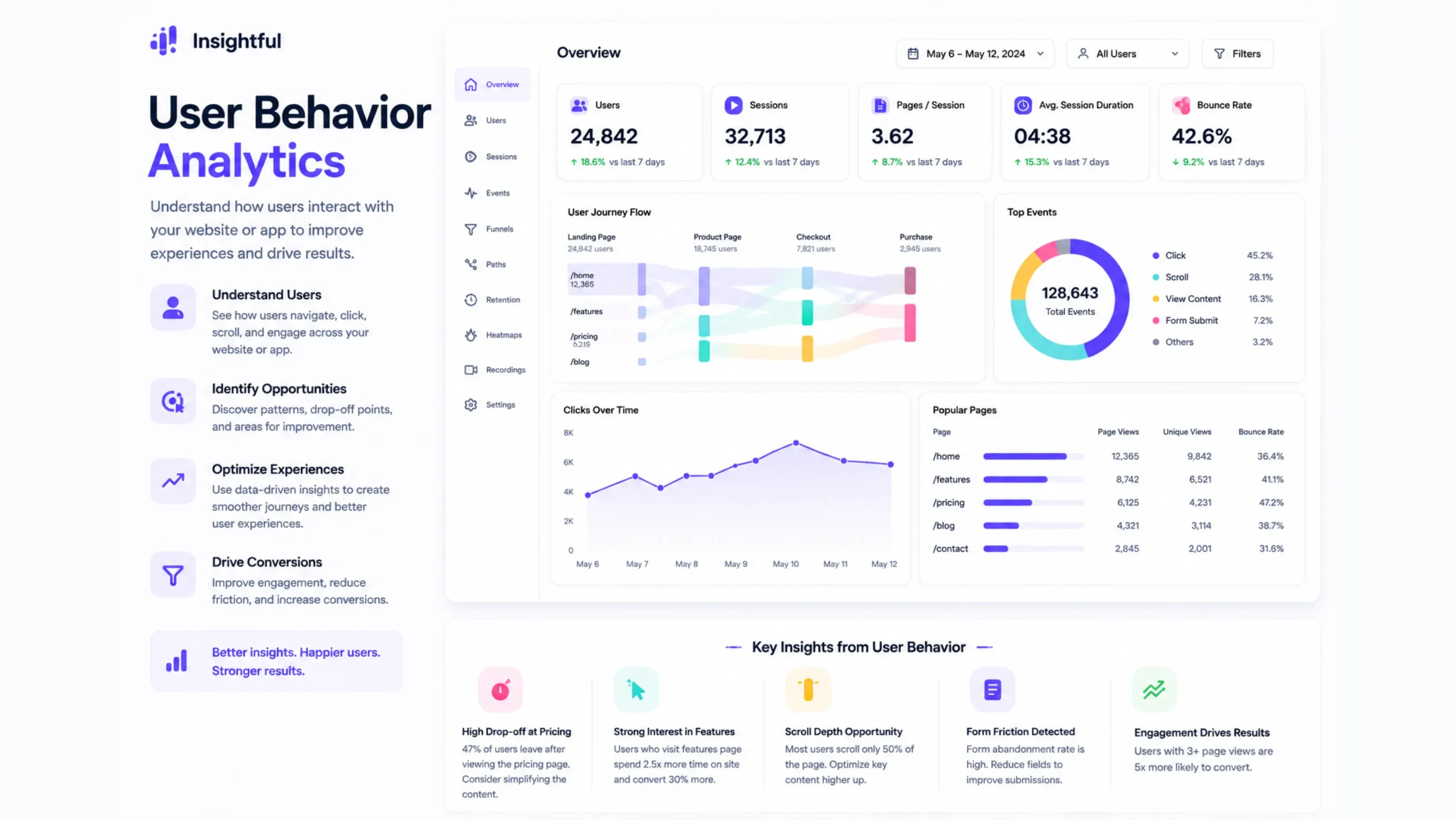
What Is User Behavior Analytics?
User Behavior Analytics, often shortened to UBA, is the practice of tracking, measuring, and analyzing how users interact with digital products. It helps businesses understand what visitors do, where they click, how they navigate, what captures their attention, and where they encounter obstacles.
Think of it as observing customer behavior inside a physical store.
A store owner may notice which aisles attract shoppers, which products get picked up, and where customers hesitate before making a purchase. User Behavior Analytics does something similar in digital environments.
It helps teams move beyond assumptions and see how real people interact with websites, mobile apps, SaaS platforms, ecommerce stores, and online services.
Why User Behavior Analytics Matters
Many businesses focus heavily on traffic numbers.
Traffic matters, of course.
Yet traffic alone doesn’t explain user decisions.
A website may attract thousands of visitors each month and still struggle to generate leads or sales. The missing piece is often behavior.
User Behavior Analytics helps answer questions like:
- What are visitors trying to accomplish?
- Which pages receive the most engagement?
- Where do users become frustrated?
- Why do people abandon forms or carts?
- Which content attracts attention?
- What actions lead to conversions?
Those insights often reveal opportunities that traditional reports overlook.
The Shift From Guessing to Knowing
Here’s the thing.
People rarely use websites exactly as designers expect.
A button that seems obvious may go unnoticed.
A navigation menu that looks perfectly organized may confuse visitors.
A signup process that feels simple internally may frustrate new users.
Without behavioral data, teams often rely on opinions.
With User Behavior Analytics, they can observe actual actions and make decisions based on evidence.
That’s a significant difference.
How User Behavior Analytics Works
User Behavior Analytics platforms collect interaction data as users browse a website or application.
The system records actions such as:
- Page visits
- Clicks and taps
- Mouse movements
- Scroll depth
- Form interactions
- Navigation paths
- Session duration
- Conversion events
The collected information is then processed and visualized through reports, dashboards, heatmaps, session recordings, funnels, and behavioral trends.
Instead of seeing isolated actions, businesses gain a broader picture of user behavior patterns.
Key Components of User Behavior Analytics
Several technologies work together within a User Behavior Analytics strategy.
Heatmaps
Heatmaps use colors to highlight areas of a page that receive the most interaction.
They show where users click, scroll, and focus their attention.
Session Recordings
Session recordings replay individual user sessions, allowing teams to watch visitor interactions as they happen.
It’s often one of the fastest ways to uncover usability issues.
Funnel Analysis
Funnels track the steps users take before completing a desired action.
This helps identify where people abandon a process.
Event Tracking
Event tracking measures specific user actions such as button clicks, downloads, purchases, or form submissions.
User Journey Analysis
This approach examines the paths visitors follow while moving through a website or application.
Patterns quickly begin to emerge.
What Can User Behavior Analytics Reveal?
A surprising amount.
Businesses use behavioral insights to uncover:
Friction Points
Areas where users become confused or stuck.
Drop-Off Locations
Pages or steps where visitors leave before converting.
Content Engagement
Sections that attract attention and keep users engaged.
Conversion Drivers
Elements that encourage users to take action.
Mobile Usability Issues
Problems that affect visitors on smartphones and tablets.
Feature Adoption
Which product features users embrace and which ones remain ignored.
Sometimes the smallest behavioral clue leads to the biggest improvement.
User Behavior Analytics and UX Design
User experience design revolves around one central idea: understanding users.
User Behavior Analytics provides direct evidence of user behavior.
Design teams use these insights to:
- Improve navigation
- Refine layouts
- Simplify forms
- Adjust content placement
- Improve accessibility
- Reduce friction
Imagine designing a road system without knowing where cars actually travel.
That would be difficult.
The same principle applies to digital products.
Behavioral data shows where users naturally go and where they struggle along the way.
User Behavior Analytics and Conversion Optimization
Many marketing teams rely heavily on User Behavior Analytics for Conversion Rate Optimization (CRO).
The objective is straightforward.
Identify barriers preventing visitors from taking action.
Behavioral analysis often reveals:
- Hidden usability issues
- Weak calls-to-action
- Poor page layouts
- Confusing checkout flows
- Content that distracts users
Once those issues are addressed, conversion rates often improve.
Small changes can create noticeable results.
Popular User Behavior Analytics Tools
Several platforms specialize in behavioral analysis.
Some widely used tools include:
- Hotjar
- Microsoft Clarity
- FullStory
- Mixpanel
- Amplitude
- Heap
- Smartlook
- Contentsquare
Each platform focuses on different aspects of user behavior, though many combine multiple features into a single solution.
User Behavior Analytics vs Traditional Analytics
Many people assume User Behavior Analytics and web analytics are the same thing.
They’re connected, though they serve different purposes.
Traditional analytics focuses on metrics such as:
- Page views
- Traffic sources
- Sessions
- Bounce rates
- Conversion rates
User Behavior Analytics focuses on actions and interactions.
Traditional analytics tells you what happened.
Behavioral analytics helps explain why it happened.
The two approaches work best together.
Common Use Cases
User Behavior Analytics supports a wide range of business goals.
Ecommerce Optimization
Improve product pages, checkout flows, and purchasing experiences.
SaaS Product Development
Understand feature usage and customer engagement.
Lead Generation
Improve forms, landing pages, and conversion paths.
Mobile App Improvements
Identify usability problems and engagement trends.
Customer Retention
Discover patterns that influence long-term user engagement.
Behavioral data often becomes a valuable resource across multiple teams.
Challenges and Limitations
User Behavior Analytics is powerful, though it isn’t perfect.
Behavior shows actions.
It doesn’t always reveal motivation.
For example, repeated clicks on a button could signal excitement—or confusion.
That’s why many organizations combine behavioral analytics with:
- User interviews
- Surveys
- Customer feedback
- A/B testing
- Support conversations
The combination creates deeper insights.
Privacy and Ethical Considerations
As behavioral tracking becomes more advanced, privacy remains an important topic.
Organizations must handle user data responsibly.
Many platforms support:
- Data masking
- Consent management
- GDPR compliance
- CCPA compliance
- Privacy controls
Businesses that respect user privacy often build stronger trust with customers.
And trust matters.
A lot.
The Future of User Behavior Analytics
Artificial intelligence is changing how behavioral data is analyzed.
Modern platforms can automatically identify:
- Frustration signals
- Abandonment patterns
- Conversion opportunities
- User segments
- Behavioral anomalies
Instead of manually reviewing thousands of interactions, teams can focus on insights that deserve attention.
Technology continues evolving, though the purpose remains the same.
Understanding people better.
Final Thoughts
User Behavior Analytics is the practice of tracking and analyzing user interactions across websites, applications, and digital products. By examining clicks, navigation paths, scrolling behavior, engagement patterns, and conversion actions, businesses gain valuable insight into how people actually use their digital experiences.
Data alone rarely tells the full story.
Behavior fills in the missing pieces.
For marketers, UX designers, product teams, and business owners, User Behavior Analytics offers a clearer view of customer needs, frustrations, and opportunities for improvement.
The better you understand behavior, the easier it becomes to create experiences people genuinely enjoy using.
Frequently Asked Questions (FAQs)
1. What is User Behavior Analytics?
User Behavior Analytics is the process of tracking and analyzing how users interact with websites, apps, and digital products to understand behavior patterns and improve experiences.
2. Why is User Behavior Analytics important?
It helps businesses identify usability issues, improve customer experiences, increase conversions, and make informed decisions based on actual user actions.
3. What data does User Behavior Analytics collect?
It typically collects clicks, scrolling activity, navigation paths, session duration, form interactions, page visits, and conversion events.
4. How is User Behavior Analytics different from traditional analytics?
Traditional analytics focuses on traffic and performance metrics, while User Behavior Analytics focuses on how users interact with digital products.
5. Which tools are commonly used for User Behavior Analytics?
Popular tools include Hotjar, Microsoft Clarity, Mixpanel, Amplitude, FullStory, Heap, Smartlook, and Contentsquare.
6. Is User Behavior Analytics useful for small businesses?
Yes. Businesses of all sizes can use behavioral insights to improve user experiences, identify conversion barriers, and make smarter product and marketing decisions.