


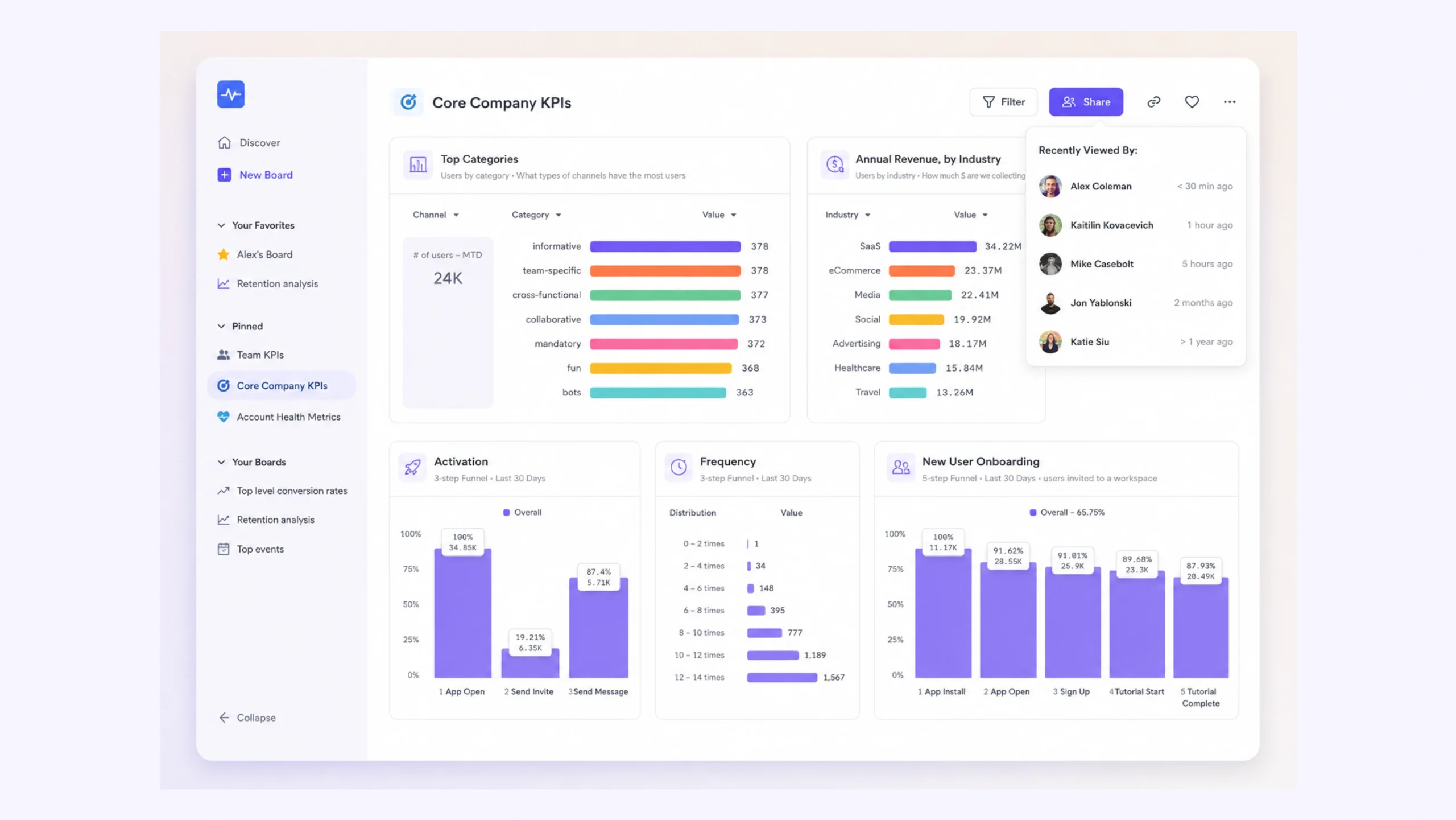
What Is Product Analytics?
Product analytics is the process of collecting, measuring, and analyzing user behavior within a digital product to understand how people interact with it, identify opportunities for improvement, and support better product decisions.
Think about walking into a busy store and watching customers move through different aisles. You notice where they stop, what they pick up, what they ignore, and where they leave.
Product analytics does something similar for websites, mobile apps, SaaS platforms, and digital products.
It helps teams answer important questions:
- Which features are people using?
- Where are users getting stuck?
- Why are users leaving?
- What drives engagement?
- Which actions lead to long-term retention?
Without analytics, teams often rely on opinions. With analytics, they rely on evidence.
Why Product Analytics Matters
Building a product without analytics is a little like driving through a city at night with the headlights turned off.
You might move forward.
You might even reach your destination.
But you’re making decisions with limited visibility.
Product analytics provides clarity.
Instead of guessing why conversions dropped or why users abandoned a feature, teams can examine actual behavior and identify patterns hidden within the data.
Those insights often reveal surprising truths.
Sometimes users completely ignore the feature a team spent months building.
Other times, a small feature becomes the product’s biggest strength.
Data Tells Stories
Here’s the thing.
Numbers by themselves aren’t very interesting.
Stories are.
Product analytics transforms behavior into stories.
For example:
A team notices that thousands of users create accounts every week, but only a small percentage complete onboarding.
The numbers reveal a problem.
The story suggests confusion, friction, or poor onboarding design.
Analytics helps teams connect those dots.
What Product Analytics Measures
Product analytics tracks actions users perform inside a product.
These actions are commonly called events.
Examples include:
- Account creation
- Button clicks
- Feature usage
- Searches
- Purchases
- File uploads
- Subscription upgrades
- Session duration
By tracking these events, teams gain a clearer picture of user behavior.
Over time, patterns begin to emerge.
Key Product Analytics Metrics
Many metrics appear in product dashboards, but a few tend to receive the most attention.
Active Users
Active users measure how many people use a product during a specific period.
Common variations include:
- Daily Active Users (DAU)
- Weekly Active Users (WAU)
- Monthly Active Users (MAU)
These metrics help teams understand product engagement.
Retention Rate
Retention measures how many users continue returning after their first experience.
A product attracting thousands of new users sounds impressive.
Yet if those users never come back, growth becomes difficult to sustain.
Retention often reveals the true health of a product.
Churn Rate
Churn tracks the percentage of users who stop using a product.
High churn usually signals frustration, poor product value, or unmet expectations.
Conversion Rate
Conversion measures how many users complete a desired action.
Examples include:
- Signing up
- Making a purchase
- Starting a trial
- Upgrading a subscription
Small improvements in conversion can create substantial business impact.
Feature Adoption
Feature adoption tracks how many users engage with specific product features.
This helps teams understand which features create value and which features may require improvement.
Product Analytics vs Traditional Analytics
People often confuse product analytics with traditional website analytics.
The two are related but focus on different goals.
Traditional analytics tools often measure:
- Page views
- Traffic sources
- Marketing campaigns
- Visitor demographics
Product analytics focuses more deeply on behavior inside the product.
Questions become:
- Which workflows succeed?
- Where do users abandon tasks?
- Which actions predict retention?
- Which features create long-term engagement?
One looks at visitors.
The other examines product usage.
How Product Teams Use Product Analytics
Product analytics influences nearly every stage of product development.
Improving Onboarding
Teams analyze onboarding funnels to identify where users abandon the setup process.
Removing friction often increases activation rates.
Prioritizing Features
Analytics reveals which features customers actually use.
This helps teams allocate resources more effectively.
Reducing Churn
Behavioral data can uncover warning signs before users leave.
Early intervention often improves retention.
Measuring Releases
After launching a new feature, teams can monitor adoption and engagement to evaluate success.
Popular Product Analytics Tools
Modern product teams have access to a wide range of analytics platforms.
Popular examples include:
- Mixpanel
- Amplitude
- Google Analytics
- Heap
- PostHog
- Hotjar
Each tool provides different capabilities, though their goal remains similar: helping teams understand user behavior.
Funnels, Cohorts, and User Paths
As teams mature, they often move beyond basic metrics.
Three commonly used analysis methods include:
Funnel Analysis
Funnels track how users move through a sequence of steps.
For example:
Visit Landing Page → Sign Up → Complete Onboarding → Subscribe
Funnels reveal where users drop off.
Cohort Analysis
Cohorts group users based on shared characteristics.
Teams may compare users who joined during different months to identify retention patterns.
User Path Analysis
Path analysis shows how users move through a product.
Unexpected paths often reveal usability issues or hidden opportunities.
Common Mistakes Teams Make
Analytics can be powerful.
It can also be misleading when used incorrectly.
One common mistake is tracking everything.
Collecting hundreds of metrics often creates confusion rather than clarity.
Another mistake is focusing only on vanity metrics.
A growing user count may look impressive.
Yet if engagement and retention remain weak, the product may still struggle.
Some teams become obsessed with numbers and forget to talk to customers.
Analytics explains what happened.
User research often explains why it happened.
Both perspectives matter.
Product Analytics and Product Growth
Growth rarely happens by accident.
Successful companies continuously measure user behavior, identify friction points, test improvements, and evaluate outcomes.
Product analytics supports that process.
It helps teams:
- Improve onboarding
- Increase engagement
- Strengthen retention
- Reduce churn
- Validate product decisions
- Discover growth opportunities
Small improvements across these areas often create significant long-term gains.
Looking Ahead
As artificial intelligence becomes more integrated into digital products, product analytics is evolving too.
Modern analytics platforms can identify behavioral patterns, detect anomalies, predict churn risks, and surface insights automatically.
The fundamentals remain unchanged.
Teams still need to understand users.
They still need evidence instead of assumptions.
And they still need data that connects behavior with business outcomes.
Final Thoughts
Product analytics is the practice of analyzing user behavior inside a digital product to understand engagement, identify problems, and guide product decisions. By tracking actions, measuring outcomes, and uncovering behavioral patterns, teams gain the insights needed to build products that people actually use, value, and return to over time.
Good products are built with creativity.
Great products combine creativity with evidence.
Product analytics provides that evidence.
Frequently Asked Questions (FAQs)
1. What is product analytics?
Product analytics is the process of tracking and analyzing user behavior within a digital product to improve user experience and support product decisions.
2. Why is product analytics important?
It helps teams understand how users interact with a product, identify problems, and discover opportunities for improvement.
3. What metrics are commonly tracked in product analytics?
Common metrics include active users, retention, churn, conversion rates, feature adoption, and engagement levels.
4. How is product analytics different from web analytics?
Web analytics focuses on traffic and website performance, while product analytics focuses on user behavior inside the product itself.
5. Which tools are used for product analytics?
Popular tools include Mixpanel, Amplitude, Google Analytics, Heap, PostHog, and Hotjar.
6. Can product analytics improve retention?
Yes. Product analytics helps teams identify friction points, understand user behavior, and make improvements that encourage users to return.