


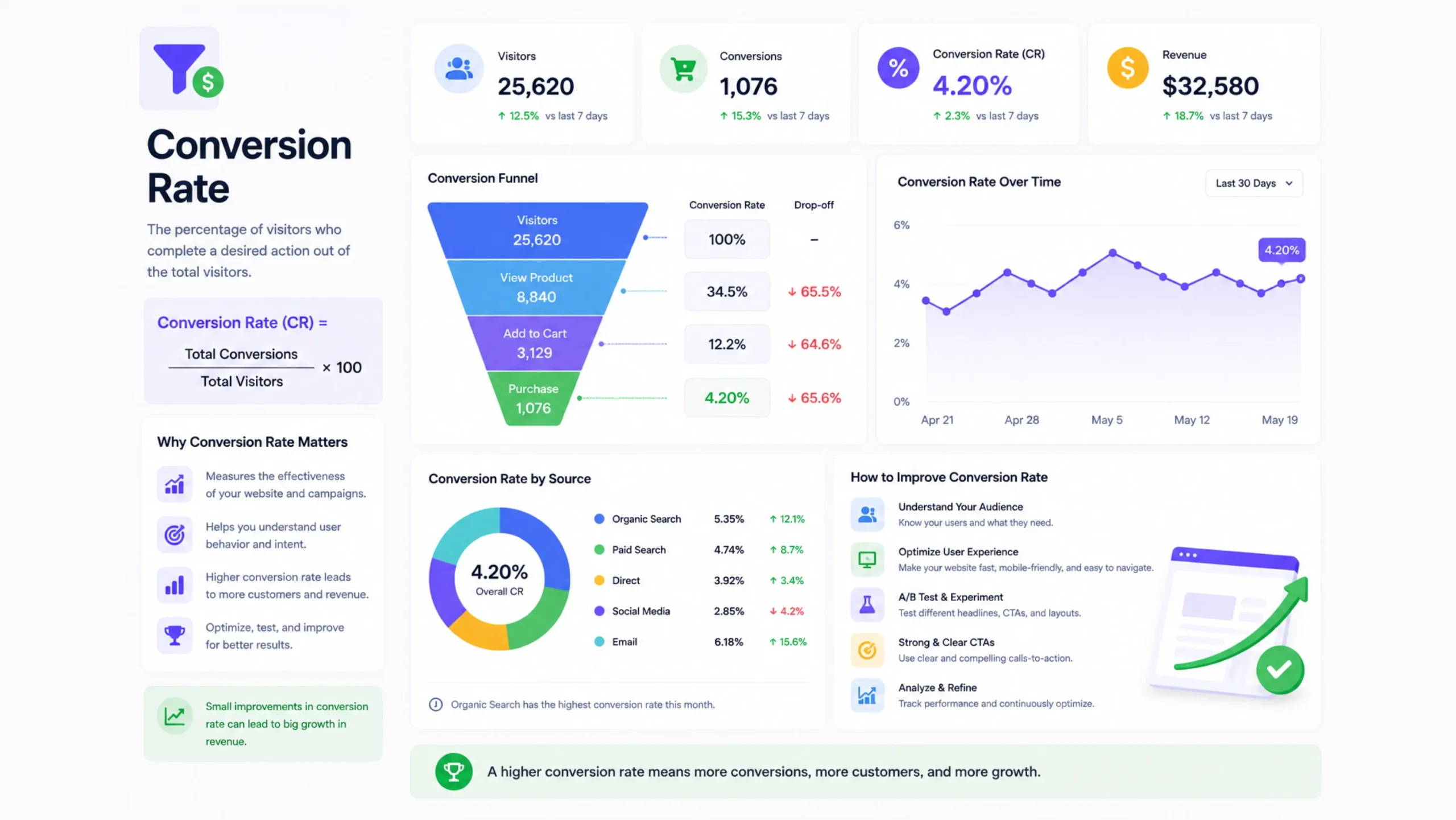
What Is Conversion Rate?
Conversion Rate is one of the most important metrics in digital marketing, sales, and user experience.
It measures how many people take a desired action after visiting a website, landing page, app, or campaign.
Imagine 1,000 people visit an online store. If 50 of them make a purchase, the conversion rate is 5%.
Simple? Yes.
Powerful? Absolutely.
Traffic alone doesn’t determine success. A website can attract thousands of visitors every day and still struggle to generate leads or sales. Conversion rate helps businesses understand how effectively they turn visitors into customers, subscribers, or prospects.
Why Conversion Rate Matters
Many businesses focus heavily on traffic numbers.
More visitors sound impressive.
Yet visitors who leave without taking action rarely contribute to business growth.
Conversion rate helps answer critical questions:
- Is the website convincing visitors to act?
- Are marketing campaigns attracting the right audience?
- Is the user experience working effectively?
- Are landing pages performing well?
- Are advertising dollars generating results?
A higher conversion rate often means more revenue without increasing traffic.
That’s why marketers, designers, product teams, and business owners monitor it closely.
How Conversion Rate Works
Every website or campaign has a goal.
The goal might be:
- Making a purchase
- Booking a demo
- Downloading an ebook
- Joining a newsletter
- Requesting a quote
- Registering for an event
When visitors complete that action, they become conversions.
Conversion rate compares the number of conversions with the total number of visitors.
The result shows how efficiently a website turns interest into action.
The Conversion Rate Formula
The standard formula is:
This percentage helps businesses evaluate campaign performance and website effectiveness.
A Simple Example
Let’s say a landing page receives:
- 2,000 visitors
- 100 form submissions
Using the formula:
100 ÷ 2,000 × 100 = 5%
The conversion rate is 5%.
Now imagine improving the page and increasing submissions to 200.
The conversion rate becomes 10%.
Traffic remains the same, yet results double.
That’s why conversion rate receives so much attention.
Different Types of Conversions
Not every business measures the same action.
Different goals create different conversion types.
Sales Conversions
A visitor completes a purchase.
Lead Conversions
A visitor submits a contact form or requests information.
Subscription Conversions
A user signs up for a newsletter or membership.
Trial Conversions
A prospect starts a free software trial.
Download Conversions
A visitor downloads a guide, template, or resource.
Registration Conversions
A user registers for a webinar, event, or course.
The conversion itself varies. The measurement process remains similar.
What Is a Good Conversion Rate?
One of the most common questions is:
“What is a good conversion rate?”
The answer varies widely.
A strong conversion rate depends on:
- Industry
- Audience
- Product price
- Traffic source
- Offer quality
- Website experience
Some websites convert at 2%.
Others convert at 10%, 20%, or even higher.
A B2B software company and an online clothing store often have very different conversion benchmarks.
Comparing your performance against your own historical results is often more useful than chasing industry averages.
Factors That Affect Conversion Rates
Several factors influence conversion performance.
Website Design
Visitors make decisions quickly.
A confusing design can reduce conversions significantly.
Page Speed
Slow websites often lose potential customers before they even see the offer.
Trust Signals
Reviews, testimonials, security badges, and case studies help build confidence.
Offer Quality
A compelling offer attracts more conversions.
Audience Relevance
The right visitors convert more often than random traffic.
Mobile Experience
Many users browse on mobile devices. Poor mobile experiences can hurt results.
Call-to-Action (CTA)
Clear and persuasive calls-to-action help guide users toward conversion.
How to Improve Conversion Rates
Improving conversion rates often produces larger gains than increasing traffic.
Here are several proven approaches.
Simplify Forms
Shorter forms generally receive more submissions.
Improve Page Speed
Faster websites create smoother user experiences.
Strengthen Headlines
Strong headlines capture attention and communicate value quickly.
Add Social Proof
Customer reviews and testimonials help reduce uncertainty.
Improve Mobile Design
Mobile users expect smooth navigation and easy interactions.
Run A/B Tests
Testing different layouts, headlines, buttons, and offers reveals what works best.
Create Better User Experiences
Visitors are more likely to convert when the experience feels simple and intuitive.
Small adjustments often lead to meaningful improvements over time.
Conversion Rate vs Conversion Rate Optimization (CRO)
These terms are related but different.
Conversion Rate is a metric.
It tells you what percentage of visitors convert.
Conversion Rate Optimization (CRO) is the process of improving that percentage.
Think of conversion rate as the score.
CRO is the effort used to improve the score.
One measures performance.
The other improves performance.
Common Conversion Rate Mistakes
Many businesses misinterpret conversion data.
Focusing Only on Traffic
More visitors don’t automatically create more customers.
Ignoring User Intent
Not every visitor arrives ready to buy.
Tracking the Wrong Goal
Measuring irrelevant actions can create misleading conclusions.
Making Changes Without Testing
Assumptions often produce poor results.
Overcomplicating the Experience
Too many choices can reduce conversions.
Clear and focused experiences generally perform better.
Tools Used to Measure Conversion Rates
Several analytics platforms help businesses monitor conversion performance.
Popular options include:
- Google Analytics
- Hotjar
- Microsoft Clarity
- Mixpanel
- Amplitude
- HubSpot
- Salesforce
- Adobe Analytics
- Optimizely
These tools provide insights into user behavior, conversion funnels, and performance trends.
Why Conversion Rate Is More Important Than Many Realize
Here’s the thing.
Businesses often spend significant money attracting visitors.
Advertising budgets grow.
SEO campaigns expand.
Content production increases.
Yet none of those investments matter much if visitors fail to take action.
Conversion rate acts like a report card for digital performance.
It reveals how effectively a business converts attention into measurable outcomes.
A small improvement can create substantial revenue growth without spending more on traffic.
That’s why conversion rate remains one of the most valuable metrics in digital business.
Final Thoughts
Conversion Rate measures the percentage of visitors who complete a desired action on a website, app, or marketing campaign. It helps businesses evaluate performance, identify opportunities for improvement, and maximize the value of existing traffic.
Companies that monitor and improve conversion rates often achieve stronger growth, better marketing efficiency, and higher returns from their digital efforts. Traffic creates opportunities. Conversion rate determines how many of those opportunities become results.
Frequently Asked Questions (FAQs)
1. What is a conversion rate?
Conversion rate is the percentage of visitors who complete a desired action, such as making a purchase, filling out a form, or signing up for a service.
2. How do you calculate conversion rate?
Divide the number of conversions by the total number of visitors and multiply by 100.
3. Why is conversion rate important?
It helps businesses measure how effectively they turn visitors into customers, leads, or subscribers.
4. What is considered a good conversion rate?
A good conversion rate varies by industry, audience, and business model. Performance should be evaluated within your own market and goals.
5. What affects conversion rates?
Factors such as website design, page speed, trust signals, offer quality, user experience, and audience relevance all influence conversion rates.
6. How can businesses improve conversion rates?
Businesses can improve conversion rates by simplifying forms, improving page speed, strengthening calls-to-action, adding social proof, and testing different page elements.