


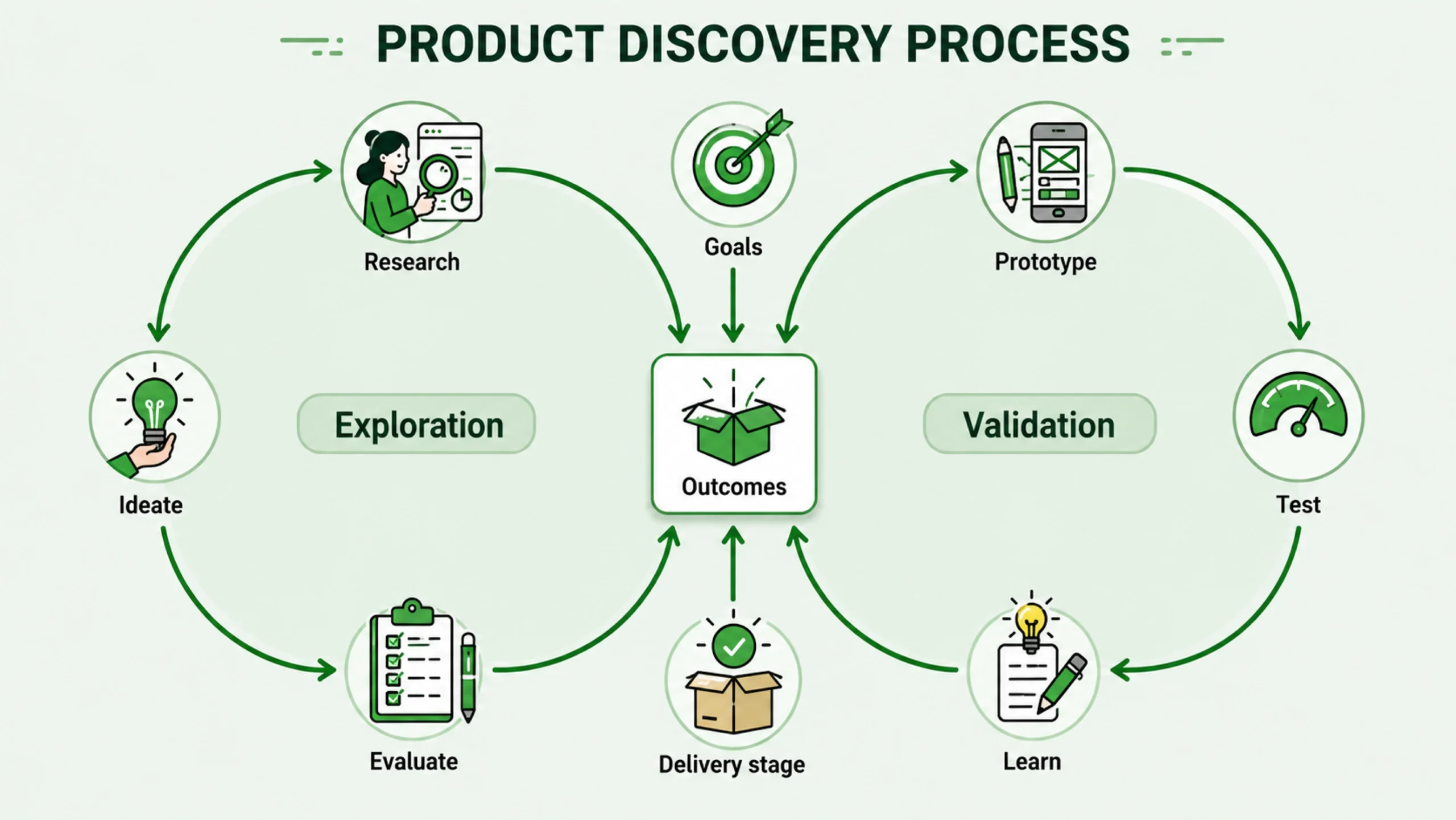
What Is Product Discovery?
Product discovery is the process of identifying customer problems, exploring opportunities, testing ideas, and validating potential solutions before investing significant time and resources in development.
In simple terms, product discovery helps teams answer a critical question:
“Are we building the right thing?”
Many organizations focus heavily on building products. Product discovery focuses on learning what should be built first.
It’s a stage filled with questions, conversations, research, experiments, and evidence gathering.
Without product discovery, teams often rely on assumptions.
And assumptions can become expensive.
Before Building, Stop and Think
Imagine building a house.
You could start pouring concrete immediately.
Or you could spend time understanding the land, the weather, the budget, and the people who will live there.
Most people would agree that the second approach makes more sense.
Product discovery works in a similar way.
Instead of rushing into development, teams take time to understand users, business goals, and market opportunities.
That small investment often prevents large mistakes later.
Why Product Discovery Matters
Many products fail for a surprisingly simple reason.
They solve problems that people don’t actually have.
Teams sometimes become excited about features, technology, or trends and forget to verify whether customers truly need them.
Product discovery helps reduce that risk.
It allows organizations to:
- Understand customer needs
- Validate ideas early
- Reduce development waste
- Prioritize valuable opportunities
- Lower project risk
- Improve product-market fit
- Increase confidence in decisions
The goal isn’t to eliminate uncertainty completely.
That’s impossible.
The goal is to reduce uncertainty before making major investments.
The Real Purpose of Product Discovery
At first glance, product discovery may seem like a research activity.
In reality, it’s a decision-making activity.
Teams gather evidence to make better choices.
They learn:
- What problems users face
- How serious those problems are
- Which opportunities deserve attention
- What solutions users value
- What ideas should be abandoned
That last point deserves attention.
Good product discovery often reveals what not to build.
And that can save months of work.
Product Discovery vs Product Delivery
People frequently confuse these two concepts.
They work closely together but serve different purposes.
Product Discovery
Focuses on learning.
Questions include:
- What problem exists?
- Who experiences it?
- How significant is it?
- What solution might work?
Product Delivery
Focuses on execution.
Questions include:
- How do we build it?
- How long will it take?
- What resources are needed?
- How do we launch it?
Discovery determines the direction.
Delivery turns that direction into reality.
Key Principles of Product Discovery
Strong product discovery follows several guiding principles.
Start With Problems, Not Features
Many failed products begin with feature ideas.
Successful products usually begin with customer problems.
The distinction matters.
People don’t buy features.
They seek solutions.
Learn Continuously
Discovery isn’t a one-time activity.
Customer needs change.
Markets shift.
Competitors introduce new offerings.
Learning must continue throughout a product’s life.
Test Before Committing
A simple prototype can reveal valuable insights before development begins.
Testing early often prevents costly mistakes later.
Let Evidence Guide Decisions
Opinions matter.
Experience matters.
Evidence matters even more.
Research helps teams move beyond assumptions and personal preferences.
How Product Discovery Works
Every organization follows its own process.
Still, most discovery efforts share common stages.
Step 1: Research and Exploration
The process starts with learning about customers and their environment.
Teams gather information through:
- User interviews
- Surveys
- Support tickets
- Analytics data
- Customer feedback
- Market research
- Competitor analysis
Patterns begin to emerge.
Those patterns often reveal hidden opportunities.
Step 2: Identify Customer Problems
Research generates observations.
The next step is identifying meaningful problems.
Not every issue deserves attention.
Teams evaluate:
- Frequency
- Severity
- Business impact
- Customer frustration
- Market demand
The strongest opportunities usually sit at the intersection of user needs and business value.
Step 3: Define Assumptions
Every idea contains assumptions.
For example:
- Users want this feature.
- Users will pay for this service.
- Users will understand this workflow.
Discovery helps identify those assumptions before treating them as facts.
Step 4: Generate Solution Ideas
Once the problem becomes clear, teams begin exploring possible solutions.
Brainstorming sessions, workshops, sketches, and concept creation help generate options.
At this stage, quantity often matters.
The first idea isn’t always the strongest one.
Step 5: Create Prototypes
Ideas become easier to evaluate when people can interact with them.
Teams often build:
- Wireframes
- Clickable prototypes
- Mockups
- Concept screens
- Landing pages
These lightweight artifacts allow quick learning without major development costs.
Step 6: Validate With Users
This is where discovery becomes especially valuable.
Real users interact with concepts and provide feedback.
Their reactions often reveal:
- Confusing workflows
- Missing information
- Incorrect assumptions
- Unexpected needs
- New opportunities
Sometimes a promising idea gains support.
Sometimes it falls apart completely.
Both outcomes provide useful information.
Step 7: Decide What to Build
After gathering evidence, teams make informed decisions.
They may:
- Move forward
- Revise the concept
- Conduct more research
- Postpone the idea
- Cancel the initiative
Contrary to popular belief, stopping a weak idea is often a successful discovery outcome.
It prevents wasted effort.
Common Product Discovery Methods
Product teams use many techniques during discovery.
Some of the most common include:
User Interviews
Direct conversations reveal motivations, frustrations, and goals.
Surveys
Surveys provide feedback from larger audiences.
Usability Testing
Users interact with concepts while teams observe their behavior.
Customer Journey Mapping
This helps visualize customer experiences across multiple touchpoints.
Affinity Mapping
Teams organize research findings into meaningful themes and patterns.
Competitive Analysis
Studying competitors reveals gaps, strengths, and opportunities.
Prototype Testing
Interactive concepts help validate ideas before development begins.
Product Discovery Deliverables
Discovery often produces several outputs.
These help teams communicate findings and make decisions.
Common deliverables include:
- Research summaries
- User personas
- Problem statements
- Opportunity assessments
- Customer journey maps
- User flows
- Wireframes
- Prototypes
- Insight reports
- Prioritized opportunity lists
These documents create shared understanding across teams.
Who Participates in Product Discovery?
Product discovery works best when multiple perspectives are involved.
Participants often include:
- Product managers
- Product designers
- UX researchers
- Developers
- Business stakeholders
- Customer support teams
- Marketing teams
- Customers
Good ideas can emerge from almost anywhere.
Limiting discovery to a single department often narrows perspective.
Common Product Discovery Mistakes
Even experienced teams encounter challenges.
Falling in Love With Solutions
Teams sometimes become attached to ideas before validating them.
This can lead to biased decision-making.
Skipping User Research
Assumptions frequently replace evidence when research is ignored.
The results are rarely positive.
Interviewing Too Few Users
A handful of conversations may reveal useful insights.
Yet broader patterns require broader participation.
Treating Discovery as a One-Time Activity
Customer expectations evolve continuously.
Discovery should evolve too.
Chasing Trends
A feature may be popular in the market but irrelevant to your users.
Popularity alone isn’t proof of value.
Product Discovery in the Age of AI
Artificial intelligence is changing how discovery work happens.
AI tools can help teams:
- Analyze research data
- Summarize interviews
- Identify patterns
- Generate concepts
- Organize insights
Yet AI doesn’t replace customer conversations.
People remain at the center of product discovery.
Technology can process information quickly.
Understanding human behavior still requires curiosity and empathy.
Why Product Discovery Creates Better Products
Here’s the thing.
Most product failures don’t happen because teams can’t build.
They happen because teams build something people don’t need.
Product discovery helps prevent that scenario.
It reduces guesswork.
It increases confidence.
It creates stronger connections between customer needs and business goals.
Most importantly, it helps teams invest their energy in solving the right problems.
And solving the right problem is often more valuable than finding the perfect solution.
Final Thoughts
Product discovery is the process of learning before building. It helps teams understand customers, validate assumptions, explore opportunities, and make informed product decisions.
Rather than rushing into development, successful teams spend time gathering evidence and testing ideas. This approach reduces risk, saves resources, and increases the likelihood of creating products people genuinely want.
The strongest products rarely begin with a feature list.
They begin with curiosity, research, and a desire to understand people.
That’s the heart of product discovery.
Frequently Asked Questions (FAQs)
1. What is product discovery?
Product discovery is the process of researching customer needs, validating ideas, and identifying valuable solutions before product development begins.
2. Why is product discovery important?
It helps teams reduce risk, avoid building unnecessary features, and make better product decisions based on evidence rather than assumptions.
3. What is the difference between product discovery and product delivery?
Product discovery focuses on learning what should be built, while product delivery focuses on building and launching the solution.
4. Who is involved in product discovery?
Product managers, designers, researchers, developers, stakeholders, and customers often contribute to discovery activities.
5. What methods are used during product discovery?
Common methods include user interviews, surveys, usability testing, prototype testing, customer journey mapping, and competitor analysis.
6. How often should product discovery happen?
Product discovery should be an ongoing activity that continues throughout the product lifecycle rather than a one-time project phase.