


User Research: The Foundation of Great User Experiences.
Imagine spending six months building a product.
The design looks beautiful.
The development team delivers every feature on schedule.
The stakeholders are excited.
Then the product launches—and users struggle to understand it.
Some abandon it within minutes.
Others never return.
It’s a frustrating situation, and it happens more often than many teams would like to admit.
The problem usually isn’t a lack of effort. It’s a lack of understanding.
That’s where user research comes in.
User research helps teams learn who their users are, what they need, how they behave, and where they face challenges. Instead of making decisions based on assumptions, teams gather evidence directly from the people they are designing for.
In many ways, user research acts like a compass. Without it, a project may still move forward, but there’s no guarantee it’s heading in the right direction.
What Is User Research?
User research is the process of studying users to understand their behaviors, needs, motivations, goals, and pain points.
The purpose is simple: learn from real people before making product decisions.
Researchers gather insights through interviews, observations, surveys, usability tests, analytics, and other methods.
The information collected helps teams create products, services, and experiences that solve actual problems rather than imagined ones.
Think of it this way.
A doctor doesn’t prescribe treatment without understanding the patient first.
A UX team shouldn’t design solutions without understanding users.
The principle is remarkably similar.
Why User Research Matters
People often assume they know what users want.
That’s a risky assumption.
What seems obvious to a designer might confuse a customer.
What stakeholders believe is valuable might not matter to users at all.
User research helps bridge that gap.
Instead of relying on opinions, teams gather insights from real-world behavior.
The findings often reveal surprising patterns.
Users may:
- Use products differently than expected
- Ignore certain features completely
- Develop workarounds for confusing processes
- Struggle with tasks that appear straightforward
These discoveries help teams make better decisions.
And better decisions usually lead to better experiences.
Here’s the Thing: Users Rarely Think Like Designers
One of the biggest lessons in UX is that users don’t spend hours studying products.
Designers do.
Product managers do.
Developers do.
Users simply want to complete a task.
A customer ordering groceries online isn’t thinking about information architecture.
Someone booking a doctor’s appointment isn’t analyzing interaction patterns.
They’re focused on achieving a goal.
User research helps teams step outside their own perspective and see products through the eyes of actual users.
That shift changes everything.
The Main Purpose of User Research
User research serves several important goals.
It helps teams:
- Understand user needs
- Discover pain points
- Validate ideas
- Improve usability
- Reduce business risks
- Prioritize features
- Identify opportunities for innovation
Notice something interesting?
Research isn’t only about finding problems.
It’s also about uncovering opportunities.
Sometimes users reveal needs they never explicitly mention.
Observing behavior often reveals insights that surveys alone might miss.
Types of User Research
User research can be divided into several categories.
Different projects require different approaches.
Generative Research
Generative research happens early in a project.
Its purpose is exploration.
Teams seek answers to questions like:
- Who are our users?
- What problems do they face?
- What motivates them?
- How do they currently solve these problems?
This research helps shape product direction.
Evaluative Research
Evaluative research focuses on assessing existing ideas, designs, or products.
Teams test concepts to determine:
- What’s working
- What’s confusing
- What needs improvement
Usability testing is a common example.
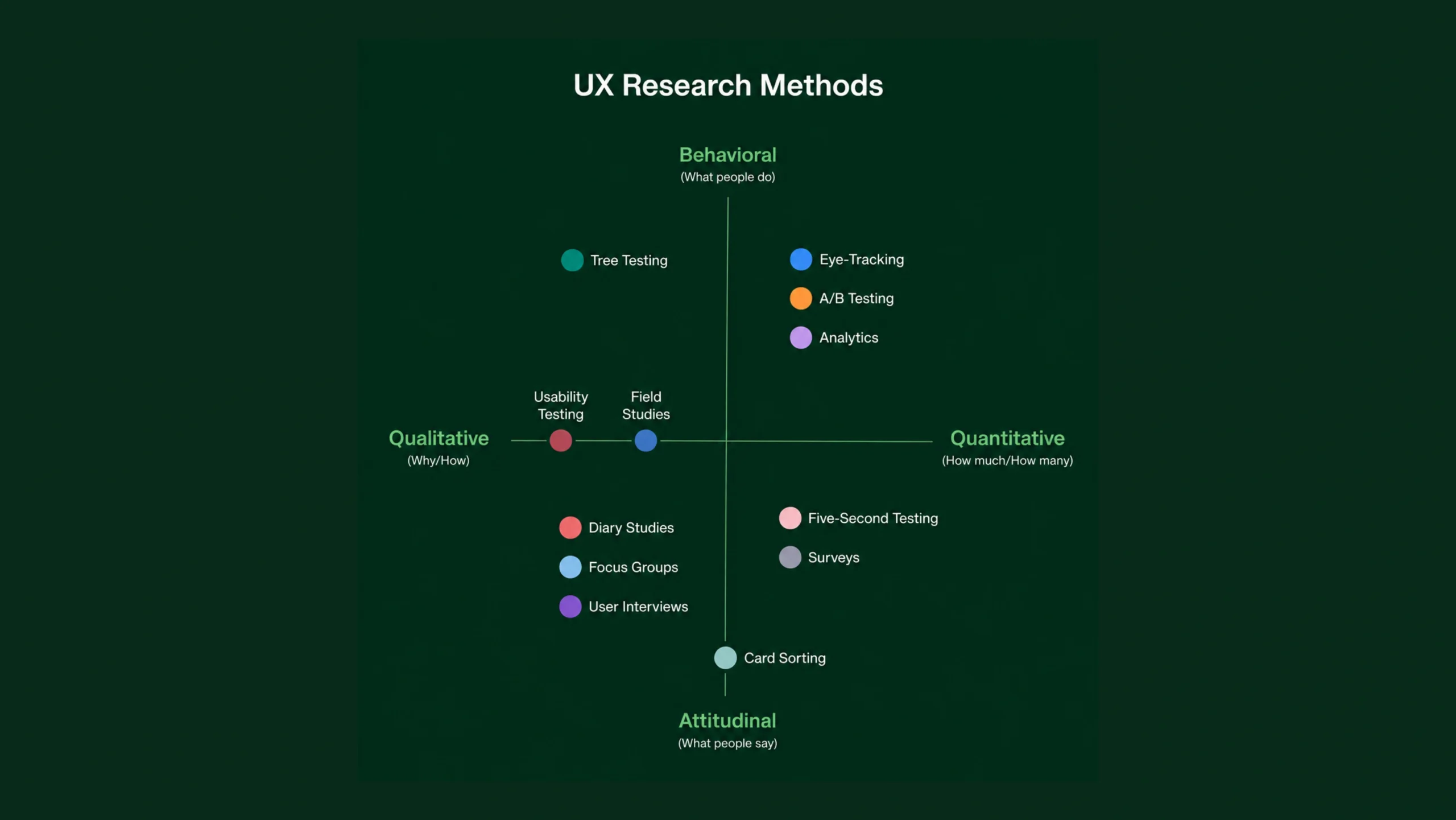
Behavioral Research
Behavioral research examines what users actually do.
This matters because people sometimes say one thing and do another.
Observing behavior often provides stronger insights than relying solely on opinions.
Attitudinal Research
Attitudinal research focuses on what users say, think, or feel.
Interviews and surveys typically fall into this category.
These methods help uncover motivations and perceptions.
Qualitative vs Quantitative Research
User research generally falls into two major categories.
Both matter.
Both answer different questions.
Qualitative Research
Qualitative research explores thoughts, emotions, motivations, and experiences.
It helps answer questions like:
- Why are users struggling?
- How do users feel?
- What frustrations exist?
Examples include:
- Interviews
- Field studies
- Contextual inquiries
- Moderated usability tests
Qualitative research provides depth.
Quantitative Research
Quantitative research focuses on numbers and measurable patterns.
It answers questions such as:
- How many users completed a task?
- What percentage abandoned checkout?
- How often is a feature used?
Examples include:
- Surveys
- Analytics
- A/B testing
- Conversion metrics
Quantitative research provides scale.
Together, qualitative and quantitative research create a more complete picture.
Common User Research Methods
Researchers use many techniques depending on project goals.
Let’s look at some of the most common.
User Interviews
User interviews involve one-on-one conversations with participants.
Researchers ask open-ended questions to understand experiences, needs, and challenges.
The real value often comes from follow-up questions.
A single comment can reveal an issue nobody expected.
Surveys
Surveys collect feedback from larger groups of users.
They are useful for identifying trends and measuring opinions across broader audiences.
Good survey questions are surprisingly difficult to write.
A poorly phrased question can influence responses without anyone realizing it.
Usability Testing
Usability testing evaluates how people interact with a product.
Participants complete specific tasks while researchers observe.
This method often reveals:
- Navigation issues
- Confusing labels
- Broken workflows
- User frustrations
Few research methods expose usability problems as quickly as usability testing.
Field Studies
Researchers observe users in their natural environments.
This might involve:
- Watching retail employees use software
- Observing healthcare workers
- Studying commuters using mobile apps
Context matters.
People behave differently in real environments than they do in controlled settings.
Card Sorting
Card sorting helps teams organize content and navigation structures.
Participants group information into categories that make sense to them.
The results often influence website menus and information architecture.
Diary Studies
Participants document their experiences over time.
These studies help researchers understand long-term behaviors and habits.
They’re particularly useful for products used regularly rather than occasionally.
Analytics Research
Digital products generate enormous amounts of behavioral data.
Analytics can reveal:
- Popular pages
- Drop-off points
- Conversion rates
- User flows
Data helps identify where problems may exist.
Research helps explain why those problems exist.
The User Research Process
User research follows a structured process.
Different teams adapt the details, yet the overall framework remains similar.
Step 1: Define Research Goals
Research begins with questions.
Teams identify what they need to learn.
Examples include:
- Why are users abandoning checkout?
- What features matter most?
- How do customers complete tasks today?
Clear goals create focused research.
Step 2: Choose Research Methods
Researchers select methods based on objectives.
If the goal is understanding behavior, observation may be appropriate.
If the goal is measuring trends, surveys might work better.
Different questions require different approaches.
Step 3: Recruit Participants
The quality of research often depends on recruiting the right people.
Researchers seek participants who represent actual users.
Talking to the wrong audience can produce misleading results.
Step 4: Conduct Research
Researchers gather information through interviews, testing sessions, surveys, observations, or other methods.
The focus remains on learning rather than validating personal opinions.
Step 5: Analyze Findings
Raw data alone isn’t enough.
Researchers organize information, identify patterns, and uncover meaningful insights.
This stage often reveals recurring themes.
Patterns matter more than isolated comments.
Step 6: Share Insights
Research findings must be communicated clearly.
Reports, presentations, journey maps, and workshops help teams understand what was learned.
Research has little value if insights remain hidden.
User Research and UX Design
User research and UX design are deeply connected.
Research informs design decisions throughout the product lifecycle.
Researchers help answer:
- Who are the users?
- What are their goals?
- What obstacles do they face?
Designers then create solutions based on those insights.
Without research, design can become guesswork.
With research, design becomes informed problem-solving.
Benefits of User Research
Organizations invest in research for good reasons.
The benefits often extend far beyond design teams.
Better Products
Research helps teams build products people actually need.
That sounds obvious.
Yet many failed products solve problems users never had.
Reduced Risk
Launching a product without user feedback carries significant risk.
Research helps identify issues before major investments are made.
Improved Customer Satisfaction
Products that address real needs tend to create happier customers.
Satisfied users often become loyal users.
Faster Decision-Making
Research provides evidence.
Evidence reduces debates driven by personal opinions.
Teams spend less time guessing and more time solving problems.
Stronger Business Outcomes
Better experiences often lead to:
- Higher retention
- Increased conversions
- Improved engagement
- Greater customer trust
Everyone benefits.
Common User Research Mistakes
Even experienced teams occasionally stumble.
Several mistakes appear repeatedly.
Asking Leading Questions
Questions should remain neutral.
Leading questions influence responses and create biased results.
For example:
“Don’t you think this feature is helpful?”
That’s not research.
That’s persuasion.
Researching Too Late
Some teams conduct research after major decisions have already been made.
Early research often prevents costly mistakes.
Ignoring Contradictory Findings
Sometimes research challenges existing assumptions.
That can be uncomfortable.
Yet uncomfortable findings are often the most valuable.
Talking to the Wrong Users
Research loses value if participants don’t represent actual users.
Recruitment quality matters tremendously.
Focusing Only on What Users Say
People’s actions often reveal insights their words do not.
Observing behavior remains one of the most powerful research techniques.
Popular User Research Tools
Modern researchers use a variety of tools.
Some widely used options include:
- Figma
- Maze
- UserTesting
- Dovetail
- Hotjar
- Optimal Workshop
- Typeform
- Google Forms
- Miro
- Lookback
Tools support research.
They don’t replace it.
The conversations and observations remain the most valuable part.
The Growing Role of AI in User Research
Artificial intelligence is beginning to support research activities.
AI can help with:
- Interview transcription
- Theme identification
- Data summarization
- Sentiment analysis
Still, human judgment remains critical.
People understand nuance, context, emotion, and cultural signals in ways software often cannot.
The future will likely combine AI efficiency with human interpretation.
User Research Is Really About Empathy
Let’s step back for a moment.
Beneath the methods, frameworks, reports, and analytics lies a simple idea.
User research helps teams understand people.
That’s it.
Researchers listen.
They observe.
They learn.
They look beyond assumptions and seek genuine understanding.
The strongest products rarely emerge from guesswork.
They emerge from curiosity, empathy, and a willingness to learn from the people who use them.
Final Thoughts
User research is the practice of studying users to understand their needs, behaviors, goals, and challenges. It provides the foundation for creating products and services that genuinely help people.
By gathering insights through interviews, surveys, usability testing, observations, analytics, and other methods, teams reduce uncertainty and make smarter decisions.
Good user research doesn’t tell teams what to build. It helps them understand the problems worth solving.
And in product design, that difference matters more than many people realize.
Products come and go.
Technology changes.
User expectations evolve.
The need to understand people remains constant.
That’s why user research continues to sit at the center of successful UX design.
Frequently Asked Questions (FAQs)
What is user research?
User research is the process of studying users to understand their needs, behaviors, goals, motivations, and challenges. It helps teams create products and services that better serve their audience.
Why is user research important in UX design?
User research reduces assumptions and provides evidence-based insights. It helps designers create experiences that solve real user problems and improve overall satisfaction.
What are the main types of user research?
The primary types include generative research, evaluative research, behavioral research, and attitudinal research. Each serves different goals throughout product development.
What is the difference between qualitative and quantitative research?
Qualitative research focuses on understanding user thoughts, feelings, and motivations. Quantitative research focuses on numerical data, trends, and measurable outcomes.
What are common user research methods?
Popular methods include user interviews, surveys, usability testing, field studies, card sorting, diary studies, and analytics analysis.
When should user research be conducted?
User research should occur throughout the product lifecycle—from early discovery and concept development to testing, launch, and continuous improvement.