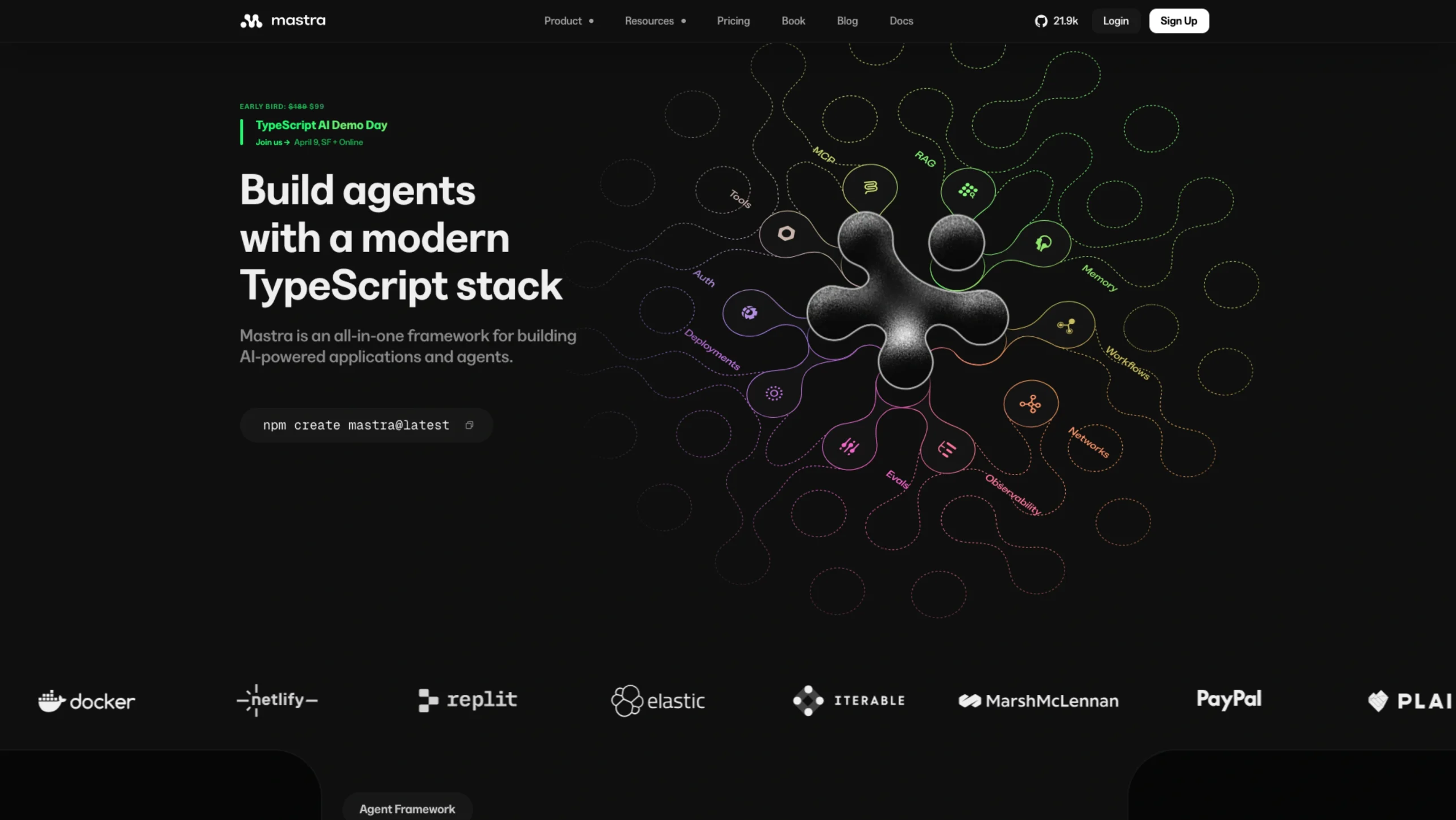
Mastra.ai is a powerful, open-source TypeScript framework designed to help developers build, deploy, and manage AI agents and complex agentic workflows.
Created by the team behind Gatsby (including Sam Bhagwat), it bridges the gap between early-stage AI prototyping and production-ready applications by providing a structured, “batteries-included” environment for the modern web stack.
Here is a detailed breakdown of what makes Mastra.ai stand out:
1. The Core Philosophy: “AI for Web Developers”
While many AI frameworks (like LangChain) were born in the Python ecosystem, Mastra is purpose-built for TypeScript. It treats AI agents as a part of your application’s logic rather than a separate, black-box experiment. It focuses on:
- Type Safety: Deep integration with Zod for structured inputs and outputs.
- Production Readiness: Built-in observability, evals, and deployment paths.
- Control vs. Autonomy: It provides a “Graph-based” workflow engine so developers can choose between fully autonomous agents and strictly defined multi-step processes.
2. Key Technical Features
- Agent Framework: Define agents with specific instructions, chosen LLMs (GPT-4, Claude, Gemini, etc.), and sets of “tools” they can call.
- Workflows (Directed Acyclic Graphs): Unlike standard linear chains, Mastra allows for complex branching, parallel execution, and loops using a
.then(),.branch(), and.parallel()syntax. - Model Context Protocol (MCP): Mastra natively supports the MCP standard, allowing you to connect your agents to external data sources and tools (like Google Sheets, GitHub, or internal DBs) without writing custom integrations from scratch.
- Human-in-the-Loop: A standout feature that allows you to “suspend” a workflow or agent execution to wait for human approval or input before resuming.
- Built-in Memory: It handles both short-term thread history and long-term “semantic” memory (using RAG) out of the box.
3. The Developer Experience (DX)
Mastra is designed to feel like a modern web framework:
- Mastra Studio: A local developer playground (accessed via
localhost:4111) where you can visualize your agents, test workflows, and debug tool calls in real-time before writing a single line of frontend code. - AI Tracing & Observability: Specialized tracing that filters out “framework noise.” It highlights only what matters: model interactions, token usage, and tool execution paths.
- Scorers & Evals: It includes tools to measure the “correctness” of agent responses using model-graded or rule-based metrics, essential for refining prompts.
4. Tech Stack & Integrations
Mastra is highly modular and fits into almost any modern JS/TS environment:
- Frameworks: First-class support for Next.js, React, Astro, SvelteKit, and Hono.
- LLM Providers: Access to 3,000+ models from 90+ providers (OpenAI, Anthropic, Google Gemini, xAI, etc.) through a unified interface.
- Vector DBs: Simplified RAG (Retrieval-Augmented Generation) with built-in sync and vector storage management.
- UI Libraries: Integrates with Vercel AI SDK UI, CopilotKit, and Assistant UI to build chat interfaces quickly.
5. Why use it?
If you are building a simple chatbot, Mastra might be overkill. However, it is the ideal tool for:
- Enterprise Agents: Where you need high reliability, audit logs, and human oversight.
- Complex Automations: Where an agent needs to perform multi-step tasks like “Read a PR, run tests, summarize changes, and post to Slack.”
- Domain-Specific Copilots: Creating coding, legal, or finance assistants that need access to specific private data and precise tool execution.