


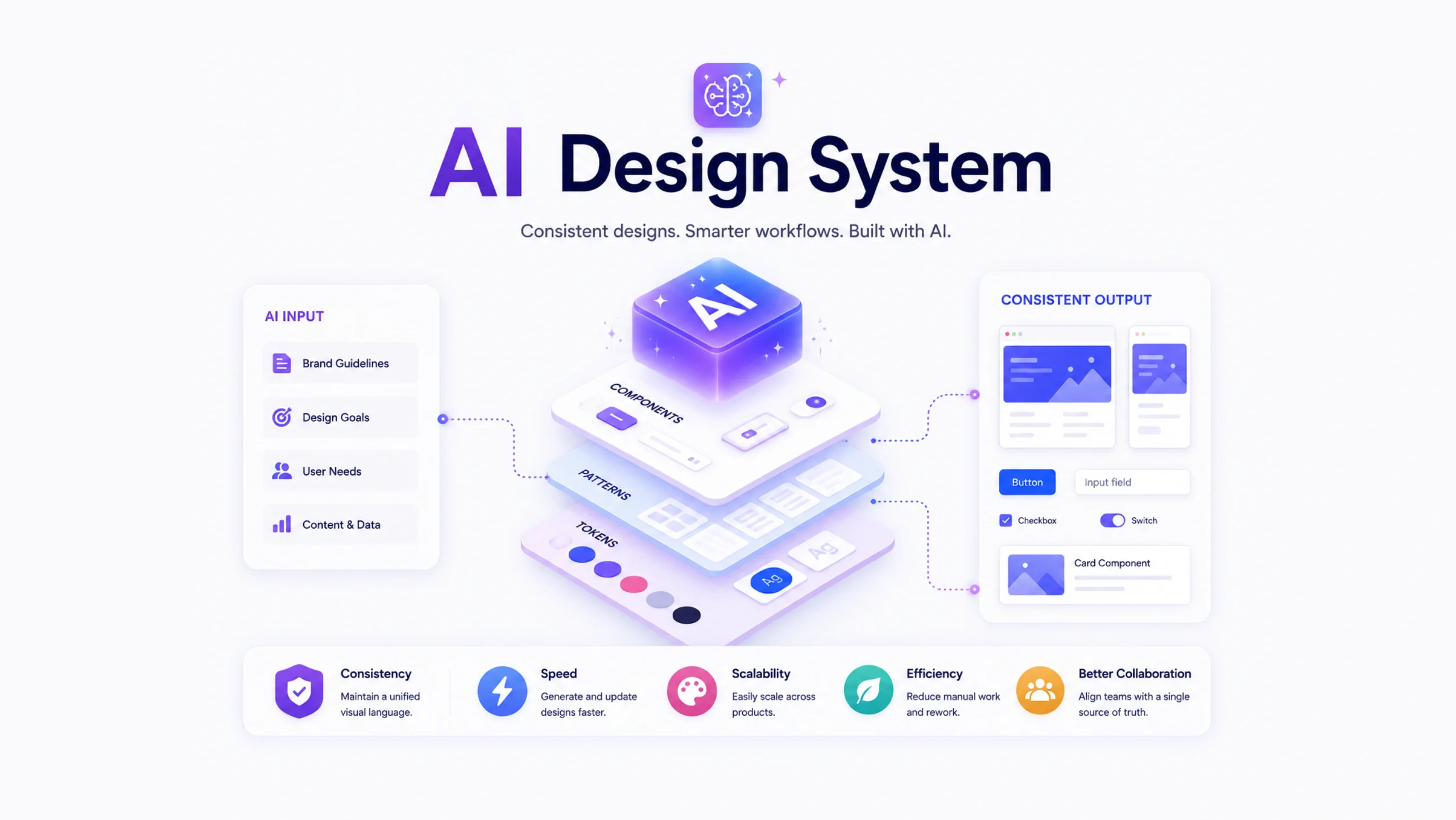
What Is an AI Design System?
An AI Design System is a structured framework that helps teams create consistent, reliable, and user-friendly AI experiences.
Traditional design systems focus on visual elements such as colors, typography, buttons, forms, grids, and interface components.
An AI Design System goes further.
It includes guidance for designing AI interactions, conversational experiences, AI-generated content, user controls, transparency, trust, feedback mechanisms, and human oversight.
Think of it as a rulebook that helps designers, developers, product managers, and researchers create AI-powered products that feel coherent and predictable.
Why AI Products Need Design Systems
AI products introduce challenges that traditional software rarely faces.
Users may wonder:
- Why did the AI generate this answer?
- Can I trust this recommendation?
- What happens if the AI is wrong?
- How much control do I have?
These questions directly affect user experience.
Without clear design standards, different teams may solve these problems differently, creating confusion across products.
An AI Design System helps establish consistency and shared expectations.
A Simple Analogy
Imagine a large city without traffic rules.
Every driver creates their own system.
Some stop at intersections.
Some don’t.
Some drive on the left.
Others drive on the right.
Chaos follows.
Design systems create consistency in digital products.
AI Design Systems create consistency in AI-powered experiences.
The goal is making interactions easier to understand and easier to trust.
Why Traditional Design Systems Aren’t Enough
A standard design system may define:
- Buttons
- Forms
- Icons
- Navigation
- Typography
- Layout rules
AI introduces entirely new challenges.
Teams must decide:
- How AI responses appear
- How confidence levels are displayed
- How users provide feedback
- How errors are communicated
- How recommendations are explained
- How human review is integrated
These elements require dedicated design guidance.
Core Components of an AI Design System
A mature AI Design System often includes several layers.
AI Interaction Patterns
Rules for conversations, prompts, recommendations, and AI-generated outputs.
Transparency Guidelines
Methods for explaining how AI decisions are made.
Trust Indicators
Visual cues that help users evaluate reliability.
Feedback Mechanisms
Ways for users to rate responses, report issues, or correct mistakes.
Human Oversight Patterns
Guidelines for situations where people should review AI-generated content.
Ethical Design Principles
Rules for fairness, privacy, accountability, and responsible AI usage.
Designing for Trust
Trust is one of the biggest challenges in AI product design.
A beautifully designed interface means very little if users don’t trust the system.
AI Design Systems often include guidance for:
- Showing sources
- Explaining recommendations
- Displaying confidence levels
- Clarifying limitations
- Identifying AI-generated content
Users generally respond better when systems communicate openly rather than pretending to be perfect.
Common AI Design Patterns
Several patterns appear frequently across AI products.
AI Chat Interfaces
Conversational layouts that allow users to interact naturally.
Prompt Suggestions
Recommended prompts that help users get started.
Regenerate Responses
Options for creating alternative outputs.
Feedback Buttons
Thumbs-up and thumbs-down controls.
Source Citations
Links and references supporting AI-generated content.
Human Escalation
Options to transfer tasks to human experts when needed.
These patterns help create familiarity across different AI applications.
Real-World Examples
AI Design Systems influence many products people use every day.
AI-powered productivity tools often rely on standardized interaction patterns.
Coding assistants use predictable suggestion interfaces.
Customer support platforms create structured AI conversations.
Enterprise software uses AI recommendation cards, summaries, and automated insights.
As AI becomes more common, consistent experiences become increasingly valuable.
Benefits of an AI Design System
Organizations gain several advantages from having a dedicated AI Design System.
Consistency
Users experience familiar interactions across products and features.
Faster Development
Teams can reuse patterns instead of creating solutions from scratch.
Better User Experience
Established standards reduce confusion.
Improved Trust
Clear communication helps users understand AI behavior.
Stronger Collaboration
Designers, developers, and product teams work from shared guidelines.
For large organizations, these benefits can significantly reduce product fragmentation.
AI Design Systems and Responsible AI
Responsible AI has become a major discussion within the technology industry.
Organizations increasingly recognize that powerful AI systems require thoughtful design.
An AI Design System often supports responsible AI initiatives by defining standards for:
- Transparency
- User consent
- Privacy
- Bias mitigation
- Human review
- Error handling
These guidelines help teams build products that respect user expectations.
Challenges in Creating an AI Design System
Building an AI Design System isn’t always straightforward.
AI technology evolves rapidly.
What works today may need adjustments tomorrow.
Teams often face questions such as:
- How much explanation is enough?
- When should humans intervene?
- How should uncertainty be displayed?
- What level of user control is appropriate?
The answers vary depending on the product and audience.
This makes AI Design Systems more dynamic than many traditional design systems.
Building an AI Design System
Most organizations start with a few foundational elements.
Document AI Principles
Define how AI should behave across products.
Identify Common Patterns
Look for repeated interaction models.
Standardize Feedback Loops
Create consistent ways for users to provide feedback.
Define Trust Mechanisms
Determine how transparency and confidence indicators should appear.
Test with Real Users
Observe how people interact with AI features and refine the system over time.
The system should evolve alongside both technology and user expectations.
The Growing Role of Designers
AI has expanded the role of product and UX designers.
Designers are no longer focused only on screens and layouts.
They now help shape conversations, recommendations, decision support systems, and human-AI collaboration.
This shift makes AI Design Systems increasingly important.
They provide a foundation for creating experiences that feel predictable, understandable, and trustworthy.
The Future of AI Design Systems
As AI becomes integrated into more products, AI Design Systems will likely become standard practice.
Future systems may include:
- Multimodal interaction standards
- Voice interface guidelines
- Agent-based workflows
- Personalization frameworks
- Human-AI collaboration patterns
- Governance and compliance rules
Organizations that establish these standards early may find it easier to scale AI initiatives across multiple products and teams.
Final Thoughts
An AI Design System is a structured collection of components, principles, patterns, and guidelines created specifically for AI-powered products. It helps teams design consistent, trustworthy, and user-friendly experiences while addressing challenges such as transparency, feedback, human oversight, and responsible AI use.
As artificial intelligence becomes a central part of digital products, AI Design Systems are becoming increasingly valuable. They help organizations balance innovation with usability, creating experiences that users can understand, trust, and confidently interact with.
Frequently Asked Questions (FAQs)
1. What is an AI Design System?
An AI Design System is a framework of reusable components, patterns, and guidelines that help teams design consistent AI-powered experiences.
2. How is an AI Design System different from a traditional design system?
Traditional design systems focus on interface components, while AI Design Systems also include guidance for AI interactions, transparency, trust, and feedback.
3. Why are AI Design Systems important?
They help create consistent, trustworthy, and user-friendly AI experiences across products and teams.
4. What are common elements of an AI Design System?
Common elements include AI interaction patterns, feedback mechanisms, transparency guidelines, trust indicators, and human oversight workflows.
5. Who uses AI Design Systems?
UX designers, product designers, developers, product managers, researchers, and AI teams commonly use them.
6. Can small teams benefit from an AI Design System?
Yes. Even simple standards for AI interactions and feedback can improve consistency and user experience as products grow.