


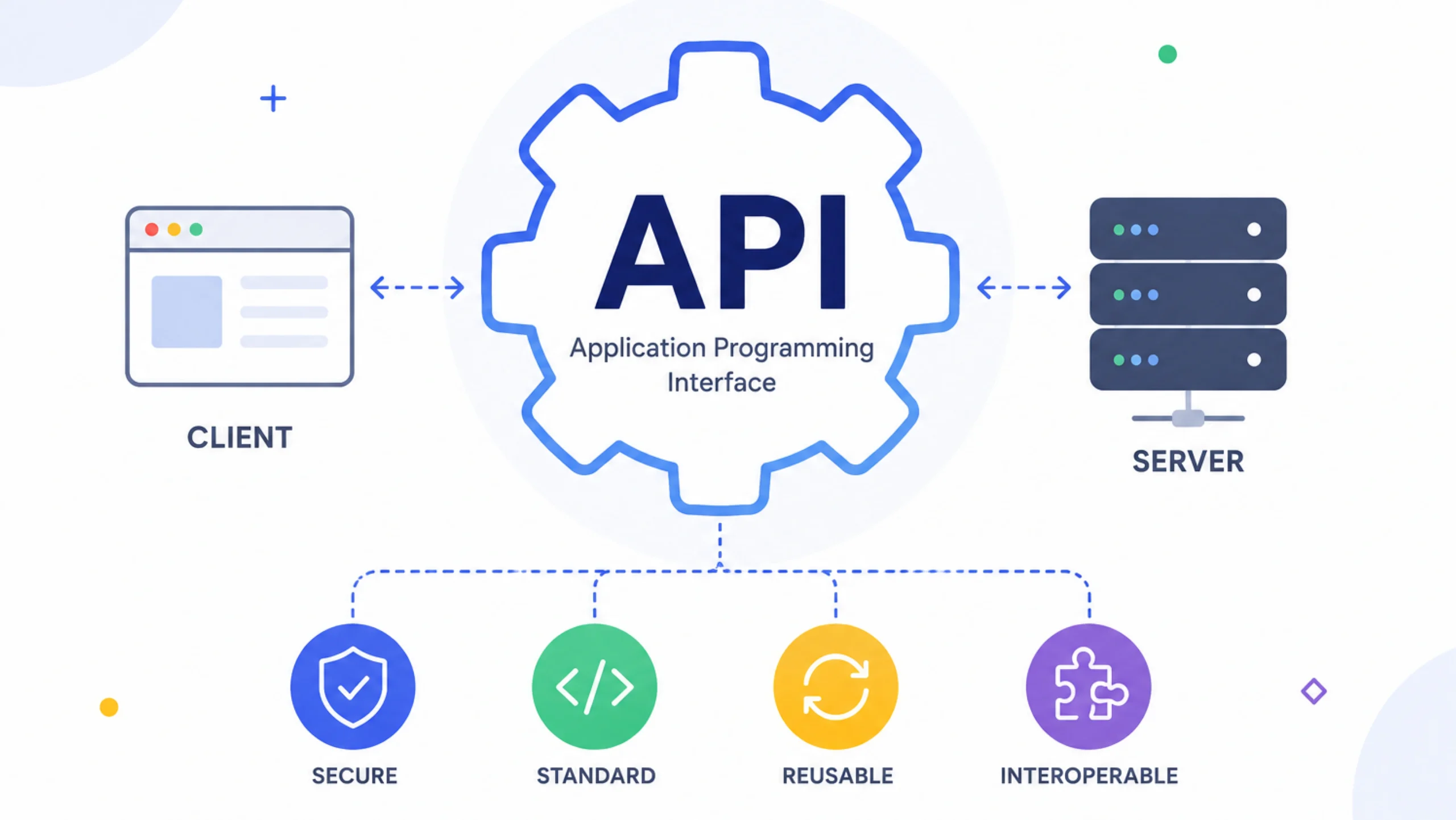
What Is an API?
If you’ve ever checked the weather on your phone, logged into a website using Google, paid online through a payment gateway, or asked an AI chatbot a question, you’ve used an API—even if you didn’t realize it.
APIs are one of the hidden forces that keep the internet running smoothly. They connect systems, move information between applications, and allow developers to build powerful experiences without creating everything from scratch.
In simple terms, an API acts as a messenger between two software systems. One application requests information or performs an action, and the API delivers that request to another system and returns the response.
Without APIs, many of the digital services we rely on every day would stop working.
Why APIs Matter
Modern software rarely exists in isolation.
A food delivery app might need:
- Maps for navigation
- Payment processing
- SMS notifications
- Customer authentication
- Restaurant databases
Building every one of these services internally would take enormous time and resources.
APIs solve this problem by allowing applications to connect with specialized services.
Think of APIs as translators in a conversation.
Two people may speak different languages, yet a translator helps them communicate clearly.
An API performs a similar role for software.
A Simple Real-World Analogy
Imagine sitting at a restaurant.
You don’t walk into the kitchen and cook your own meal.
Instead:
- You place an order with the waiter.
- The waiter delivers the request to the kitchen.
- The kitchen prepares the food.
- The waiter brings the food back.
The waiter functions much like an API.
You don’t need access to the kitchen. You simply make a request and receive a result.
Software systems use APIs in much the same way.
How APIs Work
The process is surprisingly straightforward.
Step 1: Request
An application sends a request to an API.
For example:
“Show today’s weather.”
Step 2: Processing
The API sends the request to the appropriate service or database.
Step 3: Response
The service processes the request and returns the result.
Step 4: Display
The application presents the information to the user.
This entire process often happens within milliseconds.
Most users never notice it occurring behind the scenes.
Common API Examples You Use Every Day
Many people interact with APIs dozens or even hundreds of times daily.
Weather Apps
Weather applications retrieve forecasts from weather service APIs.
Google Login
When a website allows users to sign in with Google, an API handles the authentication process.
Payment Gateways
Services such as Stripe and PayPal provide APIs that process transactions securely.
Social Media Sharing
Sharing content between platforms often relies on APIs.
Ride-Sharing Apps
Transportation apps use APIs for maps, routing, pricing, and location tracking.
AI Chat Applications
Many AI products connect to large language models through APIs.
Without APIs, these services would be far more difficult to build and maintain.
Types of APIs
APIs come in several forms.
Public APIs
Public APIs are available for external developers to use.
Examples include:
- Weather APIs
- Maps APIs
- Currency exchange APIs
Private APIs
Organizations use private APIs internally.
These APIs help different systems inside a company communicate with one another.
Partner APIs
Partner APIs are shared with approved business partners.
Access is usually restricted.
Composite APIs
Composite APIs combine multiple requests into a single operation, reducing communication overhead.
Each type serves different business and technical needs.
REST APIs: The Most Common Type
When developers talk about APIs, they are often referring to REST APIs.
REST stands for Representational State Transfer.
The name sounds technical, though the concept is fairly simple.
REST APIs allow systems to communicate using standard web protocols.
They typically use HTTP methods such as:
- GET
- POST
- PUT
- DELETE
For example:
A GET request retrieves information.
A POST request creates new information.
REST became popular because it is straightforward, flexible, and widely supported.
APIs and Modern Applications
Here’s the thing: many modern applications are essentially collections of APIs working together.
A single app might connect to:
- Payment APIs
- Authentication APIs
- AI APIs
- Messaging APIs
- Analytics APIs
- Mapping APIs
This modular approach allows teams to build products faster.
Instead of reinventing every wheel, developers connect proven services together.
APIs and Artificial Intelligence
The rise of AI has made APIs even more important.
Most businesses don’t train their own large AI models.
Instead, they connect to AI services through APIs.
For example, developers can integrate:
- Chatbots
- Image generation
- Speech recognition
- Translation services
- Content creation tools
using AI APIs.
A customer support platform might send a question to an AI model through an API and receive an answer within seconds.
The user experiences a seamless conversation, though multiple systems are working together behind the scenes.
API Requests and Responses
APIs operate through structured communication.
A request typically contains:
- Endpoint
- Parameters
- Authentication credentials
- Request method
The response usually contains:
- Data
- Status codes
- Error messages
- Metadata
Many APIs exchange information using JSON.
JSON is lightweight, easy to read, and widely supported across programming languages.
API Authentication
Not every API is open to everyone.
Many services require authentication.
Authentication helps verify who is accessing the system.
Common methods include:
API Keys
A unique identifier that grants access.
OAuth
A secure authorization framework often used for social logins.
Access Tokens
Temporary credentials used for secure communication.
Authentication helps protect systems from misuse and unauthorized access.
Benefits of APIs
APIs offer many advantages for businesses and developers.
Faster Development
Teams can connect existing services instead of building everything themselves.
Better Integration
Applications can communicate with external platforms easily.
Flexibility
Developers can combine services from different providers.
Cost Savings
Organizations avoid rebuilding functionality that already exists elsewhere.
Innovation
New products can be created by combining multiple APIs in creative ways.
Many startups have built entire businesses around API-powered services.
Challenges and Limitations
APIs are powerful, though they are not without challenges.
Downtime
If an API provider experiences outages, connected applications may stop functioning properly.
Security Risks
Improperly secured APIs can expose sensitive data.
Rate Limits
Many providers restrict the number of requests allowed within a certain period.
Version Changes
API updates can sometimes break existing integrations.
Managing these risks is an important part of software development.
APIs and User Experience
Users rarely think about APIs.
They notice the outcomes instead.
A fast payment process.
A real-time weather update.
A smooth login experience.
A responsive AI assistant.
Strong API integrations often create better digital experiences. Poor integrations can lead to slow performance, missing data, or frustrating errors.
This is why product teams, designers, and developers frequently collaborate when planning API-powered features.
The Future of APIs
As software becomes increasingly connected, APIs continue growing in importance.
Cloud computing, artificial intelligence, Internet of Things (IoT) devices, and automation platforms all depend heavily on APIs.
Many modern businesses now operate as API-first organizations, building services intended to connect with other platforms from the beginning.
The trend is clear: software is becoming more interconnected, and APIs are the bridges making those connections possible.
Final Thoughts
APIs are the communication layer of modern software. They allow applications to exchange information, access external services, and create experiences that would otherwise be difficult or impossible to build.
From weather apps and payment systems to AI assistants and enterprise platforms, APIs quietly power much of the digital world.
Most users never see them. Most users never think about them.
Yet nearly every click, purchase, login, or AI interaction relies on APIs working behind the scenes to keep everything connected.
Frequently Asked Questions (FAQs)
1. What does API stand for?
API stands for Application Programming Interface.
2. What is the main purpose of an API?
An API allows different software applications to communicate and exchange data with one another.
3. Are APIs only used by developers?
Developers build and integrate APIs, but everyday users benefit from them whenever they use connected digital services.
4. What is an API key?
An API key is a unique identifier used to authenticate and authorize access to an API.
5. What is the difference between an API and a database?
A database stores information, while an API provides a structured way for applications to access and interact with that information.
6. Why are APIs important for AI applications?
APIs allow developers to connect applications with AI models, enabling features such as chatbots, content generation, image creation, and language translation.