


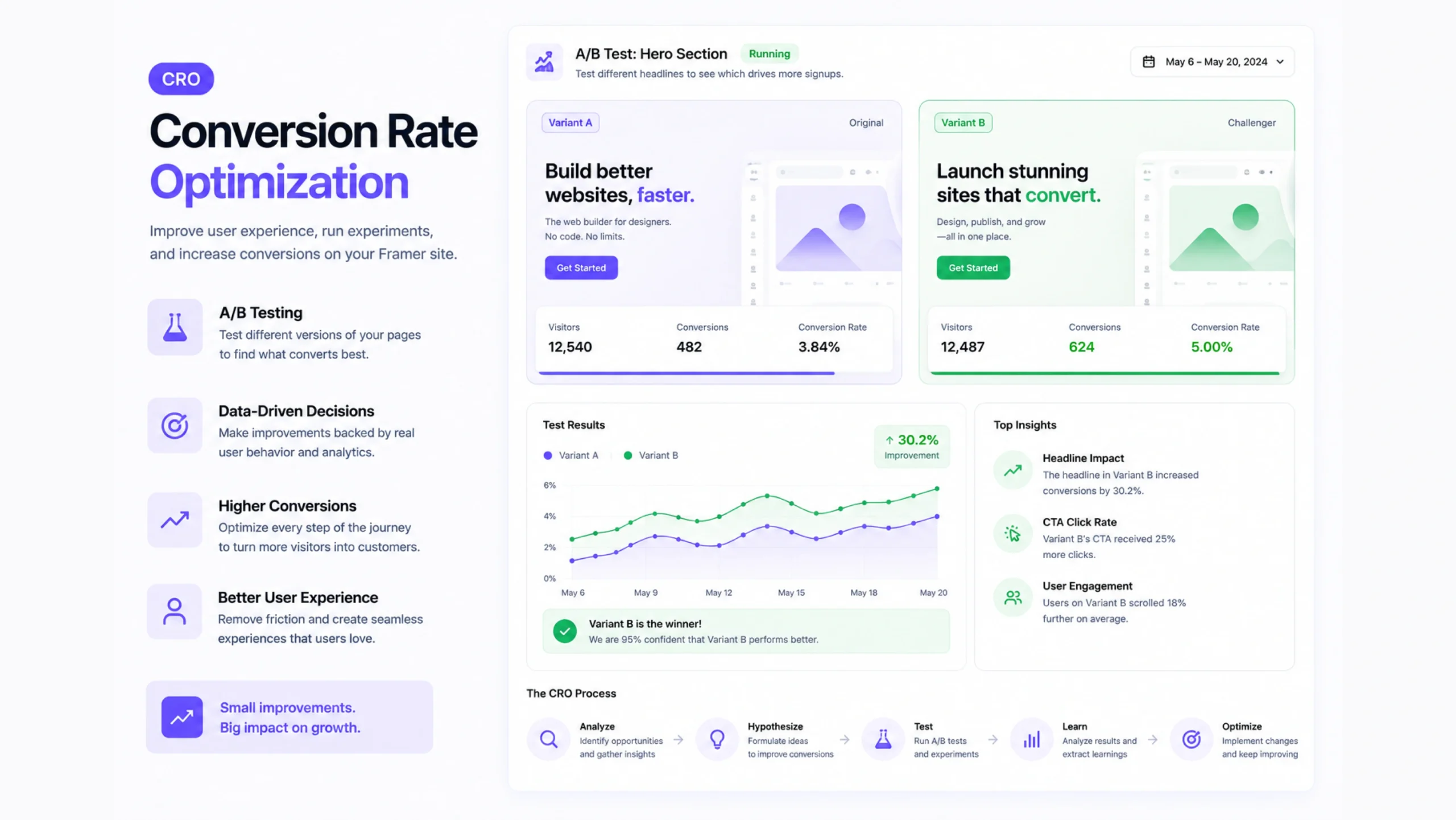
What Is Conversion Rate Optimization (CRO)?
Conversion Rate Optimization (CRO) is the process of improving a website, landing page, or digital experience to increase the percentage of visitors who complete a desired action. These actions may include making a purchase, filling out a form, subscribing to a newsletter, booking a demo, or creating an account.
Instead of focusing solely on attracting more traffic, CRO focuses on making better use of the traffic a website already receives.
Think of it this way. Imagine a retail store where 1,000 people walk through the door each day, yet only 20 buy something. The owner could spend money bringing in another 1,000 visitors—or improve the shopping experience so 50 or 100 people make a purchase. CRO follows that second approach.
Why CRO Matters More Than Most Businesses Realize
Many companies spend significant budgets on advertising, content marketing, social media campaigns, and search engine visibility.
Traffic grows.
Visitors arrive.
Yet sales stay flat.
Sound familiar?
The problem often isn’t traffic. It’s conversion.
A website can attract thousands of visitors each month and still struggle to generate revenue if users encounter confusing layouts, weak messaging, slow loading pages, or complicated forms.
CRO helps identify and fix those issues.
Even small improvements can create meaningful results. A landing page conversion rate moving from 2% to 4% may double leads without increasing advertising costs.
That’s why marketers, product teams, UX designers, and business owners pay close attention to conversion performance.
How Conversion Rate Optimization Works
CRO is based on observation, testing, and continuous improvement.
Rather than guessing what users want, teams collect data and analyze behavior.
The process often looks like this:
- Analyze website performance.
- Identify friction points.
- Form a hypothesis.
- Create improvements.
- Run experiments.
- Measure results.
- Apply winning changes.
The cycle repeats over time.
Interestingly, CRO is part science and part psychology. Numbers reveal what users are doing, while behavioral insights explain why they’re doing it.
What Counts as a Conversion?
A conversion can mean different things depending on the website.
For an ecommerce store, a conversion might be a completed purchase.
For a SaaS company, it may be a free trial signup.
For a consulting business, it could be a booked discovery call.
Common conversion goals include:
- Product purchases
- Newsletter subscriptions
- Demo requests
- Contact form submissions
- Webinar registrations
- Account creation
- App downloads
- Membership registrations
The goal depends on the business model.
The Formula Behind CRO
The conversion rate is calculated using a simple formula:
Conversion Rate = (Conversions ÷ Visitors) × 100
For example:
- 10,000 visitors
- 300 purchases
Conversion Rate = 3%
A higher percentage generally means the website is converting visitors more effectively.
Let’s Talk About Human Behavior
Many people assume conversion optimization is mainly about buttons and colors.
Actually, human psychology often plays a larger role.
People make decisions based on:
- Trust
- Clarity
- Convenience
- Urgency
- Social proof
- Confidence
A visitor may abandon a checkout process simply because shipping costs appear too late.
Someone else may leave because the form asks for too much information.
Small moments matter.
Sometimes very small moments.
Key Elements of a Strong CRO Strategy
Clear Value Proposition
Visitors should immediately understand what a business offers and why it matters.
Confusing messaging creates hesitation.
Clear messaging creates momentum.
User Experience (UX)
Good user experiences remove obstacles.
Poor user experiences create friction.
A cluttered interface, inconsistent navigation, or difficult checkout flow can reduce conversions quickly.
Page Speed
People dislike waiting.
Research consistently shows that slower websites often experience lower conversion rates.
Even a few extra seconds can influence user decisions.
Mobile Optimization
Mobile traffic continues to grow across industries.
A website that performs beautifully on desktop but struggles on smartphones may lose a large percentage of potential customers.
Trust Signals
Trust affects decisions more than many businesses expect.
Examples include:
- Customer reviews
- Testimonials
- Security badges
- Case studies
- Industry certifications
- Client logos
These elements help reduce uncertainty.
Popular CRO Techniques
A/B Testing
A/B testing compares two versions of a page or element.
One version becomes the control.
The other introduces a change.
The version producing better results becomes the winner.
Common tests include:
- Headlines
- Call-to-action buttons
- Images
- Form lengths
- Product descriptions
Heatmap Analysis
Heatmaps show where visitors click, scroll, and spend time.
They help reveal patterns that traditional analytics may miss.
Form Optimization
Long forms often discourage submissions.
Reducing unnecessary fields can increase completion rates.
Sometimes removing one field creates surprising gains.
Better Call-to-Actions
Calls-to-action guide visitors toward desired actions.
Strong CTAs are:
- Clear
- Relevant
- Action-oriented
- Easy to find
Visitors shouldn’t have to search for the next step.
Improving Landing Pages
Landing pages frequently serve as the first impression.
Refining headlines, visuals, content structure, and trust elements can significantly influence performance.
Tools Commonly Used for CRO
Many organizations rely on specialized tools to analyze behavior and test ideas.
Popular examples include:
- Google Analytics
- Hotjar
- Microsoft Clarity
- VWO
- Optimizely
- Crazy Egg
- Unbounce
- HubSpot
Each tool provides different insights into visitor behavior and conversion performance.
Benefits of Conversion Rate Optimization
The value of CRO extends beyond higher sales.
Increased Revenue
More conversions often lead directly to higher revenue.
Lower Customer Acquisition Costs
When existing traffic converts better, marketing budgets become more efficient.
Better User Experience
Many CRO improvements naturally improve usability and customer satisfaction.
Data-Driven Decisions
CRO encourages decisions based on evidence rather than assumptions.
Competitive Advantage
Websites that convert effectively often outperform competitors receiving similar traffic levels.
CRO and SEO: A Powerful Partnership
Some people treat SEO and CRO as separate disciplines.
In reality, they complement each other.
SEO attracts visitors.
CRO helps those visitors take action.
A website ranking highly in search results but converting poorly leaves opportunities on the table.
Likewise, a highly optimized website without traffic limits growth.
Successful businesses frequently invest in both.
One brings people in.
The other helps them move forward.
Common CRO Mistakes
Many organizations make avoidable mistakes during optimization efforts.
Making Changes Without Data
Assumptions can be expensive.
Data should guide decisions whenever possible.
Ignoring Mobile Users
Mobile traffic often represents a large share of visitors.
Poor mobile experiences can hurt conversions significantly.
Testing Too Many Variables
Changing several elements simultaneously makes it difficult to identify what influenced results.
Focusing Only on Design
Visual improvements matter, though messaging, trust, pricing, and usability often influence conversions just as much.
Ending Tests Too Early
Reliable testing requires enough data to produce meaningful insights.
Patience matters.
The Future of Conversion Rate Optimization
CRO continues to evolve.
Artificial intelligence, personalization engines, predictive analytics, and behavioral tracking tools are creating new ways to understand user intent.
Visitors increasingly expect experiences that feel relevant and friction-free.
Businesses that listen carefully to user behavior will likely continue seeing stronger results than those relying solely on assumptions.
Technology changes.
Human decision-making patterns remain surprisingly consistent.
People still value trust, clarity, simplicity, and convenience.
Final Thoughts
Conversion Rate Optimization (CRO) is the practice of improving websites and digital experiences to increase the percentage of visitors who complete meaningful actions. By combining analytics, user research, testing, psychology, and design improvements, businesses can generate more leads, sales, and customer engagement without relying entirely on additional traffic.
For startups, ecommerce brands, SaaS companies, agencies, and enterprise organizations alike, CRO remains one of the most effective ways to improve digital performance and maximize marketing investments.
Frequently Asked Questions (FAQs)
1. What does Conversion Rate Optimization (CRO) mean?
Conversion Rate Optimization is the process of improving a website or digital experience to increase the percentage of visitors who complete desired actions such as purchases, sign-ups, or inquiries.
2. Why is CRO important?
CRO helps businesses generate more value from existing website traffic by improving user experiences and increasing conversions.
3. What is a good conversion rate?
A good conversion rate varies by industry, audience, and business model. Many businesses aim for continuous improvement rather than focusing on a specific number.
4. What tools are commonly used for CRO?
Popular CRO tools include Google Analytics, Hotjar, Microsoft Clarity, VWO, Optimizely, and Crazy Egg.
5. How is CRO different from SEO?
SEO focuses on attracting visitors through search engines, while CRO focuses on converting those visitors into customers, leads, or subscribers.
6. What are the most common CRO techniques?
Common techniques include A/B testing, heatmap analysis, form optimization, landing page improvements, and stronger call-to-action design.