


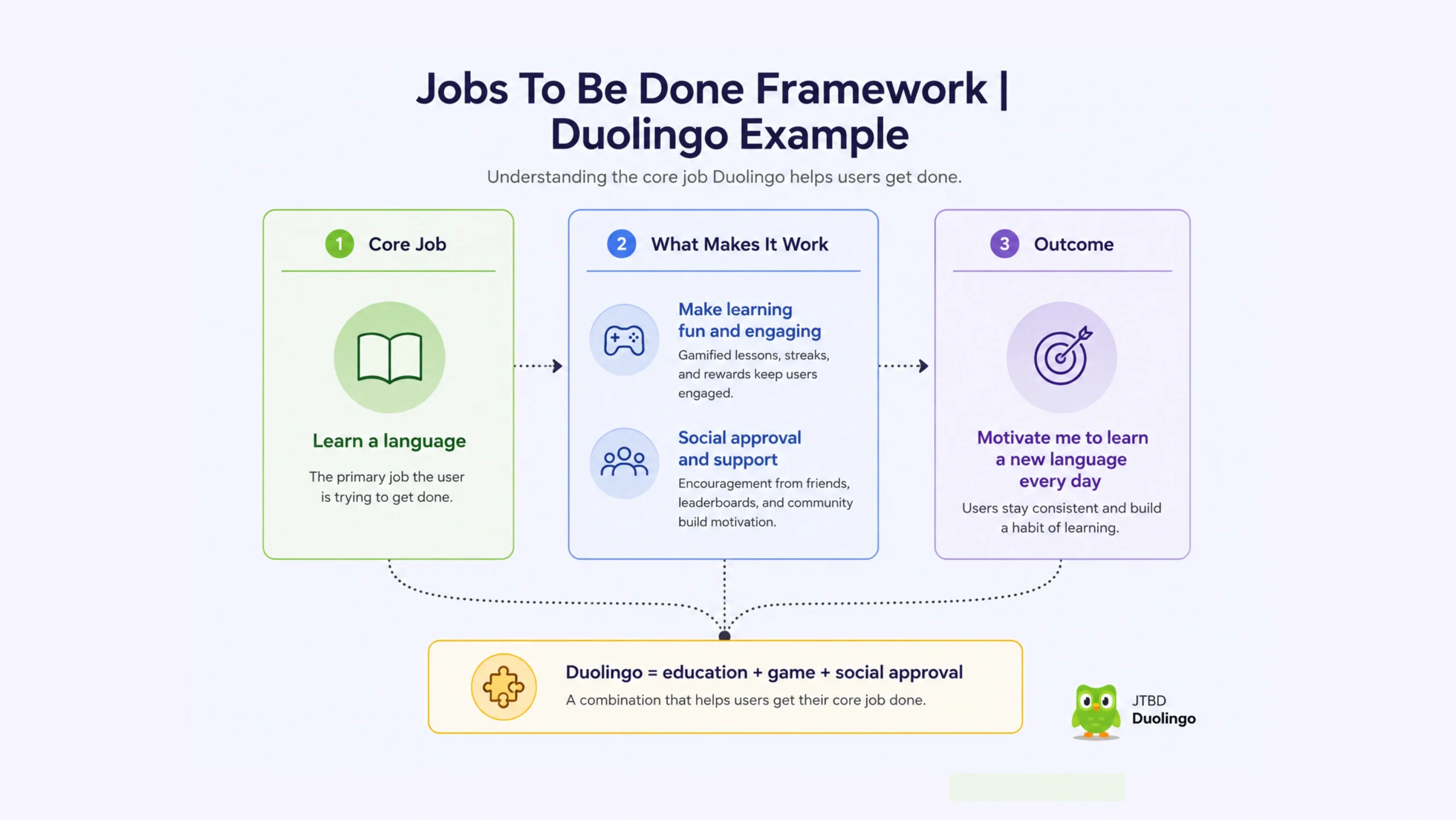
What Is JTBD?
JTBD, short for Jobs To Be Done, is a product and research framework that focuses on the underlying task, goal, or problem a customer wants to accomplish when using a product or service.
The central idea is simple:
People don’t buy products because they want the product itself.
They buy products because they want progress in their lives.
A customer isn’t purchasing a drill because they love drills.
They’re purchasing it because they need a hole in the wall.
And even that isn’t the final goal. The real goal might be hanging a family photo, decorating a home, or creating a comfortable living space.
JTBD encourages teams to look beyond features and focus on the reason customers seek a solution in the first place.
A Different Way to Think About Customers
Most product discussions begin with questions like:
- Who is the user?
- How old are they?
- Where do they live?
- What industry do they work in?
Those questions can be useful.
Yet JTBD asks something different:
“What is the customer trying to accomplish?”
That shift changes everything.
Instead of focusing on demographics, teams focus on motivation and desired outcomes.
Two completely different people may hire the same product for the same reason.
A student and a CEO might both use a note-taking app because they need a reliable way to organize information quickly.
The job matters more than the person’s background.
Where the JTBD Framework Came From
The concept gained popularity through the work of Clayton Christensen and other researchers studying customer behavior and innovation.
One of the most famous examples involves milkshakes.
Researchers discovered that many customers purchased milkshakes during their morning commute.
The purchase wasn’t primarily about taste.
The milkshake was being “hired” to keep commuters occupied, satisfied, and full during a long drive to work.
The lesson was simple but powerful.
Products compete against alternatives that help customers complete the same job.
Why Customers “Hire” Products
Here’s the thing.
Customers rarely wake up wanting features.
They wake up wanting results.
They want to:
- Save time
- Learn faster
- Reduce stress
- Feel confident
- Stay organized
- Communicate better
- Entertain themselves
Products become tools that help them achieve those outcomes.
JTBD describes this relationship as “hiring” a product.
If a product performs the job well, customers continue using it.
If another solution performs the job better, customers switch.
Looking Beyond Functional Needs
Many people assume JTBD is only about practical tasks.
Actually, jobs often contain emotional and social dimensions too.
A person purchasing expensive running shoes may want comfort and performance.
That’s the functional job.
They may also want confidence during workouts.
That’s an emotional job.
They may want to be seen as a serious athlete.
That’s a social job.
Human decisions are rarely driven by logic alone.
JTBD acknowledges this reality.
The Three Types of Jobs
Functional Jobs
These are the practical tasks customers want to complete.
Examples include:
- Track expenses
- Schedule appointments
- Edit videos
- Order food
Functional jobs are usually the easiest to identify.
Emotional Jobs
These relate to how customers want to feel.
Examples include:
- Feeling secure
- Feeling productive
- Feeling less anxious
- Feeling confident
Emotional jobs often influence purchasing decisions more than teams expect.
Social Jobs
These involve how customers want others to perceive them.
Examples include:
- Appearing professional
- Looking knowledgeable
- Demonstrating success
- Building credibility
Social factors influence decisions across many industries.
JTBD vs Personas
Personas describe who users are.
JTBD describes what users are trying to achieve.
Both approaches can be useful.
A persona might tell you:
“Sarah is a 35-year-old marketing manager.”
Interesting information.
But it doesn’t explain her goal.
A JTBD statement might reveal:
“Sarah needs a faster way to generate campaign reports before stakeholder meetings.”
Now the problem becomes much clearer.
One explains the person.
The other explains the motivation.
How JTBD Helps Product Teams
Product teams constantly face difficult questions.
Which features should be built?
What problems deserve attention?
Why are customers leaving?
JTBD provides a structured way to answer those questions.
Instead of chasing feature requests, teams focus on customer outcomes.
The conversation shifts from:
“What should we build?”
to
“What job are customers trying to complete?”
That distinction often leads to better product decisions.
Creating a JTBD Statement
Many teams use a simple JTBD format.
A common example looks like this:
When [situation], I want to [motivation], so I can [desired outcome].
For example:
“When preparing for a client presentation, I want to organize research quickly so I can present insights confidently.”
The statement captures context, motivation, and outcome.
Together, they reveal the job the customer wants completed.
Real-World JTBD Examples
Let’s look at a few examples.
Food Delivery App
Customers aren’t hiring the app merely to place orders.
They’re hiring it to get a meal quickly without cooking.
Streaming Service
Customers aren’t hiring the platform merely to watch videos.
They’re hiring it to relax, escape boredom, or spend quality time.
Project Management Software
Teams aren’t hiring the tool because they enjoy task boards.
They’re hiring it to coordinate work and reduce confusion.
The job often sits several layers beneath the visible feature.
Benefits of Using JTBD
Organizations frequently adopt JTBD because it helps them:
- Discover hidden customer needs
- Identify innovation opportunities
- Prioritize product decisions
- Improve customer experiences
- Create stronger messaging
- Reduce feature overload
The framework helps teams focus on outcomes rather than assumptions.
Common Mistakes Teams Make
Like any framework, JTBD can be misunderstood.
One mistake is treating jobs as features.
Features are solutions.
Jobs are customer goals.
Another mistake is creating jobs that are too broad.
For example:
“Customers want to be happy.”
That’s too vague.
Good JTBD research identifies specific situations and desired outcomes.
Some teams also ignore emotional motivations and focus only on practical tasks.
That often leaves valuable insights undiscovered.
JTBD and UX Research
JTBD works particularly well alongside UX research.
Researchers can use interviews to uncover:
- Customer goals
- Frustrations
- Decision-making factors
- Desired outcomes
- Switching behavior
These insights often reveal why customers choose one solution over another.
Sometimes the answer surprises everyone involved.
JTBD and Product Innovation
Many successful products emerged because companies recognized jobs that existing solutions handled poorly.
Customers rarely ask for innovation directly.
They talk about frustrations.
They describe obstacles.
They explain goals.
JTBD helps teams interpret those signals and identify opportunities for new solutions.
The focus stays on customer progress rather than technology.
Final Thoughts
Jobs To Be Done is a framework that helps teams understand the underlying goals customers are trying to achieve. Instead of focusing solely on user characteristics or product features, JTBD examines the progress people want to make and the outcomes they seek.
When teams understand the job behind the purchase, they gain a clearer view of customer needs, product opportunities, and meaningful innovation. The result is often a product that feels more relevant, more useful, and far more connected to real human behavior.
Frequently Asked Questions (FAQs)
1. What does JTBD stand for?
JTBD stands for Jobs To Be Done, a framework used to understand the goals customers want to accomplish when using a product or service.
2. What is the main idea behind JTBD?
The framework suggests that customers “hire” products to help them make progress or solve a specific problem.
3. How is JTBD different from personas?
Personas focus on who users are, while JTBD focuses on what users are trying to achieve.
4. Why is JTBD useful in product design?
It helps teams identify customer motivations, prioritize features, and create solutions that address real needs.
5. What are the three types of jobs in JTBD?
The three categories are functional jobs, emotional jobs, and social jobs.
6. Can JTBD be used in UX research?
Yes. JTBD is commonly used during interviews and research studies to uncover customer goals, frustrations, and desired outcomes.