


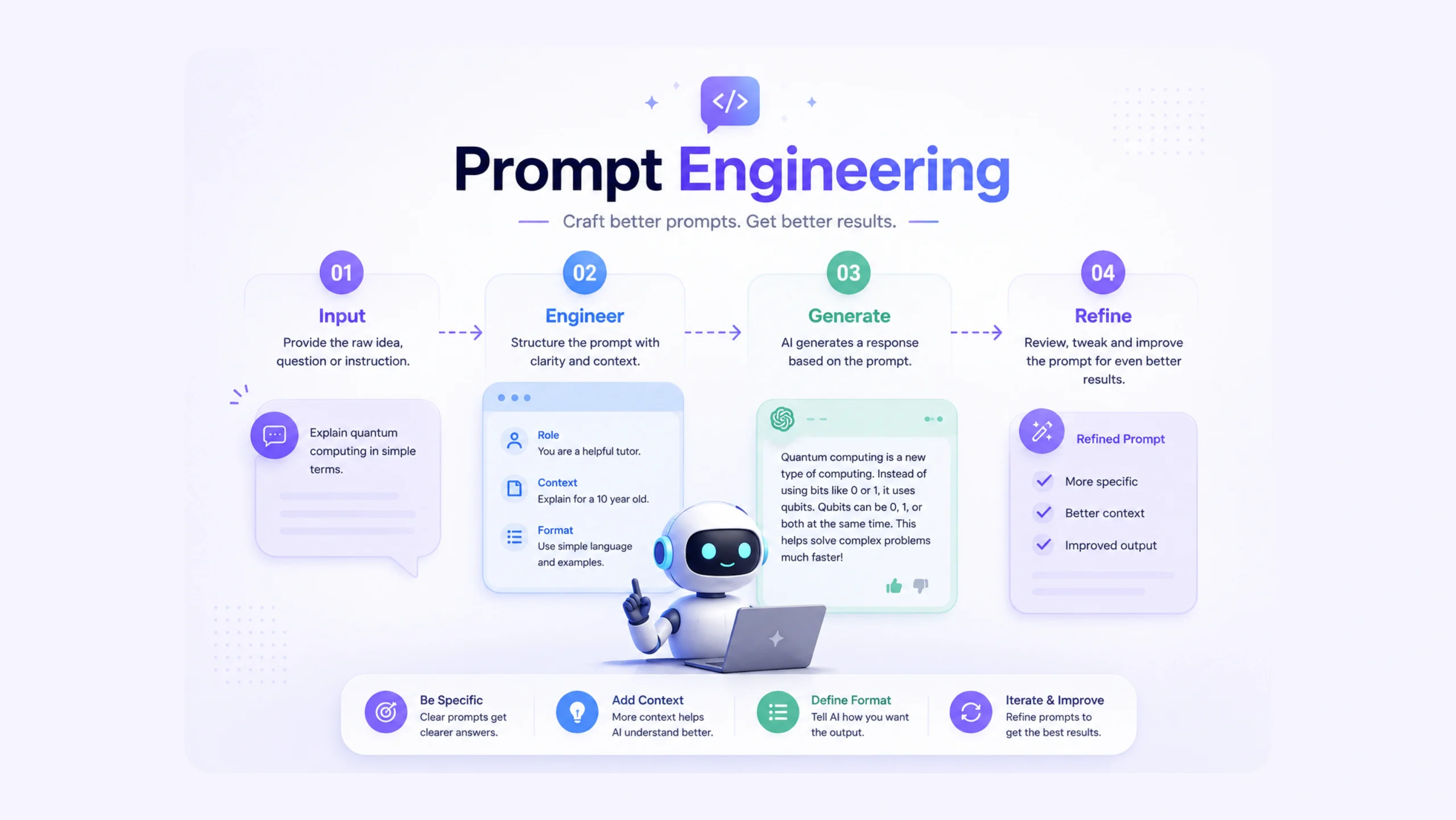
What Is Prompt Engineering?
Prompt engineering is the practice of designing and refining instructions given to artificial intelligence systems to produce accurate, useful, and relevant outputs.
Think of it like having a conversation with a highly capable assistant. The quality of the answer often depends on how clearly you ask the question.
A vague request can lead to a vague response. A detailed and well-structured prompt often produces far better results.
Prompt engineering focuses on crafting those instructions carefully so AI models understand the goal, context, format, and expectations.
Why Prompt Engineering Matters
When generative AI tools first became widely available, many people assumed the technology would automatically know exactly what they wanted.
Reality turned out to be slightly different.
AI models are powerful, but they rely heavily on the information provided in the prompt. Small changes in wording can sometimes produce dramatically different outcomes.
Imagine asking a designer to “make a website.”
You’d probably receive a lot of questions.
What type of website?
Who is the audience?
What style should it follow?
The same principle applies to AI systems.
The more context provided, the better the results tend to become.
A Simple Everyday Example
Let’s say you ask an AI tool:
“Write an article about productivity.”
You’ll likely get a generic response.
Now consider this prompt:
“Write a 1,500-word article about productivity for remote workers. Use a conversational tone, include practical examples, and organize the content with headings.”
The difference is obvious.
The second prompt provides direction.
Prompt engineering helps bridge the gap between what users want and what AI delivers.
How Prompt Engineering Works
At its core, prompt engineering involves guiding AI systems with information that improves output quality.
A prompt can include:
- Instructions
- Context
- Examples
- Constraints
- Desired formats
- Audience details
The AI analyzes this information and generates a response based on patterns learned during training.
The process often becomes iterative.
Users test prompts, review results, make adjustments, and improve instructions until the output meets expectations.
The Building Blocks of a Good Prompt
Not every prompt needs to belong.
Still, strong prompts often contain several key ingredients.
Clear Objective
The AI should know exactly what it needs to accomplish.
Instead of:
“Write about UX.”
Try:
“Explain UX design to beginners using simple language and real-world examples.”
Clarity reduces confusion.
Context
Context helps AI understand the situation.
For example:
- Who is the audience?
- What is the purpose?
- What industry is involved?
- What level of expertise should be assumed?
Context often improves relevance.
Desired Format
AI can generate content in many forms.
You can request:
- Blog posts
- Reports
- Tables
- Emails
- Code snippets
- Bullet-point summaries
Stating the preferred format saves time and improves consistency.
Constraints
Constraints define boundaries.
Examples include:
- Word count limits
- Tone requirements
- Reading level
- Brand guidelines
- Prohibited topics
Interestingly, restrictions often improve creativity rather than limiting it.
Common Prompt Engineering Techniques
As AI adoption has grown, several prompt-writing approaches have become popular.
Zero-Shot Prompting
The AI receives a task without examples.
Example:
“Summarize this article in three bullet points.”
The model relies entirely on its existing knowledge.
Few-Shot Prompting
The prompt includes examples.
For instance:
Input: Customer is happy with the service.
Output: Positive sentiment.
Input: Customer is frustrated by delays.
Output: Negative sentiment.
Input: Customer says support was helpful.
The examples help guide the response.
Role-Based Prompting
This technique assigns a role to the AI.
Examples include:
- Act as a UX researcher.
- Act as a financial analyst.
- Act as a product manager.
Roles help shape perspective and tone.
Chain-of-Task Prompting
Complex work is broken into smaller steps.
Instead of requesting everything at once, users guide the AI through a sequence of tasks.
This often produces more reliable outcomes for large projects.
Prompt Engineering Across Industries
Prompt engineering isn’t limited to technical teams.
It’s showing up almost everywhere.
Marketing
Marketers use prompts to:
- Generate campaign ideas
- Draft ad copy
- Create content calendars
- Analyze customer feedback
Product Design
Design teams use AI prompts for:
- User persona creation
- UX research summaries
- Wireframe suggestions
- Feature brainstorming
Software Development
Developers rely on prompts for:
- Code generation
- Documentation
- Debugging assistance
- Test creation
Education
Teachers and students use prompts for:
- Learning materials
- Study guides
- Lesson planning
- Knowledge summaries
The applications continue expanding every month.
Why Prompt Engineering Is Becoming a Valuable Skill
A few years ago, typing questions into search engines was a valuable digital skill.
Today, communicating effectively with AI is becoming equally important.
People who can structure requests clearly often achieve better outcomes faster.
This applies to:
- Designers
- Product managers
- Marketers
- Developers
- Researchers
- Business owners
In many organizations, prompt writing has become part of everyday work.
Benefits of Prompt Engineering
Better Output Quality
Well-written prompts usually generate more useful responses.
The AI has clearer instructions and less room for misunderstanding.
Faster Results
Precise prompts reduce the need for repeated revisions.
Teams spend less time correcting outputs.
Greater Consistency
Structured prompts help create predictable results across projects.
This becomes especially useful for content creation and business processes.
Improved Productivity
Employees can accomplish more work in less time by guiding AI effectively.
The technology becomes a practical assistant rather than a random generator.
Challenges and Limitations
Prompt engineering is powerful, but it isn’t perfect.
Results Can Vary
Small wording changes sometimes produce different outputs.
Experimentation remains part of the process.
AI Still Makes Mistakes
Even excellent prompts cannot completely eliminate errors.
Verification remains important.
Knowledge Gaps
AI models may lack current information or misunderstand context.
Human review still matters.
Overly Complex Prompts
Ironically, adding too much information can sometimes reduce clarity.
Balance is important.
The goal isn’t writing the longest prompt.
The goal is writing the clearest one.
Popular Tools Used for Prompt Engineering
Many AI platforms support prompt-based interactions.
Popular examples include:
Each platform responds differently, which is why prompt refinement often becomes part of the workflow.
The Future of Prompt Engineering
Some people predict prompt engineering will disappear as AI becomes smarter.
That may happen to some extent.
AI systems are getting better at interpreting intent and filling gaps automatically.
Yet communication remains important.
People will still need to explain goals, provide context, and define expectations.
The skill may evolve rather than disappear.
Future prompt engineering may focus less on wording and more on workflow design, context management, and AI collaboration.
Final Thoughts
Prompt engineering is the practice of crafting effective instructions that help AI systems produce useful results. By providing clear objectives, context, formats, and constraints, users can dramatically improve the quality of AI-generated outputs.
As artificial intelligence becomes a larger part of daily work, prompt engineering is emerging as a valuable skill for professionals across industries. The ability to communicate clearly with AI is quickly becoming as important as communicating clearly with people.
Frequently Asked Questions (FAQs)
1. What is prompt engineering?
Prompt engineering is the process of creating and refining instructions that guide AI systems to generate accurate and relevant responses.
2. Why is prompt engineering important?
It helps improve AI output quality, reduces errors, and produces more useful results.
3. Do I need technical skills for prompt engineering?
No. Anyone can learn prompt engineering by practicing how they structure instructions and provide context.
4. What makes a good prompt?
A good prompt includes a clear goal, relevant context, desired output format, and any important constraints.
5. Which industries use prompt engineering?
Marketing, design, software development, education, customer support, healthcare, and many other industries use prompt engineering.
6. Will prompt engineering remain important in the future?
Yes. Even as AI improves, people will still need to communicate goals, expectations, and context effectively.