


Imagine buying a new coffee machine.
The box looks great. The marketing promises a perfect cup every morning. The instructions seem simple enough.
Then you try making coffee.
You press the wrong button. The water tank is hidden. The settings menu feels confusing. Ten minutes later, you’re still staring at the machine wondering what went wrong.
The problem isn’t you.
The problem is the product.
Usability Testing exists to uncover exactly these kinds of issues.
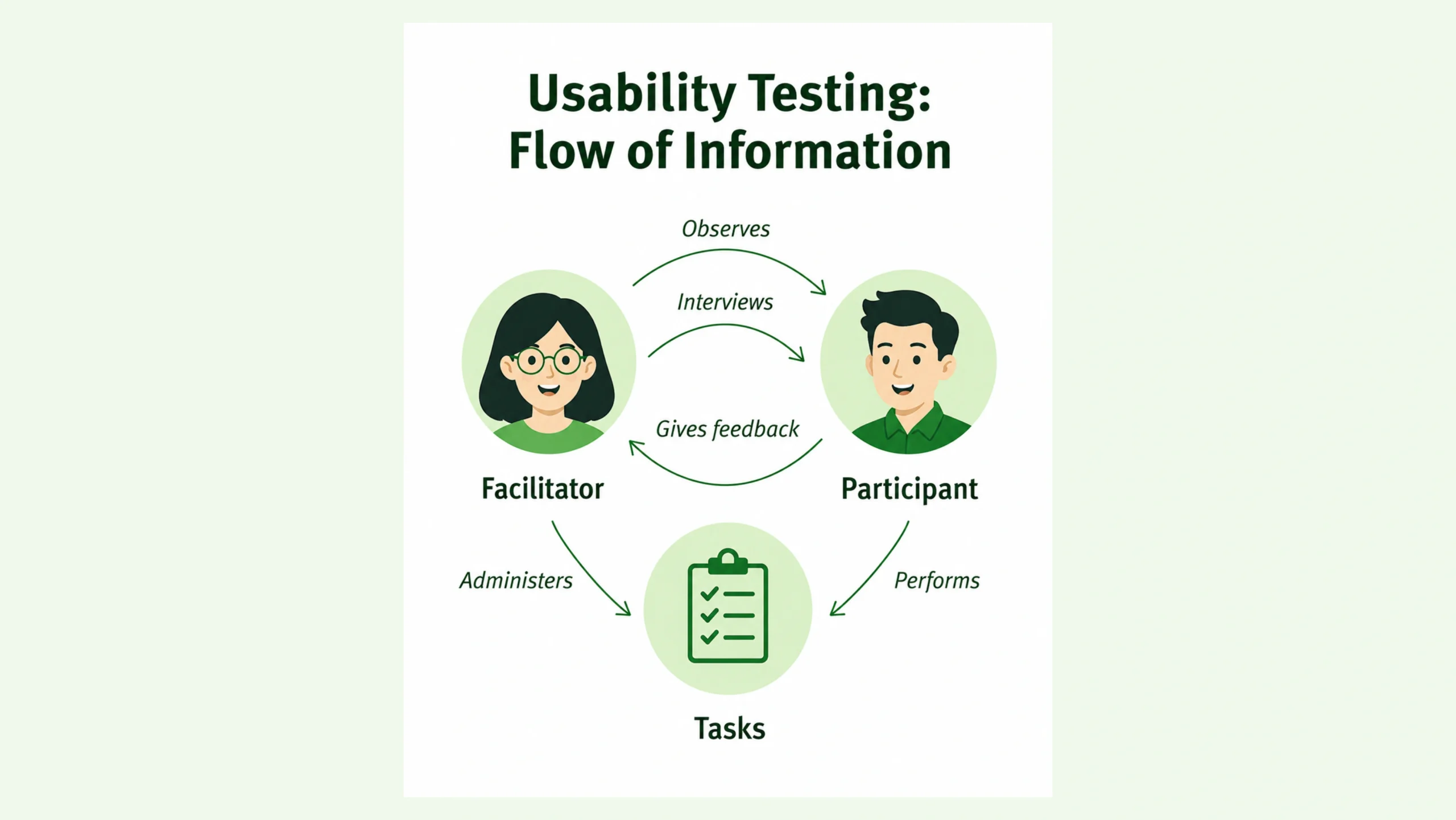
Usability Testing is a research method used to evaluate how easily real people can use a product, website, app, software platform, or digital service. Participants are asked to complete realistic tasks while researchers observe their actions, behaviors, struggles, questions, and successes.
The goal is simple:
Find usability problems before they frustrate thousands of users.
Unlike surveys that collect opinions, usability testing reveals actual behavior. And behavior often tells a very different story.
Why Usability Testing Matters
People rarely use products the way designers expect.
That statement may sound surprising at first.
After all, teams spend months designing experiences. They create wireframes, prototypes, user flows, and interface designs. Everything appears logical inside meetings.
Then real users arrive.
Suddenly they click unexpected buttons.
They ignore carefully crafted instructions.
They miss important information sitting right in front of them.
Honestly, this happens more often than many teams would like to admit.
Usability Testing shines a light on these gaps between assumptions and reality.
Without testing, organizations often build products based on internal opinions. With testing, decisions become grounded in actual user behavior.
The Hidden Cost of Poor Usability
Think about the last time you abandoned a website.
Maybe checkout was confusing.
Maybe you couldn’t find what you needed.
Maybe creating an account felt unnecessarily complicated.
You probably didn’t send feedback.
Most users don’t.
They simply leave.
Poor usability creates:
- Lost sales
- Higher support costs
- Lower customer satisfaction
- Increased abandonment rates
- Negative brand perception
A product doesn’t need hundreds of major issues to fail.
Sometimes a few small points of friction are enough.
That’s why usability testing has become a standard practice across industries.
What Is the Main Purpose of Usability Testing?
The primary purpose is to determine whether users can successfully complete important tasks.
Researchers want answers to questions like:
- Can users find what they need?
- Can they complete key actions?
- Do they understand the interface?
- Where do they become confused?
- What slows them down?
- What creates frustration?
Notice something interesting.
Usability Testing isn’t focused on asking users what they like.
It’s focused on observing what they actually do.
There’s a big difference.
A user might say a website is easy to use while struggling through every task.
Actions reveal truth.
How Usability Testing Works
The process is straightforward.
Participants receive realistic tasks.
For example:
- Purchase a product
- Schedule an appointment
- Update account information
- Find a return policy
- Submit a support request
Researchers then observe participants attempting these tasks.
During the session, researchers may track:
- Click behavior
- Navigation patterns
- Time spent
- Errors
- Questions asked
- Emotional reactions
- Success rates
The focus remains on the product, not the participant.
If multiple users struggle in the same place, the design is usually the issue.
Watching Real Users Can Be Eye-Opening
Here’s the thing.
Many teams assume they know their users.
Then they watch a usability test.
A button that seemed obvious gets ignored.
A navigation menu that felt crystal clear becomes a source of confusion.
A feature everyone loved internally goes completely unnoticed.
These moments can feel uncomfortable.
They’re also incredibly valuable.
Some UX professionals describe usability testing as the fastest way to humble an entire product team.
And honestly, they’re not wrong.
Types of Usability Testing
Different projects require different approaches.
Moderated Usability Testing
A researcher guides participants through the session.
Participants can ask questions, and researchers can explore behaviors in greater depth.
This method produces rich qualitative insights.
Unmoderated Usability Testing
Participants complete tasks independently.
Sessions often occur remotely.
This approach is faster and usually less expensive.
Remote Usability Testing
Participants test products from their own environment.
Remote testing became especially common during recent years as distributed work increased globally.
In-Person Usability Testing
Participants and researchers meet face-to-face.
Researchers can observe body language, facial expressions, and reactions directly.
Prototype Testing
Teams evaluate wireframes or interactive prototypes before development begins.
Live Product Testing
Testing occurs on fully functioning products already available to users.
When Should You Conduct Usability Testing?
Many people think testing happens only near launch.
That’s a common misconception.
Testing can occur throughout the product lifecycle.
During Discovery
Early concepts can be validated before significant investment.
During Design
Wireframes and prototypes can be tested before development starts.
During Development
Teams can evaluate features as they are built.
Before Launch
Final usability checks reduce risk.
After Launch
Continuous testing helps improve existing experiences.
Products evolve. User expectations evolve too.
Testing should evolve alongside them.
The Building Blocks of a Good Usability Test
Several elements contribute to meaningful results.
Clear Objectives
Researchers need to know what they are trying to learn.
Realistic Tasks
Tasks should reflect genuine user goals.
Representative Participants
The right audience matters more than a large audience.
Observation
Researchers carefully watch actions rather than relying solely on opinions.
Analysis
Patterns across participants reveal design opportunities.
Without these elements, results become harder to trust.
Common Usability Testing Methods
Different situations call for different techniques.
Think-Aloud Testing
Participants verbalize their thoughts while completing tasks.
Researchers gain insight into decision-making processes.
Task-Based Testing
Participants complete predefined tasks.
Researchers measure performance and success.
Guerrilla Testing
Quick, informal testing sessions often conducted in public spaces or online communities.
Comparative Testing
Users compare multiple versions of a design.
Accessibility Testing
Researchers evaluate experiences for users with disabilities.
Each method serves a slightly different purpose.
Benefits of Usability Testing
The advantages extend far beyond finding bugs.
Better User Experiences
Teams discover friction points before they affect large audiences.
Lower Development Costs
Problems found early cost less to fix.
Higher Conversion Rates
Reducing friction often improves business performance.
Increased Customer Satisfaction
People enjoy products that feel simple and intuitive.
Better Team Alignment
Research findings reduce debates driven by assumptions.
Data becomes the common language.
Metrics Often Used During Usability Testing
Researchers frequently track measurable outcomes.
Task Success Rate
Did participants complete the task?
Time on Task
How long did it take?
Error Rate
How many mistakes occurred?
Satisfaction Scores
How did participants feel about the experience?
Learnability
How quickly could users understand the system?
Together these metrics provide both quantitative and qualitative insights.
Common Mistakes Teams Make
Usability Testing is powerful, though poor execution can reduce its value.
Testing with Employees
Internal team members already understand the product.
Real users behave differently.
Leading Participants
Questions should remain neutral.
Asking Hypothetical Questions
Actual behavior matters more than predictions.
Testing Too Late
Discovering major problems right before launch creates unnecessary stress.
Ignoring Findings
Perhaps the most expensive mistake of all.
Research only matters if teams act on it.
Usability Testing vs User Research
These terms are often used interchangeably.
They aren’t the same thing.
User Research is the broader discipline.
It includes:
- Interviews
- Surveys
- Contextual inquiry
- Field studies
- Diary studies
- Card sorting
- Tree testing
- Usability testing
Usability Testing is one method within that larger toolkit.
Think of User Research as the toolbox.
Usability Testing is one of the most frequently used tools inside it.
Popular Usability Testing Tools
Modern researchers have access to many platforms.
UserTesting
Widely used for moderated and unmoderated studies.
Maze
Popular for prototype testing.
Lookback
Supports moderated interviews and usability sessions.
Hotjar
Provides behavioral insights alongside testing.
Lyssna (formerly UsabilityHub)
Offers quick usability and preference testing capabilities.
Tools help collect data.
Good research design remains far more important than the platform itself.
Real-World Examples of Usability Testing
Imagine a banking app.
Users need to transfer money between accounts.
Internal teams believe the workflow is straightforward.
Testing reveals something unexpected.
Participants repeatedly click “Payments” instead of “Transfers.”
The terminology creates confusion.
A simple label change dramatically improves task completion.
Here’s another example.
An e-commerce website experiences abandoned checkouts.
Testing reveals customers don’t understand shipping fees until the final step.
The solution isn’t complicated.
Displaying costs earlier reduces frustration and improves conversions.
Small discoveries often create surprisingly large results.
Usability Testing Isn’t Perfect
No research method answers every question.
Usability Testing has limitations.
It may not reveal:
- Long-term behavior patterns
- Market demand
- Brand perception
- Customer motivations outside the product experience
It typically occurs within controlled environments.
Real-world behavior can sometimes differ.
That’s why experienced UX teams combine usability testing with interviews, analytics, surveys, field research, and behavioral data.
Each method contributes another piece of the picture.
Why Usability Testing Remains One of the Most Valuable UX Methods
Technology changes constantly.
Design trends appear and disappear.
Artificial intelligence introduces new interfaces every year.
Yet one thing remains remarkably consistent.
People want products that are easy to use.
They want to complete tasks without confusion.
They want clarity.
They want confidence.
Usability Testing helps organizations understand whether those expectations are being met.
It transforms assumptions into evidence.
It exposes hidden friction.
Most importantly, it reminds teams that products are built for people—not for stakeholders, designers, or developers.
And that simple idea continues to make usability testing one of the most respected methods in UX research.
Frequently Asked Questions (FAQs)
1. What is usability testing in UX?
Usability Testing is a research method where real users attempt to complete tasks using a product, website, or application while researchers observe their behavior and identify usability issues.
2. Why is usability testing important?
It helps teams discover areas of confusion, friction, and inefficiency before products reach larger audiences, leading to better user experiences and stronger business outcomes.
3. What is the difference between usability testing and user research?
User Research is a broad field that includes many research methods. Usability Testing is one specific method focused on evaluating how easily users can complete tasks.
4. How many participants are needed for usability testing?
Many studies uncover significant usability issues with 5 to 10 participants. Larger studies may be conducted for broader validation and statistical confidence.
5. When should usability testing be performed?
Testing can occur during discovery, design, development, pre-launch validation, and after launch as part of continuous product improvement.
6. Can usability testing be conducted remotely?
Yes. Remote usability testing is widely used and allows participants to test products from their natural environments while researchers collect behavioral data and feedback.